
The Operational Imperative That Almost Wasn't
The military fielded its best readiness programs before it could measure them. The measurement finally exists. It lives in a journal, not in the Department's books.
By Sean Donohue, PA-C, PMP, and Mary Womack
Friends,
A trainee finishes a twelve-mile ruck in week six of One Station Unit Training with a deep ache in the shin that does not fade by morning. An athletic trainer attached to the training unit reads it as an early tibial stress reaction, pulls the load off, and lets the bone heal before it breaks. The soldier graduates on time. He does not get recycled, does not eat a profile, does not become one of the trainees the cadre quietly write off. Two years later he moves under his ruck across broken ground under contact, and his legs hold.
That is the cheapest casualty avoidance the Army has. For most of the last decade it was also the one thing no one could put a number on.
That changed this year. To see why it matters, start with the memo that forced the question.
On May 6, Secretary of War Pete Hegseth signed a memorandum to senior leaders across the services. Subject: Warfighter Performance Optimization, Total Force Fitness. The message was blunt. The Department will care for the warfighter with the same discipline it brings to any other weapon system, because lethality rises and falls with fitness and readiness.
The memo handed the Department a clock. Cognitive performance becomes, in its words, "a core occupational readiness competency," measured with the same rigor as any physical standard. The memo leans hard on the newest part of the problem, brain health and cognitive performance, and on the wearables and sensors meant to track them, the frontier the legacy systems never touched. Component heads had until June to turn over their human performance data. The Under Secretary of War for Personnel and Readiness, Anthony Tata, has sixty days from signature to assess every program across the force and return an action plan. That report is due within days.
All of it runs through the Total Force Fitness framework under the Assistant Secretary of War for Readiness. Not the Defense Health Agency. Not Health Affairs.
It does not stop at a data call. The memo lays out a year-long build: pilot projects this summer, a strategic plan in September, program enhancements through early next year, and a department-wide dashboard to hold the data once it arrives. The Department is not only asking what these programs are worth. It is building the means to answer. That it must build the means at all is the tell. The programs are old. The way to measure them across the force is brand new.
The model did not start in a hospital
It started in a command.
In the wake of nearly a decade of continuous combat, Admiral Eric Olson stood up a task force at U.S. Special Operations Command called Pressure on the Force. The force was frayed in ways a PT test could not see. Fatigue that did not lift between deployments. Rising rates of post-traumatic stress, substance abuse, and broken marriages. The study put hard edges on what commanders already felt: the long war had hollowed out the people who had fought most of it. The operator was a perishable asset, and the command was spending him faster than it was sustaining him.
Olson diagnosed it. His successor, Admiral William McRaven, built the fix. By 2013 Preservation of the Force and Family was a program of record, later codified in statute through the National Defense Authorization Act. The codification almost broke it. Permanent authority meant the command had to drag a fast, commander-built program onto formal acquisition rails it was never designed for, and the people running it spent a year proving the model could survive its own funding.
POTFF put five domains around the operator and his family: physical, psychological, spiritual, social, cognitive. It did the work with physical therapists, athletic trainers, clinical social workers, dietitians, strength coaches, and cognitive performance coaches, embedded at the unit, reporting to the commander. None of them answered to the Defense Health Agency. The model sat outside the hospital on purpose. It was built to keep operators in the fight, not to treat them once they fell out of it. This was from the command, for the command.
The Army built its own
The Army started building its own version in 2018. Holistic Health and Fitness borrowed the POTFF blueprint, embedded performance professionals at the brigade, and adapted the domains for a conventional force: physical, mental, nutritional, sleep, spiritual. A full H2F performance team runs about twenty-two people. Physical and occupational therapists, athletic trainers, strength coaches, a dietitian, a cognitive performance specialist, and the military staff to run them. They work for the brigade commander, against his mission, not for a clinic down the road.
On a normal week the team is not doing anything dramatic. It screens movement before a unit ruck. It builds a return-to-run progression for a soldier coming off an ankle sprain. It coaches a platoon sergeant on sleep and fueling ahead of a gunnery rotation. It pulls the trainee with the bad shin off the line before the bad shin becomes a fractured one. The work is preventive and unglamorous, which is exactly why it never showed up cleanly in a system built to bill for the broken version of the same soldier. A clinic counts visits. A performance team counts the visits that never had to happen, which is harder to put on a ledger and more valuable to have done.
The Army had reason to want it. It had spent years studying basic training injuries and standing athletic trainers up at its schoolhouses, and it was about to field a harder fitness test that would raise the floor for every new recruit. Catch the stress fracture in week six and you keep a soldier on the graduation timeline. Miss it and you pay for it twice, once in the recycle and again downrange.
The Army's medical department was built to run clinics and hospitals, not to embed coaches and trainers inside a brigade. So it did not plan to resource a program shaped like that, and for a while it did not. The commanders built it anyway. Field Manual 7-22, Holistic Health and Fitness, published on 1 October 2020, made the model Army doctrine, with the Secretary of the Army out front.
A team costs roughly three million dollars to field and a few million a year to keep. More than seventy brigades have one today, with 111 planned by the end of FY2027 and the entire force by 2032. By the time it reaches every brigade, the Army will have stood up the largest human performance enterprise in the world, paid out of force-modernization money, not health money. A number that defends it is not a nicety. It is the difference between a program that survives the next budget drill and one that gets traded for a platform with a louder lobby.
Then something happened that no one planned for. A pandemic.
The seam no one owned
Congress had stood up the Defense Health Agency in 2013. The 2017 National Defense Authorization Act, in Section 702, handed it the military's hospitals and clinics and took the services out of the business of running healthcare delivery. The services would own readiness instead. No one wrote down what readiness meant.
That one undefined word is where the trouble starts. Delivery went to DHA. Readiness stayed with the services. The line between the two was never drawn, and the programs that do the most for readiness, the embedded performance teams, landed squarely on the undrawn line. For two years the services and DHA argued past each other about what medical readiness even covered. Who screened the deploying soldier. Who owned the embedded trainer. Who paid when a commander pulled a provider for morning PT. The statute had split the work without splitting the responsibility, and the teams grew up in the space the argument left open.
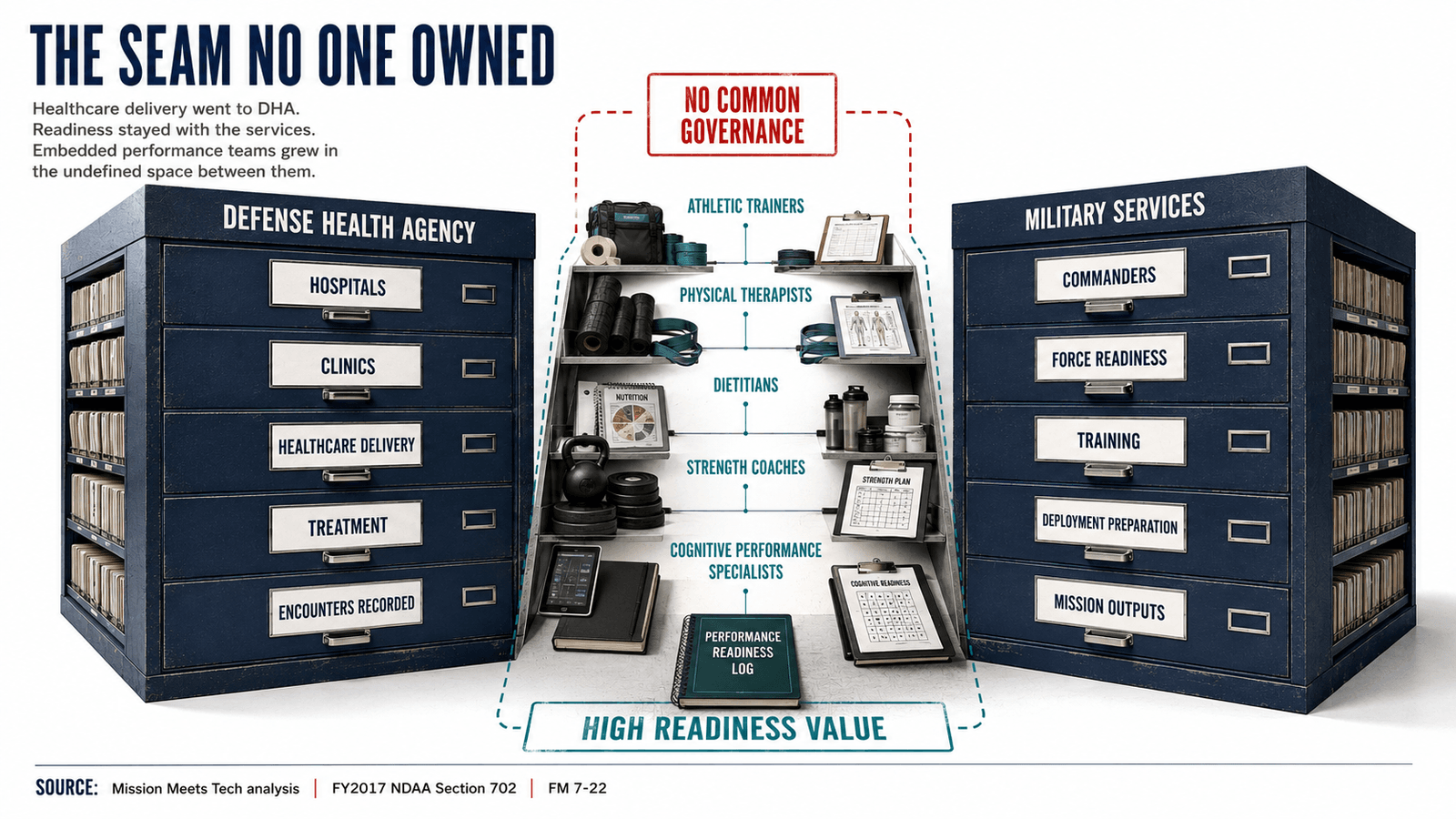
COVID turned the loose end into a problem with a deadline. Bases had to keep training. Commanders, out of patience with a medical system they felt was not meeting them, started solving it themselves. They moved rehabilitation assets out of the troop clinic and into the training area. They hired athletic trainers. They took providers off the medical company to cover morning PT and sick call. The treatment facilities did not stop them.
What grew in that seam was a second system of care for the warfighter. Run by allied health professionals. Sitting outside the health system. Shaping treatment facility access and readiness across the force. It had doctrine and commander backing. What it did not have was anyone with the authority to govern it across all of it.
That is the gap the May memo is built to close. Total Force Fitness has been a Chairman's idea since 2009 and a formal instruction, CJCSI 3405.01, since 2011. A Chairman's instruction binds the Joint Staff. It cannot compel a service to do anything. Fifteen years on, Warfighter Performance Optimization is the first instrument that reaches across every component at once.
The bill comes due
For years, when these programs had to justify themselves, the numbers came from wherever they could be found. Service databases. Individual program trackers. Treatment records built to document an encounter, not to measure whether a brigade got more lethal. Nobody standardized the inputs. Nobody agreed on the outputs. A commander could tell you his program worked. He could not hand a budget examiner a number that survived contact with a red pen.
Then, in February, the Army produced the number.
A peer-reviewed study in Sports Medicine, run by Army researchers, matched twenty-eight brigades with H2F performance teams against twenty-eight without, more than a million soldiers across five fiscal years, then ran the results through ten thousand simulations to test how far they would hold. They held. Every dollar spent on a performance team returned $8.15, roughly half in cost avoided and half in readiness gained. Around twenty-four million dollars in annual value per brigade, fourteen million of it hard cost avoidance. More than a thousand adverse events avoided and tens of thousands of duty days restored, per brigade, every year. In ninety-nine percent of the simulations, the return beat four to one.
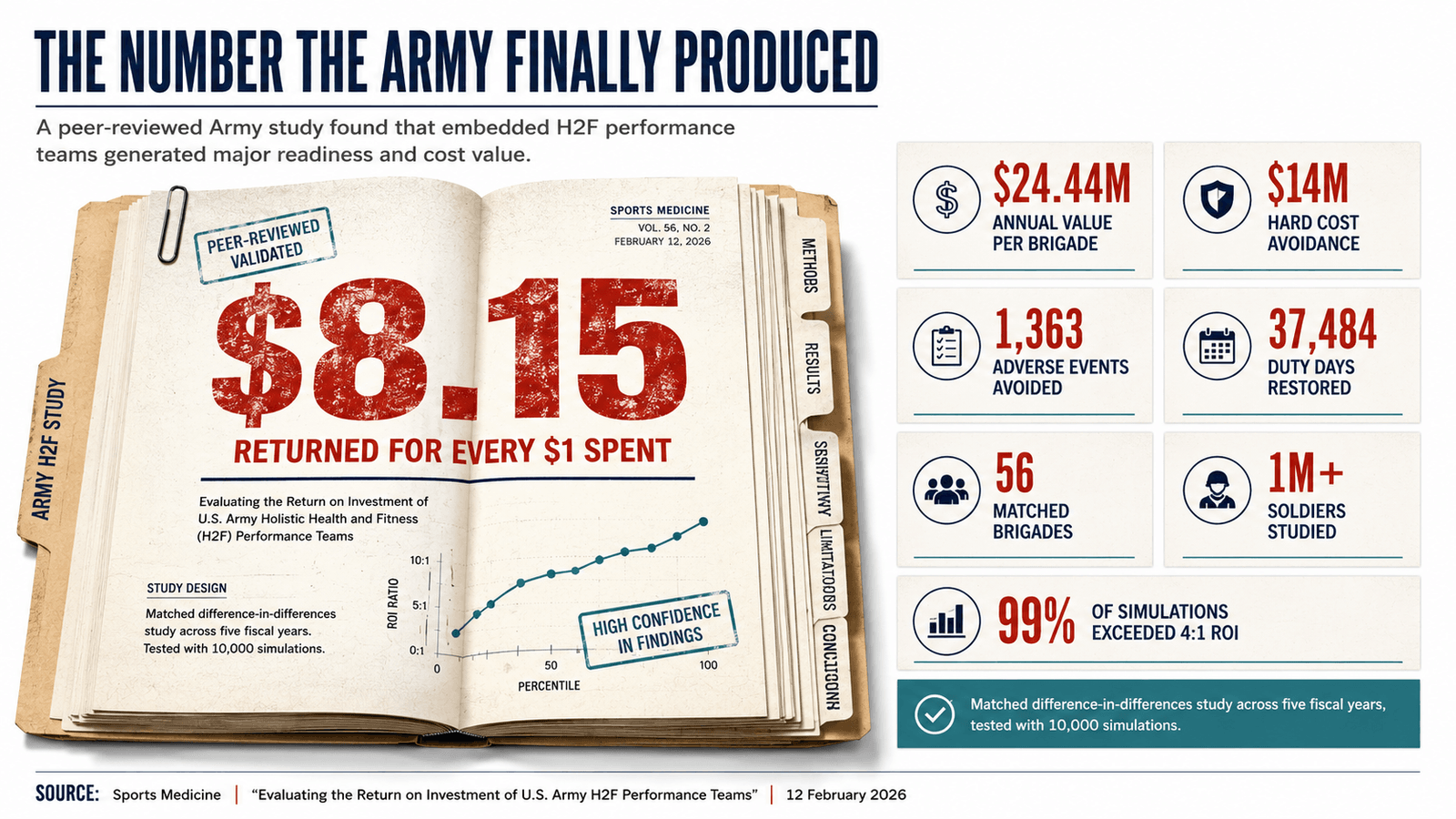
Run across the whole force, the model returns north of five billion dollars a year, and the authors left out retention and long-term disability, so the real number runs higher.
The readiness signal underneath the dollar figure is what should hold a planner's attention. Brigades with teams saw injury referrals fall, substance abuse and behavioral health profiles drop, more soldiers pass the fitness test, and more qualify expert with their rifle. Those are not wellness outcomes. Those are the inputs to whether a unit can deploy who it is supposed to deploy, when it is told to. And the design was the kind a skeptic reaches for, a matched comparison against control brigades, not the kind a program office writes to flatter itself. That is what makes it hard to wave off in a budget drill, where a commander's testimonial gets dismissed and a matched study with a confidence interval does not.
The Army believed its own numbers. Senior leaders called the early results astounding, pulled H2F civilians out of the hiring freeze, and moved to put a performance team in every brigade.
The memo still needs sixty days and a dashboard anyway. The proof lives in a journal, not in the Department's books. A study is not a system of record. It is a snapshot a budget examiner cannot pull on demand, cannot audit line by line, and cannot set beside the program down the hall.
Why one number is still impossible
One service's evidence is not the Department's. POTFF answers to SOCOM. H2F is the Army's. The Air Force and Space Force run a Holistic Health Approach with Guardian Resilience Teams. The Navy opened its first Human Performance Optimization program in San Diego this year. The Marine Corps has its own human performance branch. Same idea, six times over, under different names, different domains, and different data systems.
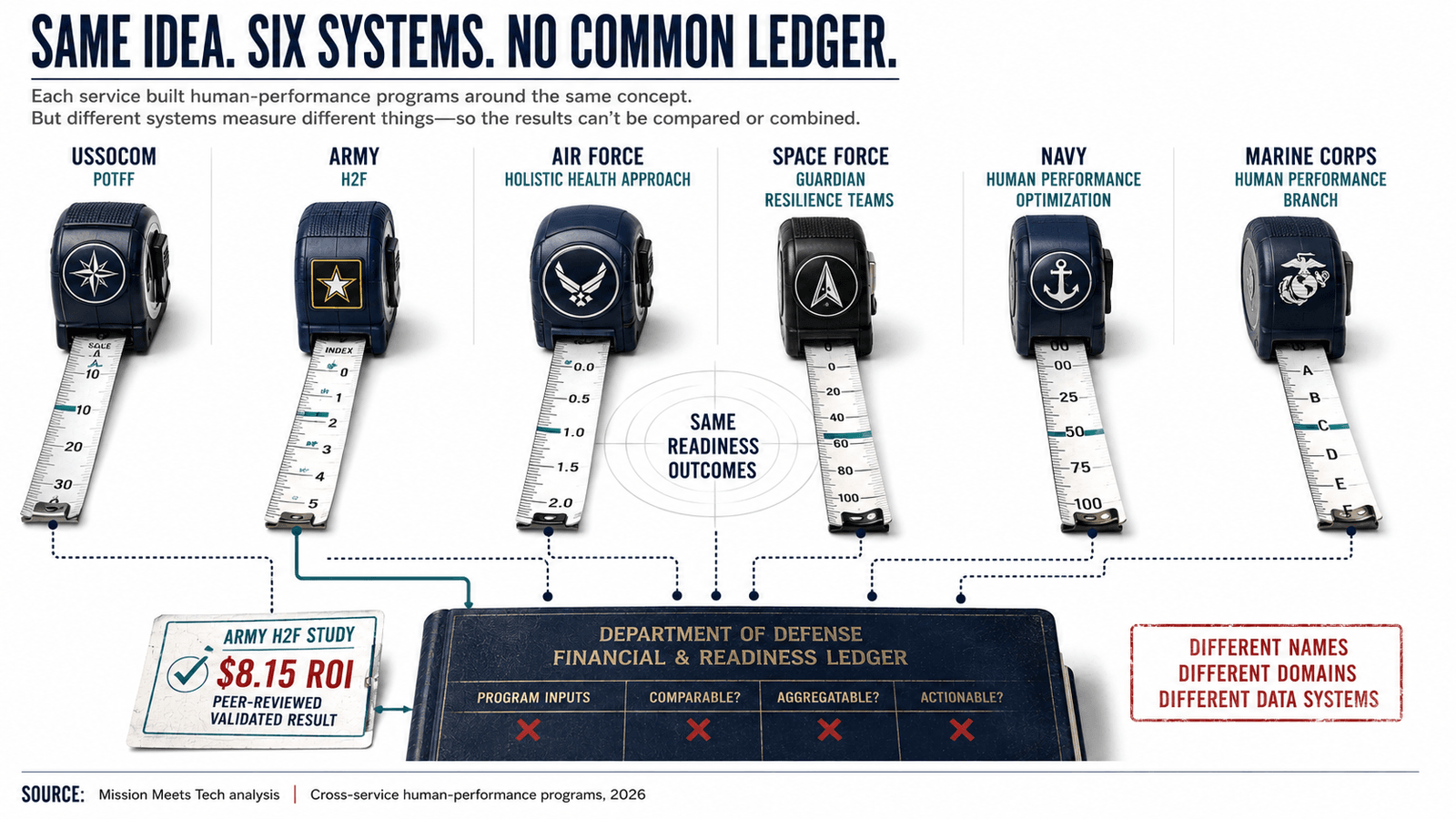
The Army can prove H2F. No one can yet prove the Department.
Comparability is what makes a single number so hard to reach. H2F counts sleep and nutrition. POTFF counts the social and spiritual load on a family. Put those columns side by side and they do not line up, which is the quiet reason a Department-wide number has stayed out of reach. The Army is already building its own answer, a management system that pulls biometrics, assessments, and self-reported data into one place for its teams. Making five of those answers comparable is a different and larger job than building any one of them.
And the yardstick keeps moving. The Army retired the Combat Fitness Test in 2025 for the Army Fitness Test, tightened combat-job standards in January, and began fielding a new Combat Field Test this spring. You cannot run a clean five-year readiness trend when the test changes three times inside it. The instrument the memo orders has to hold steady on top of standards that do not.
What's coming behind the memo
Congress is moving to write the effort into law. The draft FY2027 defense authorization establishes Warfighter Performance Optimization in statute and orders each military department to stand up a service-wide human performance strategy within 180 days, down to the technologies and services it intends to acquire. The executive branch opened with a memo. The legislative branch is closing with a deadline.
For anyone who reads requirements documents for a living, that is the signal. Human performance is moving from a wellness line in a command budget to a programmed acquisition with a statutory clock. Whatever Tata's report says, it inherits a narrow job: take a result that exists in one service, in one journal, on one set of definitions, and turn it into something the whole Department can measure the same way, audit the same way, and defend in the same budget room. The programs are not the question anymore. The bookkeeping is.
Back to the shin
The trainer who caught that stress reaction kept a soldier in the fight and kept a squad from carrying him out of one. In aggregate, the Army can now put a dollar figure on that save. For the single brigade, in real time, it stays invisible to every system the Department uses to count what it bought, because a save is a casualty that never happened, and no ledger carries a line for the thing that did not occur. Multiply that one shin by a brigade, by a fiscal year, by the whole force, and the Army can now size the dividend to the dollar. It still cannot show it on a balance sheet the Department keeps.
We fielded the programs that do this work before we built any way to prove they did it. The proof finally exists. The job the action plan inherits is to move it from a journal into the books, on a sixty-day clock, for a Department that has never measured this the same way twice.
Let's roll.
— Sean and Mary
Mission Meets Tech
The views expressed in this newsletter are my own and do not represent the official position of any organization. This content is for informational purposes only.
MMT Premium
This issue makes the argument. The companion Capture Corner maps the market it opens. Premium subscribers get the read on the layer forming above the recompetes: the Warfighter Performance Optimization governance mandate, the department-wide measurement build behind the May memo, the FY2027 NDAA service strategies now on a statutory clock, and the documents to watch before the first solicitation lands.
Founding Member rate: $199/year, locked permanently for the first 100 subscribers.
Standard rate: $249/year or $29/month.
Premium adds 48-hour early access to deep-dive analysis, monthly Capture Intelligence Sheets with sourced action windows, direct Q&A access (reply to any premium issue), and tool discounts: ProposalPulse $14.99 per assessment, MarketPulse $35 per brief.
Subscribe at missionmeetstech.com/pricing.
Sources
- Secretary of War memorandum, Warfighter Performance Optimization, Total Force Fitness, 6 May 2026: cognitive-performance language, wearables and sensors, June component data call, 60-day Personnel and Readiness review under Under Secretary Anthony Tata, summer pilots, September strategic plan, department-wide dashboard. Military Times (June 2026); MOAA (June 2026).
- "Evaluating the Return on Investment of U.S. Army H2F Performance Teams: A Matched Difference-in-Differences Study," Sports Medicine (12 February 2026), PubMed 41678032, DOI 10.1007/s40279-026-02399-3: $8.15 per dollar; $24.44M per-brigade economic value; 1,363 adverse events avoided; 37,484 duty days restored; 56 matched brigades; more than one million soldiers. Authors affiliated with CIMT/TRADOC; conflict of interest noted in the paper.
- Army H2F expansion after the ROI review: Lt. Gen. David Francis, AUSA Hot Topic (December 2025); army.mil and DVIDS (December 2025), including the hiring-freeze exclusion and the first department-wide human performance optimization platform.
- HPT composition (about twenty-two professionals), field status (more than seventy brigades as of late 2025; 111 by FY2027; full Army by 2032), and per-team cost (about $3M to field, about $2.5M per year to sustain): AUSA (December 2025); Defense News (October 2024); Modern War Institute (March 2026).
- CJCSI 3405.01, Chairman's Total Force Fitness Framework, 1 September 2011; Total Force Fitness concept introduced 2009.
- FM 7-22, Holistic Health and Fitness, 1 October 2020.
- POTFF: USSOCOM Pressure on the Force (2010-2011, Adm. Eric Olson); program of record established 2013 (Adm. William McRaven); five domains; statutory codification through the National Defense Authorization Act.
- Defense Health Agency established 2013; FY2017 NDAA Section 702 transferred the military treatment facilities to DHA, effective 1 October 2018.
- Cross-service programs: Army H2F; USSOCOM POTFF; Air Force and Space Force Holistic Health Approach and Guardian Resilience Teams; Navy Human Performance Optimization Program, Naval Base San Diego (2026); Marine Corps human-performance branch.
- AFT replaced the ACFT (2025); combat-job standards tightened (January 2026); Combat Field Test fielding began (spring 2026).
- FY2027 NDAA (Senate Armed Services Committee draft): Section 766 establishes the Warfighter Performance Optimization / Total Force Fitness initiative; Section 1079 requires each department's human-performance strategy within 180 days, including procurement requirements.