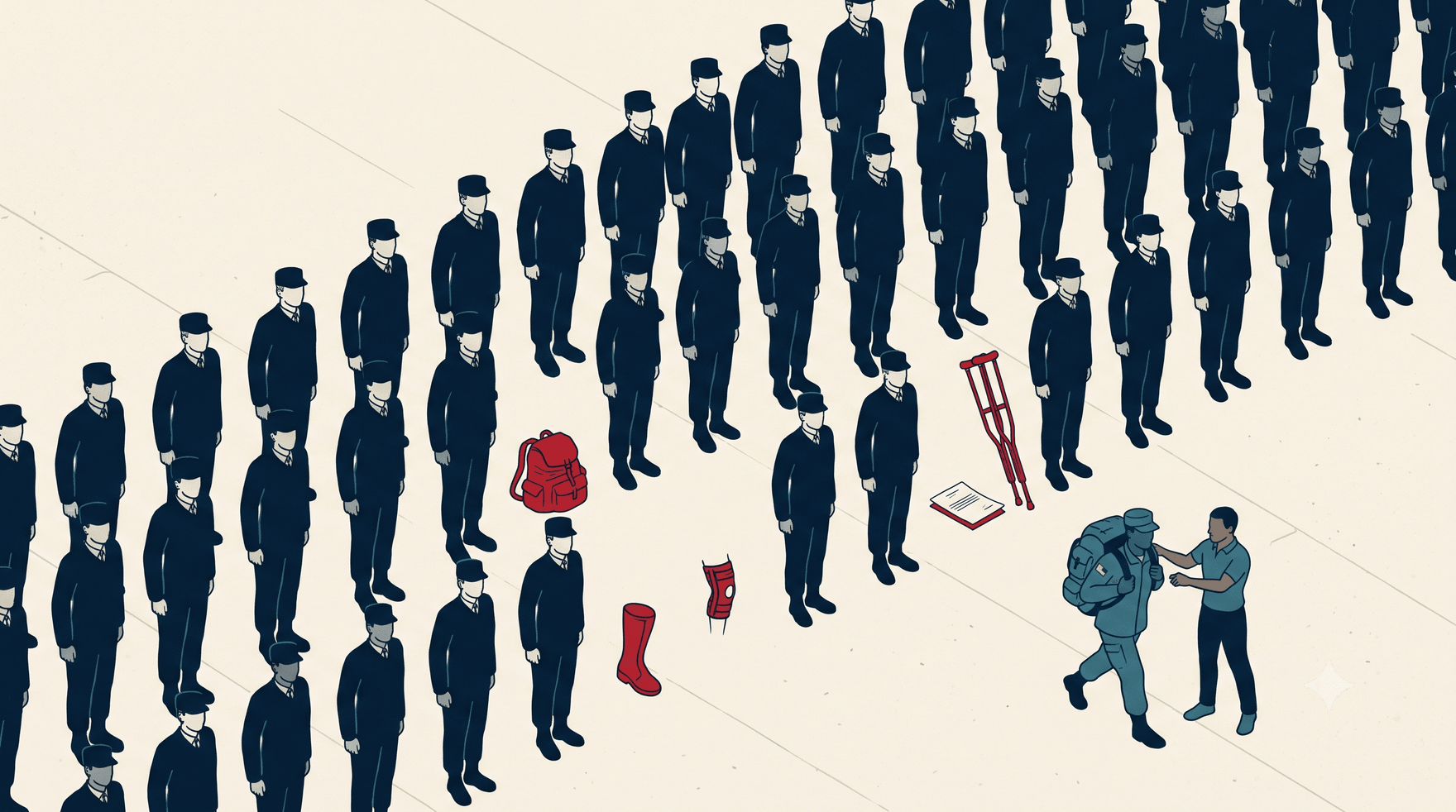
Recruiting Was the Easy Part
The Army fixed recruiting and started growing again. Keeping that larger force deployable became a contracted market worth hundreds of millions a year, and almost every contract that runs it comes due at once.
Friends,
For three years the Army's readiness story was a recruiting story. It could not fill the ranks. It missed its 2022 goal by roughly fifteen thousand recruits, trimmed its own end strength to numbers it could actually reach, and spent most of a decade getting smaller.
That story is over. The Army met its recruiting goal in 2025, hit its 2026 goal four months early with more than 61,500 future soldiers signed, and Congress authorized 11,700 more active troops, raising the force to 454,000. After years of shrinking, the Army is growing again.
Growth surfaces the harder question, the one the recruiting crisis kept buried. You can sign the contracts. Whether you can keep the soldiers in them healthy enough to deploy is a different problem, and it is the one the Army now spends hundreds of millions of dollars a year to solve.
It buys the answer from contractors. The program is called Holistic Health and Fitness, H2F, and readiness, the thing the Army exists to produce, has quietly become a services market underneath it.
The constraint moved downstream
End strength is a ceiling, not a capability. Congress can authorize 454,000 soldiers and recruiters can sign them, but a name on a personnel roster is not a brigade that can deploy. Between the two sits everything that turns a recruit into combat power: training seats, schools, equipment, experienced sergeants to lead, and bodies sound enough to carry a load over distance.
The defense press has started naming the bottleneck. After three years of treating recruiting as the emergency, the harder question is whether the force can absorb the people it is now bringing in without hollowing out. Training pipelines strain. Noncommissioned-officer bandwidth strains. And medical readiness, the share of the force actually fit to deploy, sits on the same list.
That last one is where H2F lives. A soldier on a medical profile counts against end strength and adds nothing to a deployment. Grow the force by 11,700 and you have also grown, by some fraction, the population that can fall off the deployable rolls with a stress fracture or a blown back. The Army's bet is that you protect that investment the way you protect any expensive asset: with maintenance, applied early, by specialists.
A market by design
H2F entered doctrine in 2020, in Field Manual 7-22. It put a team of strength coaches, physical therapists, dietitians, and cognitive-performance specialists inside the brigade, upstream of the injury, across five readiness domains: physical, nutritional, mental, sleep, and a spiritual domain now under review.
The model had a decade of proof behind it. Special Operations Command has run embedded performance teams under its Preservation of the Force and Family program since 2013, long enough to show that putting human-performance specialists next to operators keeps them in the fight. The Army watched that work and scaled it to the conventional force. What SOF built for a few thousand operators, H2F attempts for a million soldiers.
The Army did not build it in-house. The original workforce design for the first 110 brigades called for roughly 500 uniformed personnel, 700 civilians, and 1,900 contractors. Contractors outnumbered the uniformed staff more than three to one. From day one, the people who keep soldiers in the fight would mostly work for companies.
For two centuries the Army measured fitness with a test and repaired the soldier after he broke. H2F is the opposite instinct: spend money early to prevent the injury that takes a soldier off the line.
The size of the ramp
The market grows brigade by brigade, on a published schedule. The Army resourced 28 brigades in 2021, reached 50 by October 2024, and targets 111, roughly half the active force, by 2027. The plan runs to the full Army, about 236 brigades, by 2032. The Army Reserve began its own fielding in 2026.
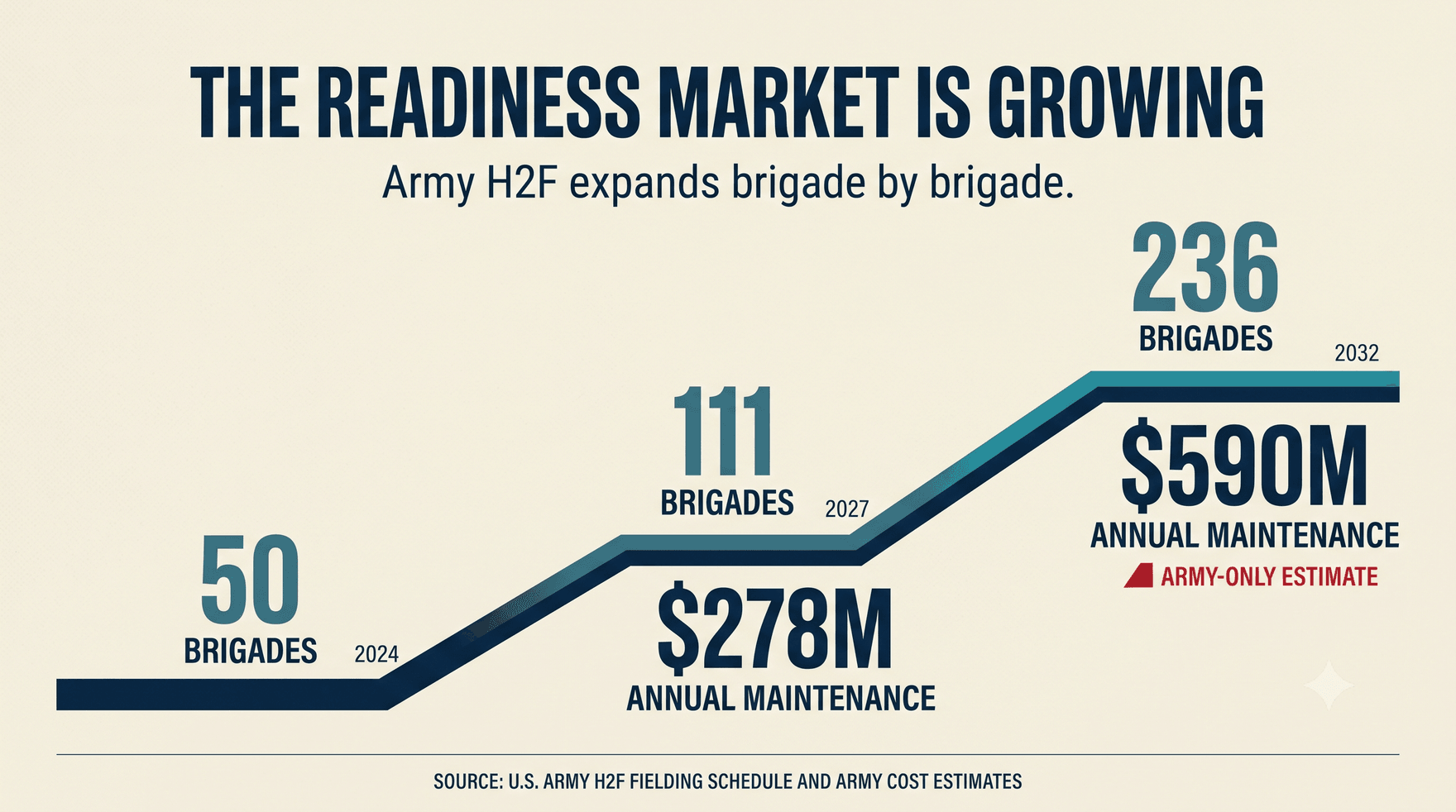
The unit economics come from the Army itself, by way of a single Defense News interview, so read them as the Army's figure and not an audited one. Standing up a performance team for an active brigade runs about $3 million, and maintaining it about $2.5 million a year. Reserve teams run roughly half that.
Build those numbers up and the market takes shape. At the 2027 target of 111 brigades, the annual maintenance bill alone runs near $278 million. At full fielding it approaches $590 million a year, Army-only. Add SOCOM, the Air Force, the Navy, and the Marine Corps and the contracted human-performance market plausibly clears a billion dollars a year by 2030.
One discipline matters when you read those numbers. The multibillion-dollar figures that circulate, a $6 billion vehicle ceiling here, a $12 billion ceiling there, are contract ceilings: the maximum that could theoretically be ordered over a vehicle's entire life. They are not annual spend. The real market today is a few hundred million dollars a year, on a path toward a billion. Anyone quoting a ceiling as the market size is selling something.
The currency is deployable soldiers
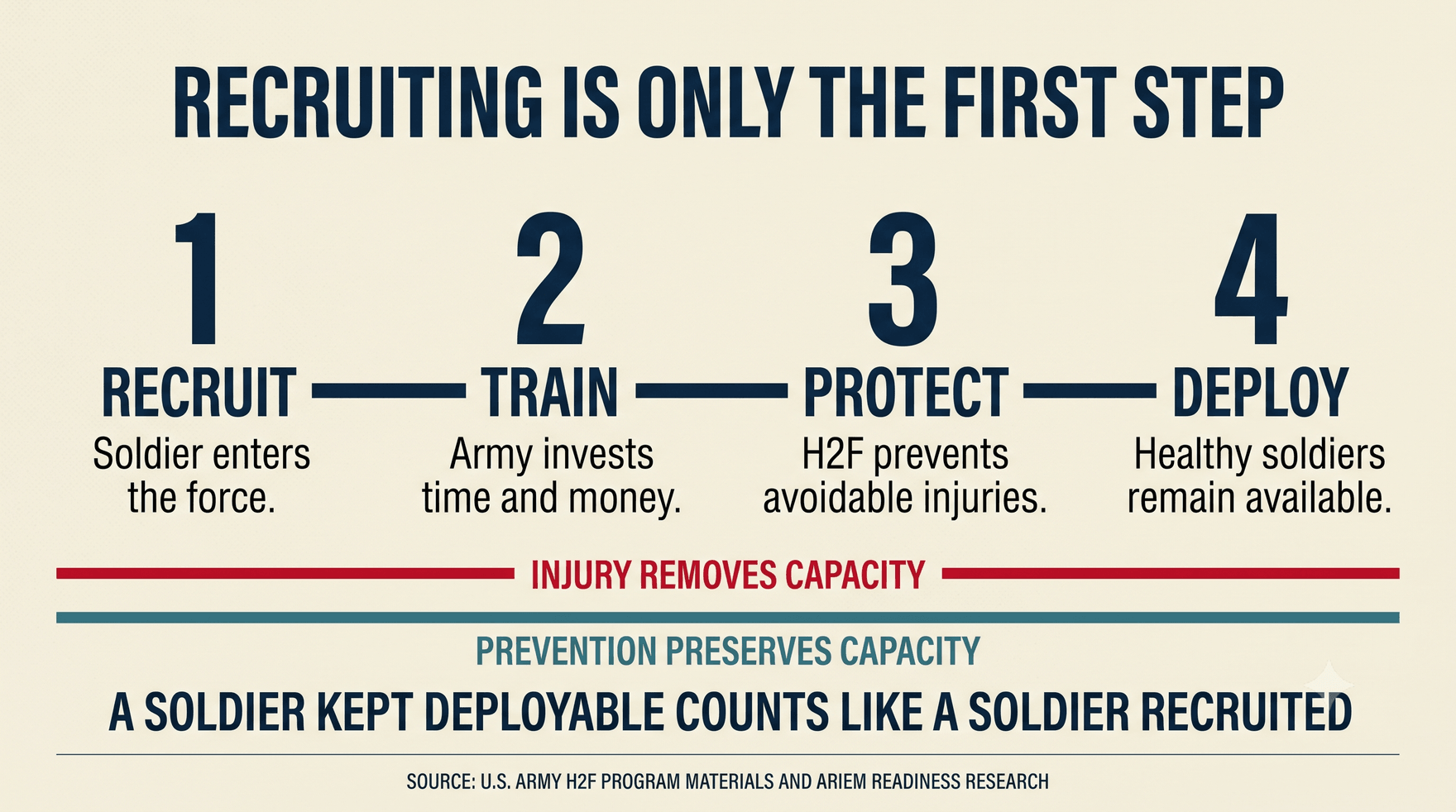
The Army measures what a performance team produces in one unit: deployability. That is what ties this program to the recruiting numbers, and it is the connection most coverage of H2F leaves out.
A study from the Army Research Institute of Environmental Medicine, built on more than 30 million soldier records, found that fielding H2F across the force would have added roughly 1,080 deployable soldiers. Those were soldiers already in uniform, kept on the deployable rolls by staying off medical profiles. The Army's own program data claims 37,484 duty days returned to a single brigade in a single year.
Set that against the recruiting numbers. A soldier kept off a profile and a soldier signed at a recruiting station land in the same place: a formation that deploys at strength. One the Army hunts for across a year of advertising and bonuses. The other it already has, and stands to lose to a torn knee on a ruck march. In a growing force, protecting the soldier you already trained is the cheaper half of force generation, and it is the half H2F is built to deliver.
The number, and what kind of number it is
The headline case rests on one figure. In February, a study in the journal Sports Medicine reported that every dollar spent on an H2F performance team returns $8.15 in cost avoided and readiness gained. The same analysis put the economic value at $24.44 million per brigade per year, alongside a 61 percent drop in musculoskeletal injury referrals, a 79 percent drop in substance-abuse profiles, and a third more soldiers qualifying expert on the rifle.
Read it with your eyes open, on two counts.
First, the authors work for the Army organization that runs H2F. It is the Army grading its own program in a peer-reviewed journal, corroborated in direction by the independent Army Research Institute study but authored inside the house. No GAO or CRS review of the program's spending has been published.
Second, the part a comptroller catches: $8.15 is cost avoidance, not appropriated savings. The Army is not writing smaller checks. It is claiming costs it believes it dodged, in injuries that did not happen and soldiers who did not separate. That math may be right. It is also the most flattering way to score a program, produced by the people who run it. The figure is a reason to take H2F seriously. It is not yet a reason to stop asking questions.
The anchor and the marquee
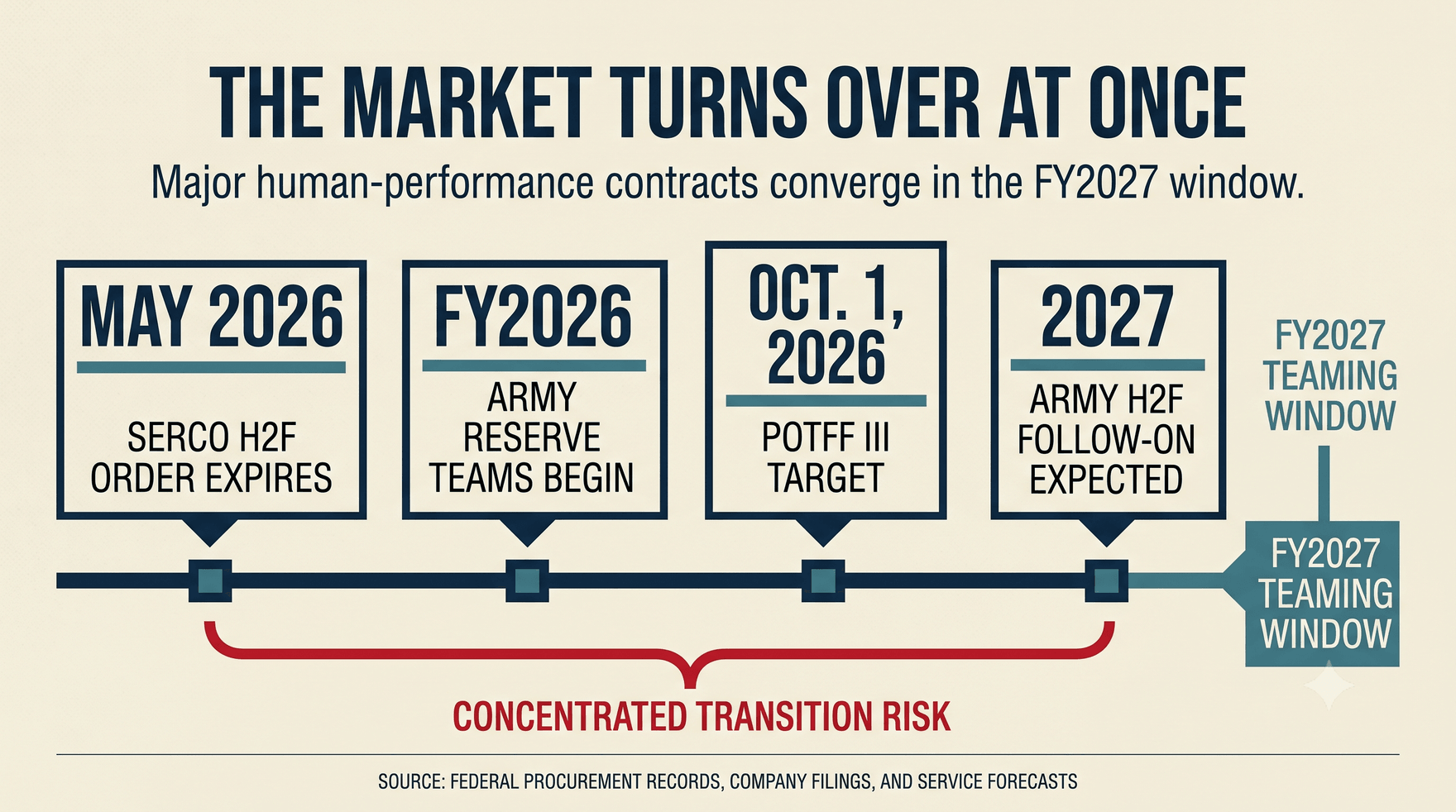
The Army market has a center of gravity, and it is a single task order. Serco holds it, worth somewhere between $247 and $286 million depending on whether you read the company filing or the federal record. It covers 45 brigades across 15 stateside locations, put more than 350 coaches and specialists in the field, and survived two protests at GAO. It expires on May 19, 2026, and the Army already has the follow-on on the street, expected to award in 2027.
The larger event sits at Special Operations Command. POTFF is recompeting now as POTFF III. KBR holds the current one. It grew from $500 million in 2018 to a $955 million ceiling. The replacement is forecast at roughly the same size, about $955 million, with an award projected for October 1, 2026.
POTFF III is a single-award contract. One company wins the entire Special Operations human-performance mission for the next eight years.
A single point of failure for readiness
Pause on that structure, because most coverage waves it through as routine contracting and it is anything but.
When you single-award a widget and the transition stumbles, you lose schedule. When you single-award human performance and the transition stumbles, operators lose the embedded teams that keep them in the fight, mid-handoff, while the program sorts itself out. SOCOM is concentrating the readiness of its entire special-operations force in one company's ability to execute. That is a continuity-of-readiness decision as much as a cost decision, and it deserves to be argued as one. The Army made the opposite call for H2F, spreading the work across many vehicle holders so no single failure takes the program down. Two services, two philosophies about how much readiness risk belongs inside one contract.
Every service is buying it
H2F and POTFF are the two largest pillars, but the pattern runs across the force, and the aggregate is what makes this a market rather than a program.
The Air Force moved first to consolidate. In 2024 it folded three predecessor contracts into a single multiple-award vehicle worth up to $988 million over ten years, spread across six small businesses. The Navy runs a smaller performance contract through its medical command and routes its special-warfare community onto the Air Force vehicle rather than stand up its own. The Marine Corps renamed its Force Fitness Division the Human Performance Division and has a service-disabled-veteran-owned solicitation on the street, smaller and more analytical than the brigade-staffing deals, aimed at its physical-readiness testing and injury-prevention work.
Four services, four front doors into the same conviction: that human performance is a discipline you staff, measure, and contract for, on purpose, rather than a thing that happens to soldiers during basic training.
The cliff
Now stack the calendar. The Serco H2F order expires in May. The Army Reserve is standing up its own performance teams. The Army personnel-services vehicle that H2F rides on is heading into a multibillion-dollar recompete of its own. POTFF III awards in October. Four major actions, one window, the largest concentration of human-performance awards this market has seen. FY2027 is the year it turns over.
The services are diverging on how. SOCOM keeps POTFF single-award, winner-take-all. The Army keeps H2F on a shared vehicle and competes it order by order. The Air Force went the other way in 2024, into a pool of six. The divergence runs down into the fine print, into the codes that decide who is allowed to compete. The Army runs H2F under a human-resources consulting code with a $29 million size standard, wide enough for sizable small businesses. SOCOM uses a physical-therapy code at $12.5 million. The Army Reserve is reaching for a tighter one at $10 million. The same company can be a small business under one program and too large under the next, decided only by which service it chases.
Who holds it now
The incumbents are visible in the public record. KBR holds POTFF and will defend it. Serco holds the Army H2F anchor and the Navy's performance contract. GAP Solutions held an earlier Army H2F prime worth more than $100 million. LMR Technical Group sits on the Air Force vehicle with five other small businesses. Beneath the primes runs a layer of specialist subcontractors, biotechnology firms, athletic-trainer staffing companies, and applied-science nonprofits that supply the actual coaches and clinicians. That layer below the primes is where most of the FY2027 teaming will happen, and where a focused small business still has a lane.
Half a billion dollars on the honor system
The totals are where a careful reader should slow down. At full Army build-out, the H2F maintenance bill alone approaches $590 million a year. Add the other services and the contracted human-performance market clears a billion a year by the end of the decade. The case for that spending rests on an ROI study the Army wrote about itself, extrapolated from per-team costs that trace to a single interview. No independent auditor has tested it.
That is a great deal of readiness money on the honor system, at the moment the force can least afford to be wrong about what keeps soldiers deployable. The growth the Army just won raises the stakes rather than lowering them. Every soldier added to the rolls is a soldier H2F is now responsible for keeping there. The first GAO look at this program will be one of the more consequential audits in military health, whenever it finally comes.
The soldier on the ruck march
Strip away the vehicles, the codes, and the ROI math, and the thing being bought is plain. A soldier who would have torn a knee on a ruck march does not tear it, because someone watched her form and changed the load three weeks earlier. A brigade that would have lost a sergeant to a back injury keeps him. In a force that spent three years unable to find enough people, keeping the ones it has is the quietest readiness win there is.
The Army fixed recruiting. The harder work starts now, and most of it runs through contractors whose contracts are about to change hands. FY2027 decides who holds the line. The soldier on the ruck march does not read the solicitation. She just keeps her knee.
Let's roll.
— Mary
Mission Meets Tech
The views expressed in this newsletter are my own and do not represent the official position of any organization. This content is for informational purposes only.
MMT Premium
This issue maps the market. The companion Capture Corner maps the recompete. Premium subscribers get the vehicle-by-vehicle read on the FY2027 cliff: the Serco H2F follow-on and what the sources-sought signals, POTFF III as a single-award winner-take-all play with KBR defending, the Gen VI HRS vehicle behind it all, the NAICS strategy that decides which small businesses compete under which service, and the teaming and organizational-conflict signals a capture lead needs before the next industry day.
Founding Member rate: $199/year, locked permanently for the first 100 subscribers.
Standard rate: $249/year or $29/month.
Premium adds 48-hour early access to deep-dive analysis, monthly Capture Intelligence Sheets with sourced action windows, direct Q&A access (reply to any premium issue), and tool discounts: ProposalPulse $14.99 per assessment, MarketPulse $35 per brief.
Subscribe at missionmeetstech.com/pricing.
Sources
Army end strength and recruiting: FY2026 NDAA (P.L. 119-60, signed Dec. 18, 2025) authorizing 454,000 active-component soldiers, +11,700 over FY2025 (Congress.gov / CRS IN12651; Military Times, Dec. 22, 2025). · "US Army meets FY26 recruiting goals," army.mil (May 2026): more than 61,500 future soldiers signed, four months early. · DoD FY2025 recruiting results: ~103% of goals across services; Army 101.72% of a 61,000 goal (Military Times). · Force-absorption / readiness-capacity framing (Military.com, "The Military Is Growing Again but Capacity, Not Recruiting, Is the Real Test," Jan. 26, 2026). · H2F doctrine: U.S. Army Field Manual 7-22, Holistic Health and Fitness (Oct. 1, 2020); h2f.army.mil. · Workforce design (500 uniformed / 700 civilian / 1,900 contractor for first 110 brigades) and FY2021 baseline (28 brigades, $110M): Minnesota Dept. of Military Affairs H2F briefing. · Fielding trajectory (50 brigades Oct. 2024, 111 by FY2027, full Army by FY2032, Reserve from FY2026) and per-team cost figures attributed to an Army official: Defense News (Oct. 14, 2024). · ROI study: "Evaluating the Return on Investment of U.S. Army H2F Performance Teams," Sports Medicine (Feb. 12, 2026), PubMed 41678032 (8.15:1 ROI; $24.44M per-brigade economic value; 61% MSKI-referral reduction; 79% substance-abuse-profile reduction; 33% expert-marksmanship increase; 37,484 duty days restored per brigade; 56 brigades; 1M+ soldiers; authors affiliated with CIMT/TRADOC, conflict of interest noted). · Independent corroboration: Army Research Institute of Environmental Medicine study (30M+ records; ~1,080 added deployable soldiers), via army.mil (Dec. 2025). · Serco H2F task order W15QKN-24-F-0432 on HRS PLS MATOC W15QKN19D0054 ($6.09B ceiling); $286.4M federal-record potential / $247M company-announced / $280M GAO; 45 brigades, 15 CONUS sites; PoP through 5/19/2026; survived two GAO protests (~Jan. 2025); NAICS 541612 (HigherGov; Bloomberg Law; SAM.gov). · Army H2F follow-on solicitation W15QKN26R1B6H (posted Feb. 5, 2026; market-research response due Mar. 5, 2026; five-year firm-fixed-price; NAICS 541612; ACC-Picatinny); FY2027 award is an analytical read off the timeline (FederalCompass; Sweetspot; SAM.gov). · GAP Solutions 2021 Army H2F prime, $100M+ (PRWeb). · USSOCOM POTFF: current contract H9240019D0001 (KBR), $500M (2018) to $955M ceiling; POTFF III draft RFP H9240026RE002 (May 16, 2026), single-award IDIQ, NAICS 621340, ~$955M per official SOCOM forecast, award forecast Oct. 1, 2026 (SAM.gov; HigherGov forecast). · Air Force HPO MA-IDIQ, $988M / 10 years / six small businesses (Mar. 2024) (ClearanceJobs; Washington Technology). · Navy BUMED performance IDIQ (Serco), $41.9M (FederalCompass). · USMC TECOM Human Performance solicitation M00264-26-R-0009, SDVOSB, NAICS 541611 (HigherGov; Marines.mil). · NAICS size standards: 541612 ($29M), 621340 ($12.5M), 621399 ($10M) (SBA / SAM.gov).