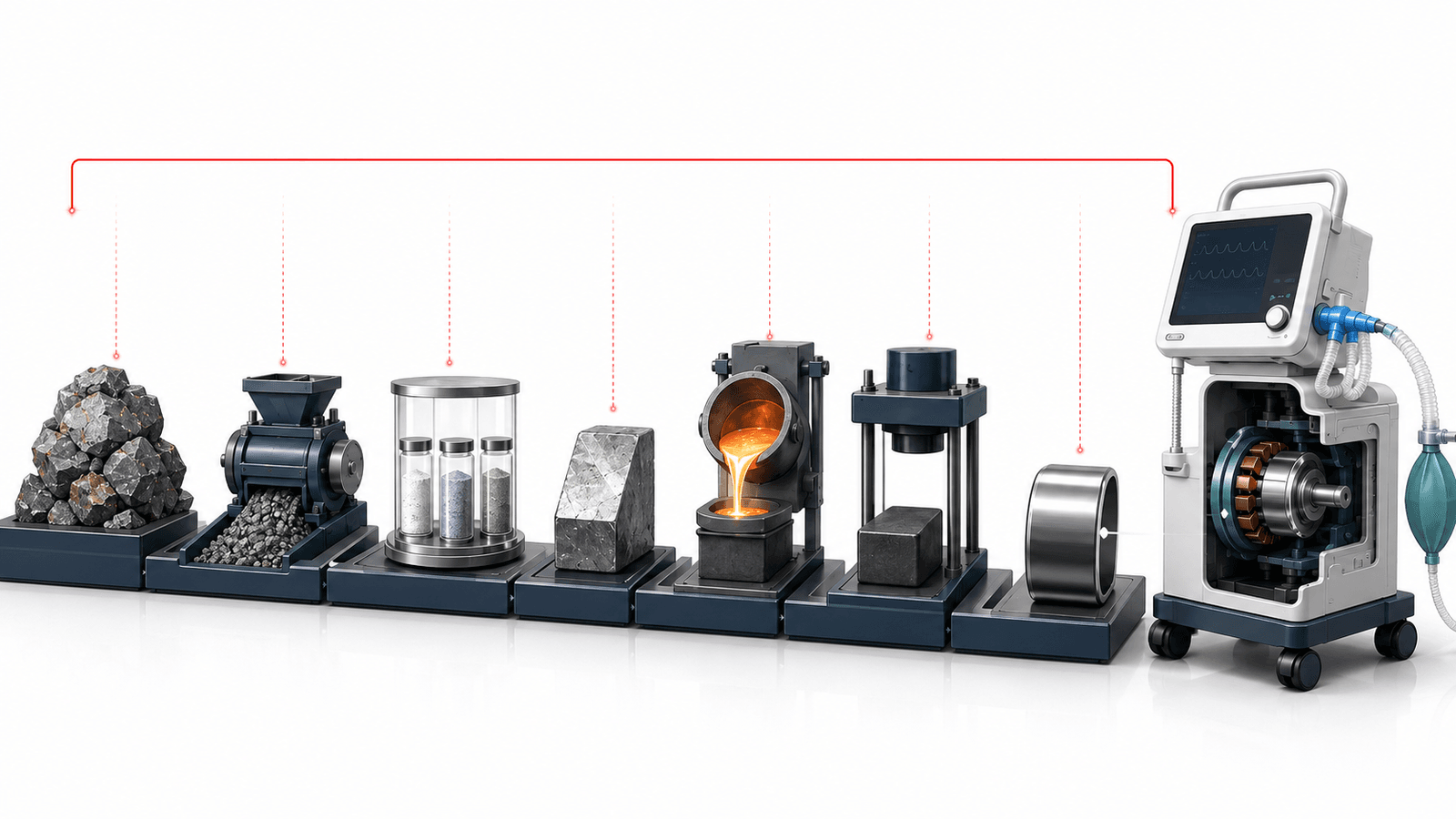
Seven Steps to a Magnet
Federal law has looked at one of them. On January 1, 2027, it looks at all seven, and the two exceptions holding medical equipment out of the fight are the thinnest part of the wall.
Friends,
A magnet starts as rock.
Somebody digs the ore out of the ground. Somebody crushes it and leaches it into a concentrate. Somebody separates that concentrate into individual elements, because neodymium and praseodymium and dysprosium come out of the earth mixed together and do not want to come apart. Somebody reduces the oxide down to metal. Somebody melts that metal with iron and boron into an alloy. Somebody mills the alloy into powder, presses it inside a magnetic field, and sinters it into a block. Somebody cuts the block, coats it, and ships it to the shop that builds the motor.
Seven steps. For the last two years, federal law has looked at one.
DFARS 252.225-7052 says a contractor may not deliver covered material melted or produced in China, Russia, North Korea, or Iran. Melted. Step five. Everything upstream of the furnace belonged to somebody else, and in practice a certificate saying the alloy was melted in Estonia closed the question.
On January 1, 2027, that clause widens by three words.
Mined. Refined. Separated.
Read them again. Those are the names of industrial processes. Step one. Step two. Step three.
The clause does not leave the reach to inference. For neodymium-iron-boron magnets it says the restriction includes, effective January 1, 2027, the entire supply chain from mining of neodymium, iron, and boron through production of finished magnets. [2] For samarium-cobalt it reaches the ore or feedstock, recycled material included.
Back to the rock, in the government's own words.
The words have been sitting in the clause since May 2024, put there by Section 854 of Public Law 118-31. They have been survivable because the door was open. A contracting officer who could not find compliant material could sign a non-availability determination, and the program kept moving.
On July 20 the President signed Executive Order 14415. Section 2 shuts that door.
Effective January 1, 2027. The same morning.
What is actually covered
Get the scope wrong at the start and every decision downstream is wrong with it, so spend ninety seconds here.
10 U.S.C. 4872 is titled "Acquisition of sensitive materials from non-allied foreign nations: prohibition." Four covered countries. It was recodified from 2533c.
The materials list is where practitioners are about to get tripped, because the statute and the clause do not currently match.
The statute lists six: samarium-cobalt magnets, neodymium-iron-boron magnets, tungsten metal powder, tungsten heavy alloy and the finished or semi-finished components containing it, tantalum metals and alloys, and molybdenum. [3]
DFARS 252.225-7052 lists five. Same list, no molybdenum. [2] The clause has not been amended to catch up with the statute, and the clause is the thing in your contract.
There is a third list coming. Public Law 119-60, signed December 18, 2025, adds germanium and gallium to the statutory definition effective two years out, on December 18, 2027. [3] Put that date in the same file as January 1.
It is a different statute from the specialty metals rule. Titanium, zirconium, the nickel and cobalt base alloys, the alloy steels: those live at 10 U.S.C. 4863, recodified from 2533b, and they run through a different clause with different exceptions and a different enforcement history.
Early commentary has already blurred the two, and the blur costs money. A magnet shop and a titanium forging house are looking at separate rules with separate deadlines. A compliance memo scoped to the wrong statute sends the right questions to the wrong tier and comes back with answers about nothing.
The test is what is inside the box you ship.
The part that lands in a hospital
Read that list again with a medical logistics eye, because the order was drafted around munitions and it does not stop there.
Tungsten shields radiation, which is why it forms the collimators that shape the beam inside imaging systems. [35][39] Molybdenum has served as an x-ray target material for decades, [38] and molybdenum sits on the statute's list while the clause has yet to name it, which makes mammography a later exposure rather than a January exposure. Tantalum has been an orthopedic implant material for twenty years, the porous form used in joint reconstruction because bone grows into it. [37] Neodymium-iron-boron is the default magnet in magnetic resonance work, standard enough that a 2024 paper using ceramic magnets instead had to explain the choice as an uncommon one. [40]
Then the motors. Brushless motors run on permanent magnets, and brushless motors sit inside the infusion pump, the surgical robot arm, the powered prosthetic, and the high-speed blower in a transport ventilator.
Four material families. One prohibition. Every one of them inside equipment the Defense Health Agency, the services, and VA buy by the pallet.
Now put two lines from the USGS ledger next to that.
Tungsten has not been mined commercially in the United States since 2015. [35]
Rare earths arrive here in significant quantity as permanent magnets already embedded in finished goods. [36]
Read both against a rule that covers material mined in a covered country starting January 1 and demands origin tracing at every tier. For tungsten, that question runs into geology before it runs into paperwork. For magnets, the material is already sealed inside the assembly when it clears customs, which is the visibility gap the iBOM exists to close and the reason closing it will cost real money.
Two exceptions have kept most of that equipment clear of this fight so far, and both are worth reading this week rather than in December.
The first is the commercial item exception. Through 2026 it pulls back COTS items that are 50 percent or more tungsten by weight. Starting January 1, 2027 it pulls back COTS items that are 50 percent or more covered material by weight. Different test, wider net, same paragraph.
The second exception is one line: an electronic device, unless otherwise specified in the contract. [2] An enormous amount of medical equipment shelters under that phrase. So does the authority of any program office to specify otherwise, in one sentence, in a solicitation, whenever it decides the risk warrants it.
My read, and I will mark it as a read rather than a finding: medical acquisition is the least prepared corner of this. The people who track DFARS 252.225-7052 for a living work in munitions, missiles, and airframes. The people buying a deployable CT or a fleet of transport ventilators are tracking FDA clearance, sustainment tails, and whether the thing survives a pallet drop. I have found nothing published connecting the two, and the guidance clock has been running since July 20.
A rule written about the magnets in tank rounds reaches the blower motor in the ventilator that flies en route care out of a Role 2. Same clause. Same certificate. Same January.
The deliverable
Section 3 is where the order stops describing policy and starts writing contract language.
It requires an integrated bill of materials tracing components, parts, equipment, software, and materials back to raw-material origin at every tier, referencing Contract Requirement Data List DI-MGMT-82256A. Supplier vetting extends to financial condition, foreign ownership control and influence, and sole-source reliance. A risk notification clock runs 15 days. Corrective action runs 45. Section 2(d) opens a Justice Department referral path for fraud on mitigation plans. Implementing guidance from the Secretary of War is due inside 180 days.
An iBOM is a third document, and the reason it is hard becomes obvious once you look at the two that already exist.
The engineering bill of materials says what the product is supposed to be. Designers write it and it is clean. The manufacturing bill of materials says what the plant actually built last Tuesday, with the substitutions, the approved alternates, and whatever the buyer could get in March when the primary source went to eleven weeks.
Those two documents disagree in every complex program. The disagreement is normal, it is documented, and it is exactly where foreign material walks in without anybody lying about anything.
An iBOM reconciles both and then keeps going, past the assembly, past the component, past the magnet, past the alloy, down to the mine.
The government has never had one.
Ninety-six percent
It is asking now because what it has instead is a number that cannot be true.
The Federal Procurement Data System lists the United States as country of origin for roughly 96 percent of the Department's goods obligations from 2020 through 2024. Take that at face value and this is the most self-sufficient industrial base on the planet, a country that digs, refines, and manufactures nearly everything its military uses.
That figure comes from two fields in a procurement database, entered at award.
GAO published the arithmetic on July 24, 2025, in GAO-25-107283. Of 115 active F-35 contracts across those five years, 114 list the United States as country of origin.
The magnets on some of those aircraft came from China. The Department found out through Lockheed Martin.
Magnets are a 4872 covered material. The database said domestic. The airframe said otherwise, and the database had no way to know.
The pattern repeats in silicon. The Department bought $1.3 billion in electronic microcircuits over the same five years with the United States listed for nearly 100 percent of it, against the Department's own estimate that 88 percent of production and 98 percent of assembly, packaging, and testing happen overseas, mostly in Taiwan, South Korea, and China.
The tools built to fix this are in worse shape than the data they were built to fix.
SCREEn, the F-35 supply chain tool, has country-of-origin information on first and second-tier suppliers for 30,000 of 40,000 parts. Go one tier deeper and coverage drops below 10 percent of the suppliers who actually provide the components and raw materials. GAO names the cause plainly: challenges acquiring sub-tier data due to the lack of contractual requirements. As of the report, SCREEn had not yet been used to find and mitigate a single foreign dependency risk.
DIBMAP covers 732 weapon systems. As of March 2025, Industrial Base Policy officials told GAO its development was on pause.
Then comes the number that explains the entire executive order.
The Defense Logistics Agency ran its Market Information Program across 63 suppliers in three classes of goods, asking where things came from. Five gave complete answers. Thirty-seven agreed to help, twenty-two declined or went quiet, four were still thinking about it. The reason suppliers gave was the absence of a contractual obligation.
Five of sixty-three.
Every supply chain illumination tool the Department owns has been running on volunteers. The volunteers said no.
Thirteen months
Which brings us to the part the trade coverage has skipped.
GAO's third recommendation in that July 2025 report was that the Under Secretary for Acquisition and Sustainment, with the military departments, identify the benefits and challenges of getting country-of-origin information from contractors, such as by testing the use of additional deliverables.
Testing. A pilot. Try it on a few programs, find out what it costs at tier three and what breaks, then decide.
The Department concurred with all three recommendations. GAO's status line as of publication: DOD has not tested an alternative approach of using contract deliverables.
Thirteen months later the White House mandated the deliverable outright, every tier, data item number attached.
That reframes the document, and the reframe is worth carrying into every conversation about it this fall. This is not a supply chain theory arriving from outside government. It is a shelved audit recommendation the Department agreed with, did not act on, and has now had imposed on it by executive action with the pilot phase deleted.
The pilot was the part that would have told everyone what an iBOM costs at the bottom of the chain. That answer now arrives as an invoice instead of a study.
The certificate is the exposure
For twenty years this regime got easier. When the Department proposed waiving the specialty metals preference in 2007, Crowell & Moring called it a major step toward making full compliance with the impractical statutory requirements a real possibility. Pillsbury recorded the same arc, and Congress answered in 2007 and 2008 with a broad scheme of exceptions.
Executive Order 14415 turns that around.
The waiver machinery it turns back toward is thin. On the specialty metals line, OSD's reporting page has carried a single-digit count of approved waivers since the DFARS final rule published in 2009, and my research pass recorded six. [8] I could not reach that page to re-confirm the figure this week, so treat the number as indicative and the shape as solid. Service secretaries hold the authority for single-contract non-availability determinations and cannot delegate it.
There is also almost nothing to litigate against. I could not find a published federal decision construing 4872 or its predecessor. The nearest tribunal ruling on the specialty metals preference is a GAO bid protest, Urdan Industries, decided July 6, 1983, holding that a bid offering a weapons-system component made of foreign specialty metal was properly rejected as nonresponsive. Reagan was in his first term. That is the governing authority.
So enforcement runs through the False Claims Act, and the precedent there exists in the exact material.
Tungsten Heavy Powder & Parts settled for $5.6 million in April 2021. The allegation was false certification of domestic sourcing when the tungsten cubes in high-explosive tank rounds came from China. The underlying contract was $1.7 million. The whistleblowers took $960,000, and the Ninth Circuit affirmed nearly $500,000 in fees on top of it.
Read the ratio. A $1.7 million contract produced a $5.6 million settlement.
Galvion paid $2,495,000 on Berry Amendment allegations that began with a DLA hotline call. LED Lighting Solutions and its owner paid $300,000 for shipping directly from China. TW Metals paid $215,000 in 2008 after disclosing the problem itself.
The base rate behind those cases is large. Justice recovered more than $6.8 billion under the False Claims Act in the fiscal year ending September 30, 2025, whistleblowers filed 1,297 qui tam suits, and relator shares run 15 to 30 percent.
Now put Section 2(d)'s referral path next to a certification requirement that generates a signed statement at every tier on every delivery.
An iBOM is a compliance document on Monday and a discovery document on Tuesday. Bad material never has to leave the dock. The certificate and the shipment only have to disagree, and the people best positioned to notice that disagreement already work in your supply chain group.
That is the same mechanism that cost Health Net's parent $11,253,400 in February 2025, on a contract that never contained the word CMMC.
A floor under the price, no door out
Section 2(c) contains one sentence that rewrites cost realism on every program carrying a magnet.
A failure to qualify a domestic source does not count as non-availability.
Set that beside what the government has already built on the supply side. In July 2025 the Department took a $400 million convertible preferred position in MP Materials with a warrant at $30.03 a share, added a $150 million loan for heavy rare earth separation at Mountain Pass, guaranteed 100 percent offtake of 7,000 metric tons a year of new magnet capacity, and set an NdPr price floor of $110 per kilogram through a modified contract for difference.
The government guaranteed a domestic magnet price in July 2025 and removed the contractor's alternative in July 2026. Those two decisions meet on January 1.
If a program has been carrying a foreign magnet source on a non-availability theory, that theory expires and the replacement has a federally supported floor underneath it. Rebuild the estimate during the fall budget drill, not in a rebaselining review next spring when the delta has a program manager's name on it.
Meanwhile the account expected to qualify those domestic sources is shrinking. Defense Production Act Purchases fell from $463,377,000 enacted in fiscal 2025 to $321,923,000 in the fiscal 2026 Joint Explanatory Statement, roughly 31 percent, while Section 4 hands Industrial Base Policy the domestic-source qualification workload the order creates.
The money migrated to instruments outside that chain of command, and Section 6 keeps the route open on the way out: EXIM, the Development Finance Corporation, and Project Vault are carved out, with 12 U.S.C. 635(b)(6)(A) expressly not triggered. Perpetua's $2.9 billion runs through EXIM. Energy Fuels' $725 million conditional commitment runs through the Office of Strategic Capital. USA Rare Earth's package of up to $1.6 billion runs through Commerce and CHIPS.
The order tightens compliance where contractors sign and holds the financing doors open behind them. Both were drafted on purpose, and a capture plan that reads only the first half will price the second half wrong.
Before January
Five months, one Christmas, and a rulemaking that has not started.
Find the magnets from the bill of materials, not the contract. Five materials in the clause today. The ones that surprise people are the magnets and the tungsten, because they arrive buried inside purchased assemblies from a distributor two states away. Open the assembly drawings.
If you buy or sell medical equipment to the Department, read paragraph (c) this week. Your cover is the commercial item exception and the electronic device exception. The first changes its test on January 1. The second holds until a contracting officer writes one sentence saying otherwise. Neither is a plan.
Read every non-availability determination holding a program together. If a DNAD is why a line is compliant today, that line now has an expiration date. There are few of them, they are tracked, and your contracting officer knows which ones they are.
Ask the mine question in writing, two tiers down, before the government asks you. The answers matter less right now than the response rate. DLA got five of sixty-three with the government's letterhead behind it. Whatever fraction of your suppliers cannot answer is the size of the problem you will be certifying around in January.
Get something into the 180-day window. As of this week I have found two substantive published reads on the order: a Wiley Rein alert dated July 23 and a DMI-IDA knowledge base entry dated July 22. I have not seen a filing yet from the associations with the clearest prior equity. The Professional Services Council told the Department in 2023 that full supply chain illumination remains nascent and that DoD should support better supply chain illumination tools. Whoever writes first on implementation mechanics shapes what the guidance assumes a tier-three supplier can do. Nothing filed from the medical device side would surprise me, and nothing filed from the medical device side is a problem.
One note on who absorbs this. On July 13 the Small Business Administration commended the Department's suspension of CMMC Phase II for small defense contractors, the Administrator calling the program an untenable barrier. Seven days later the same firms picked up a raw-material provenance mandate with a 15-day notification clock and a 45-day corrective action window.
Same firms. Seven days. The burden moved from cyber to provenance.
Step one
Go back down the chain, past the ventilator, past the blower assembly, to a shop with twenty-two people in it.
The owner builds brushless motor assemblies. High speed, tight tolerance, the kind that moves air for somebody strapped to a litter in the back of an aircraft. Good margins on a hard part. His magnets come from a distributor in Ohio. The distributor buys sintered blocks from a supplier, that supplier buys alloy from someone else, and there is a certificate in his file saying the alloy was melted in a country that is not on the list.
He has never read 4872 and has had no reason to. The certificate answers the question the law has been asking him, which is about step five.
In January the law asks about step one, and his signature says he knows.
He will get partway. The distributor will answer. The sintering house will probably answer. Then the chain runs offshore into a separation facility that holds no contract with him, has no reason to write back, and has every incentive to keep an origin off paper.
That is the wall DLA hit with fifty-eight of sixty-three suppliers, and DLA was the government.
The order's answer is that the contract will make them talk. It might. A clause flows down, primes enforce it, and a mandate is a stronger instrument than a survey. GAO said as much thirteen months ago, when it recommended finding out first, on a few programs, before writing it into everything. That is the recommendation the Department agreed to and left on the shelf, and it is why he gets the finished rule instead of the pilot.
Five months from now he signs a certificate about a hole in the ground on the other side of the world.
If the answer never comes back and the line goes quiet, that shows up eighteen months later as a transport ventilator missing from a shelf, and a flight nurse at altitude making do with what is there.
Let's roll.
— Mary
Mission Meets Tech
The views expressed in this newsletter are my own and do not represent the official position of any organization. This content is for informational purposes only.
MMT Premium
This issue reads the cliff. The companion Capture Corner works the vehicles: the nine SCRIPTS BPA holders and why a teaming plan built on a single-prime assumption is mispriced, where the largest incumbent's real footprint hides behind a different legal entity and five resellers, why the biggest AI supply chain player by dollars holds zero SCRIPTS awards and what vehicle it uses instead, the program offices already ordering illumination licenses against nuclear and submarine work weeks before the order was signed, the medical-device exception language worth quoting directly into a 180-day comment, and the three account-positioning moves that only work before the rulemaking opens.
Founding Member rate: $199/year, locked permanently for the first 100 subscribers.
Standard rate: $249/year or $29/month.
Premium adds 48-hour early access to deep-dive analysis, monthly Capture Intelligence Sheets with sourced action windows, direct Q&A access (reply to any premium issue), and tool discounts: ProposalPulse $14.99 per assessment, MarketPulse $35 per brief.
Subscribe at missionmeetstech.com/pricing.
Sources
[1] The White House, Executive Order 14415, "Securing America's Defense Supply Chains and Ensuring Domestic Acquisition of Critical Materials," July 20, 2026. https://www.whitehouse.gov/presidential-actions/2026/07/securing-americas-defense-supply-chains-and-ensuring-domestic-acquisition-of-critical-materials/
[2] DFARS 252.225-7052, "Restriction on the Acquisition of Certain Magnets, Tantalum, and Tungsten" (MAY 2024), paragraph (b)(1)(i)–(ii) step-change effective January 1, 2027 per section 854, Pub. L. 118-31; exceptions at (c). https://www.acquisition.gov/dfars/252.225-7052-restriction-acquisition-certain-magnets-tantalum-and-tungsten.
[3] 10 U.S.C. 4872, "Acquisition of sensitive materials from non-allied foreign nations: prohibition," subsection (f)(1) covered material definition (six materials, molybdenum at (F)); amendment note recording Pub. L. 119-60, div. A, title VIII, sec. 844(b), December 18, 2025, adding germanium at (G) and gallium at (H) effective two years after enactment. Office of the Law Revision Counsel, uscode.house.gov. https://uscode.house.gov/view.xhtml?req=granuleid:USC-prelim-title10-section4872&num=0&edition=prelim
[4] 10 U.S.C. 4863, specialty metals (recodified from 2533b). Cornell LII. https://www.law.cornell.edu/uscode/text/10/4863
[5] DFARS 252.225-7009, "Restriction on Acquisition of Certain Articles Containing Specialty Metals." https://www.acquisition.gov/dfars/252.225-7009-restriction-acquisition-certain-articles-containing-specialty-metals.
[6] Government Accountability Office, GAO-25-107283, "Defense Industrial Base: Actions Needed to Address Risks Posed by Dependence on Foreign Suppliers," July 24, 2025 (FPDS country-of-origin figures; F-35 and SCREEn findings; DIBMAP pause; DLA Market Information Program response rates; three recommendations, all concurred and unimplemented). https://files.gao.gov/reports/GAO-25-107283/index.html
[7] Government Accountability Office, B-210843, Urdan Industries, Ltd., July 6, 1983 (specialty metals clause; nonresponsive bid). https://www.gao.gov/products/b-210843
[8] OSD Defense Pricing and Contracting, "Reporting of Specialty Metals Non-compliances" (six waivers approved since the 2009 DFARS final rule; DNAD authority non-delegable to service secretaries under DFARS 225.7002-2(b)). https://www.acq.osd.mil/asda/dpc/cp/ic/specialty-metals-restrictions.html
[9] Defense Contract Management Agency, Specialty Metals DNAD and One Time Waiver list. https://www.dcma.mil/Specialty-Metals/
[10] Crowell & Moring, "Further Progress on What Used to Be the Berry Amendment," 2007. https://www.crowell.com/en/insights/client-alerts/further-progress-on-what-used-to-be-the-berry-amendment
[11] Pillsbury Winthrop Shaw Pittman, analysis of the 2007–2008 specialty metals statutory exceptions. https://www.pillsburylaw.com/a/web/2778/DF84D9430DA757CF44B91E720C8830BE.pdf
[12] Bradley Arant Boult Cummings, "The 5 Most Important Bid Protest Decisions of 2025," January 2026 (The DaVinci Co. LLC v. United States, COFC, July 31, 2025, distinguishing nonmanufacturer and nonavailability waivers). https://www.bradley.com/insights/publications/2026/01/the-5-most-important-bid-protest-decisions-of-2025
[13] Mark A. Strauss Law, Tungsten Heavy Powder & Parts False Claims Act settlement, April 2021 ($5.6M settlement; $1.7M underlying contract; $960,000 relator award; Ninth Circuit affirmed ~$500,000 fee award). https://www.markastrausslaw.com/contracting-procurement-fraud/court-awards-whistleblowers-500k-in-attorneys-fees-following-settlement-of-false-claims-act-lawsuit-relating-to-defense-contractors-illegal-use-of-chinese-sourced-materials-in-tank/
[14] Bloomberg Law, "Tungsten's $500,000 Award to Whistleblower in Fraud Case Upheld." https://news.bloomberglaw.com/federal-contracting/tungstens-500-000-award-to-whistleblower-in-fraud-case-upheld
[15] Washington Tariff & Trade Letter, "Helmet Supplier Settles DOD Berry Amendment Violations" (Galvion, Ltd., $2,495,000; DLA SOE TLS program; DLA Hotline origin). https://www.wttlonline.com/stories/helmet-supplier-settles-dod-berry-amendment-violations,12335
[16] Department of Justice, District of Connecticut, LED Lighting Solutions, LLC and Thomas DeSantos settlement, May 2025 ($300,000; ASBCA Nos. 63425, 63546 withdrawn with prejudice). https://www.justice.gov/usao-ct/pr/connecticut-company-and-owner-settle-liability-false-claims-related-violations-buy
[17] Department of Justice, Eastern District of Pennsylvania, TW Metals, Inc. settlement, March 19, 2008 ($215,000 following voluntary disclosure). https://www.justice.gov/archive/usao/pae/News/2008/mar/twmetalsrelease.pdf
[18] Department of Justice, "False Claims Act Settlements and Judgments Exceed $6.8B in Fiscal Year 2025" (1,297 qui tam suits; 401 investigations; relator shares 15–30 percent). https://www.justice.gov/opa/pr/false-claims-act-settlements-and-judgments-exceed-68b-fiscal-year-2025
[19] Department of Justice, "Health Net Federal Services, LLC and Centene Corporation Agree to Pay Over $11 Million to Resolve False Claims Act Liability for Cybersecurity Violations," February 18, 2025. https://www.justice.gov/opa/pr/health-net-federal-services-llc-and-centene-corporation-agree-pay-over-11-million-resolve
[20] MP Materials, "MP Materials Announces Transformational Public-Private Partnership with the Department of Defense," July 10, 2025 ($400M convertible preferred plus warrant at $30.03; $150M loan; NdPr price floor $110/kg; 100 percent offtake of 7,000 MT/yr). https://investors.mpmaterials.com/investor-news/news-details/2025/MP-Materials-Announces-Transformational-Public-Private-Partnership-with-the-Department-of-Defense-to-Accelerate-U-S--Rare-Earth-Magnet-Independence/default.aspx
[21] Federation of American Scientists, "Unpacking DoD and MP Partnership." https://fas.org/publication/unpacking-dod-and-mp-partnership/
[22] S. Rept. 119-52, Defense Production Act Purchases: FY2025 enacted $463,377,000; FY2026 budget request $236,923,000; Senate Appropriations recommendation $256,923,000. The FY2026 final figure of $321,923,000 is from the Joint Explanatory Statement at [23]; the comparison used in the text is FY2025 enacted against FY2026 final. https://www.congress.gov/committee-report/119th-congress/senate-report/52
[23] FY2026 Joint Explanatory Statement, Division A – Defense (DPA Purchases final $321,923,000; quarterly Industrial Base Policy briefings directed through September 30, 2027). https://docs.house.gov/billsthisweek/20260119/DEF%20LHHS%20HS%20THUD%20-%20JES%20-%20Division%20A%20-%20Defense%20-%201-19-2026%20-%20Reduced%20File%20Size.pdf
[24] Export-Import Bank of the United States, Perpetua Resources Stibnite Gold Project, $2.9 billion loan approved May 21, 2026. https://www.prnewswire.com/news-releases/export-import-bank-of-the-united-states-approves-2-9-billion-loan-for-development-of-perpetua-resources-stibnite-gold-project-302779531.html
[25] Department of War, Office of Strategic Capital, $725 million conditional loan commitment to Energy Fuels, June 18, 2026. https://www.war.gov/News/Releases/Release/Article/4520819/the-department-of-wars-office-of-strategic-capital-signs-725-million-conditiona/
[26] NIST / Department of Commerce, CHIPS Program definitive agreement with USA Rare Earth, up to $1.6 billion, June 3, 2026. https://www.nist.gov/news-events/news/2026/06/department-commerces-chips-program-finalizes-definitive-agreement-usa-rare
[27] Export-Import Bank of the United States, Project Vault fact sheet. https://www.exim.gov/news/fact-sheet/project-vault
[28] Wiley Rein, "New Executive Order Expands Supply Chain Due Diligence for Defense Contractors," July 23, 2026. https://www.wiley.law/alert-New-Executive-Order-Expands-Supply-Chain-Due-Diligence-for-Defense-Contractors
[29] DMI-IDA, knowledge base entry, "Executive Order 14415: Securing America's Defense Supply Chains," July 22, 2026. https://www.dmi-ida.org/knowledge-base-detail/Executive-Order-14415-Securing-Americas-Defense-Supply-Chains
[30] Professional Services Council, comment on DFARS Case 2023-D015, August 7, 2023 ("full supply chain illumination remains nascent"). https://downloads.regulations.gov/DARS-2023-0022-0002/attachment_1.pdf
[31] Professional Services Council, 2024 Policy Lines of Effort (supply chain illumination and resilience). https://www.pscouncil.org/a/Resources/2024/Policy_Lines_of_Effort.aspx
[32] Small Business Administration, "SBA Commends U.S. Department of War's Suspension of CMMC Phase II for Small Defense Contractors," July 13, 2026. https://www.sba.gov/article/2026/07/13/sba-commends-us-department-wars-suspension-cmmc-phase-ii-small-defense-contractors
[33] Venable, analysis of DFARS Case 2021-D015 implementing FY2023 NDAA Section 844, proposed April 27, 2023. https://www.venable.com/insights/publications/2023/05/department-of-defense-expands-scope-of-special
[34] Congressional Research Service, RL33751, "The Specialty Metal Clause: Oversight Issues and Options for Congress," February 6, 2014. https://www.everycrsreport.com/files/20140206_RL33751_a9432dab10baa886b9c902c56d2aec279d29b844.pdf
[35] U.S. Geological Survey, Mineral Commodity Summaries 2025: Tungsten (no commercial U.S. tungsten mining since 2015; tungsten and tungsten alloys used in applications requiring high density or the ability to shield radiation). https://pubs.usgs.gov/periodicals/mcs2025/mcs2025-tungsten.pdf
[36] U.S. Geological Survey, Mineral Commodity Summaries 2025: Rare Earths ("Significant amounts of rare earths are imported as permanent magnets embedded in finished goods"). https://pubs.usgs.gov/periodicals/mcs2025/mcs2025-rare-earths.pdf
[37] Han Q, Wang C, Chen H, Zhao X, Wang J, "Porous Tantalum and Titanium in Orthopedics: A Review," ACS Biomaterials Science & Engineering 5(11):5798–5824, November 11, 2019. PMID 33405672. https://doi.org/10.1021/acsbiomaterials.9b00493
[38] Stumbo S, Bottigli U, Golosio B, Oliva P, Tangaro S, "Direct analysis of molybdenum target generated x-ray spectra with a portable device," Medical Physics 31(10):2763–2770, October 2004. PMID 15543781. https://doi.org/10.1118/1.1785891
[39] Yamamoto S, Watabe H, Kanai Y, Shimosegawa E, Hatazawa J, "Development of a pixelated GSO gamma camera system with tungsten parallel hole collimator for single photon imaging," Medical Physics 39(2):581–588, February 2012. PMID 22320767. https://doi.org/10.1118/1.3673774
[40] Morin DM, Richard S, Ansaribaranghar N, Newling B, Balcom BJ, "A low-field ceramic magnet design for magnetic resonance," Journal of Magnetic Resonance 358:107599, January 2024 (ceramic magnets described as an uncommon choice relative to neodymium-iron-boron for low-field magnetic resonance). PMID 38041994. https://doi.org/10.1016/j.jmr.2023.107599