
The Memo Never Says "Veteran"
The White House released two documents on July 21. The report names a million veterans' genomic records as an asset to be unlocked. The memo carries the deadline, assigns the work to six agencies, and never uses the word. The VA is not one of the six.
Friends,
On July 21, Michael Kratsios released Science: A New Golden Age, a 123-page report to the President on rebuilding the federal science enterprise. He testified on it before the House Science Committee the next morning. Most of the coverage this week will run it as the first rethinking of federal science since Vannevar Bush in 1945, because that is how the White House framed it.
Bound into the back of that report is a second document. The FY2028 Research and Development Budget Priorities Memorandum, designated NSTM-5 and M-26-16, co-signed by Kratsios as Assistant to the President for Science and Technology and Russell Vought as Director of the Office of Management and Budget.
The report argues. The memo instructs, and it starts a clock.
What the clock covers
The last page of the annex, under "Implementation":
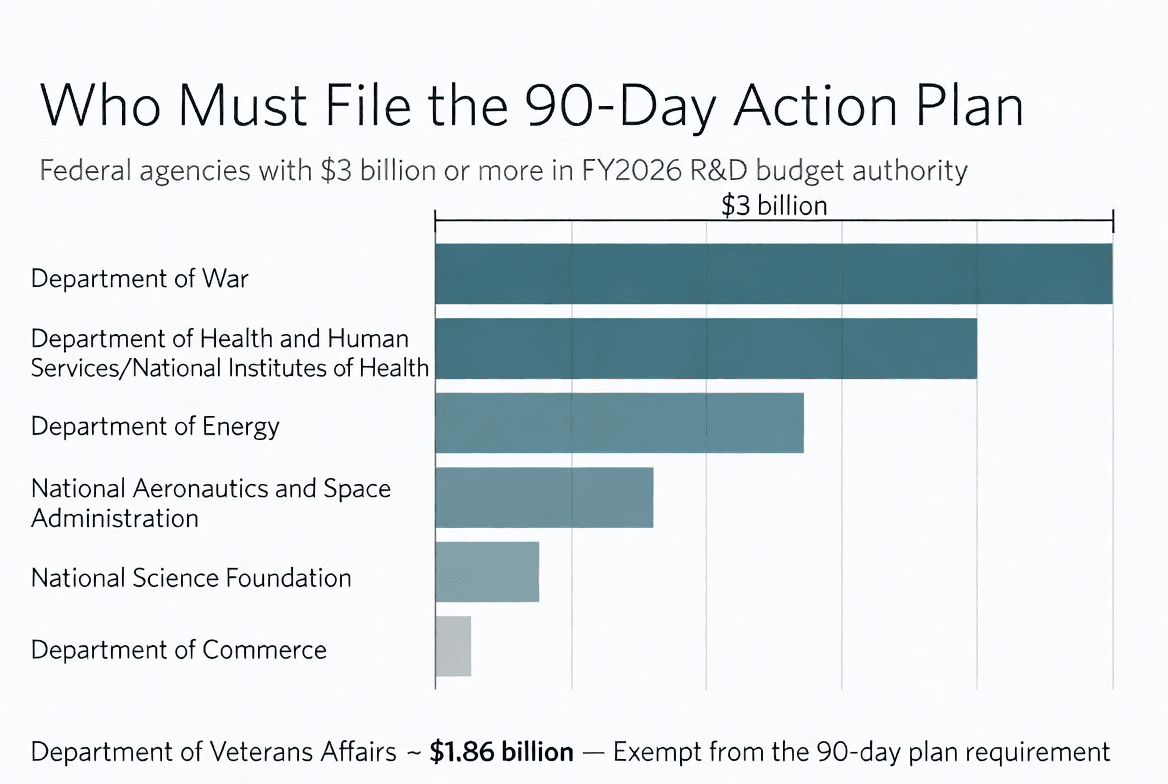
"Within 90 days of this memorandum, the head of each agency with $3 billion or more in FY 2026 budget authority for R&D shall submit to the Assistant to the President for Science and Technology (APST) and Director of the Office of Management and Budget (OMB Director) an action plan describing how the agency intends to implement the program implementation guidance set forth in the 'R&D Priority Practices' section of this memorandum."
Dated July 21, that puts the plans on OMB's desk around October 19.
Using CRS R&D-specific figures, the agencies clearing $3 billion are the Department of War, Health and Human Services including NIH, the Department of Energy, NASA, the National Science Foundation, and Commerce including NIST. Agriculture likely joins them at enacted rather than requested levels. Those five agencies account for roughly 92 percent of federal R&D, and War and NIH alone account for 77 percent.
The Department of Veterans Affairs reports about $1.86 billion in R&D budget authority. Below the line. VA does not file a plan.
Now read what the report says about the VA. Chapter V, in the section describing the Genesis Mission:
"Beyond our national laboratories, agencies including the FDA, NSF, National Oceanic and Atmospheric Administration (NOAA), and Department of Veterans Affairs steward vast quantities of scientific data accumulated over decades of federal investment, from genomic sequences to weather simulations. The Genesis Mission will unlock this capacity, including by building foundational technologies and AI-ready datasets, to tackle the nation's most complex science and technology challenges."
Genomic sequences at the VA means the Million Veteran Program. The report names the asset. The memo assigns the work to six agencies. VA appears in the first document and is exempt from the second.
There is a further silence worth measuring. Across the memorandum's twenty pages, the word "health" appears three times. Once in the opening sentence, where science and technology are said to underpin "our economic prosperity, national security, and public health." Once in "human health and therapeutics," listed as something the favored biological sciences underpin. Once inside "National Institute of Health (NIH) Director's Pioneer Award," cited as a model for long-duration grants.
Three abstractions and an institution's name. "Veteran" does not appear. Neither does "medical," "clinical," "patient," or "biomedical."
The report does marginally better across four times the length. "Veteran" appears four times in 104 pages: twice as an idiom, once listing veterans among the students community colleges serve, and once inside "Department of Veterans Affairs" in the sentence quoted above.
The document directing agencies to prepare federal datasets for AI carries no instruction about health data governance, because it carries almost no health language at all.
The asset
The pipeline the report describes is not hypothetical. It has been running for a decade.
MVP enrollment reached 1,091,487 veterans as of November 20, 2025, with over a million biological samples and more than 475 peer-reviewed publications. The program is funded through Medical and Prosthetics Research and runs through a project period ending September 2028.
In 2016, VA and the Department of Energy signed an interagency agreement called MVP-CHAMPION, a $79.6 million effort for centralized data management and genomic analysis. The analysis ran on Summit and Andes at Oak Ridge National Laboratory, examining more than 2,000 health conditions across 44 million genetic variants. Oak Ridge operates a secure enclave holding copies of the VA Corporate Data Warehouse alongside MVP genetic and survey data, governed by a security framework called CITADEL. The variant-caller work has since extended to Aurora at Argonne.
Phase II selected eight clinical priorities: lung cancer screening, suicide risk, cardiovascular risk in sleep apnea, checkpoint-inhibitor toxicity, heart failure, diabetic renal complications, post-COVID sequelae, antipsychotic toxicity.
Markers identified through MVP already feed REACH-VET, the VA's system-wide suicide-risk model. That is veteran genomic data inside a production clinical decision tool, today.
So when the report says Genesis will unlock VA data, it describes an extension of infrastructure that exists, on machines that already hold the records, under agreements already signed.
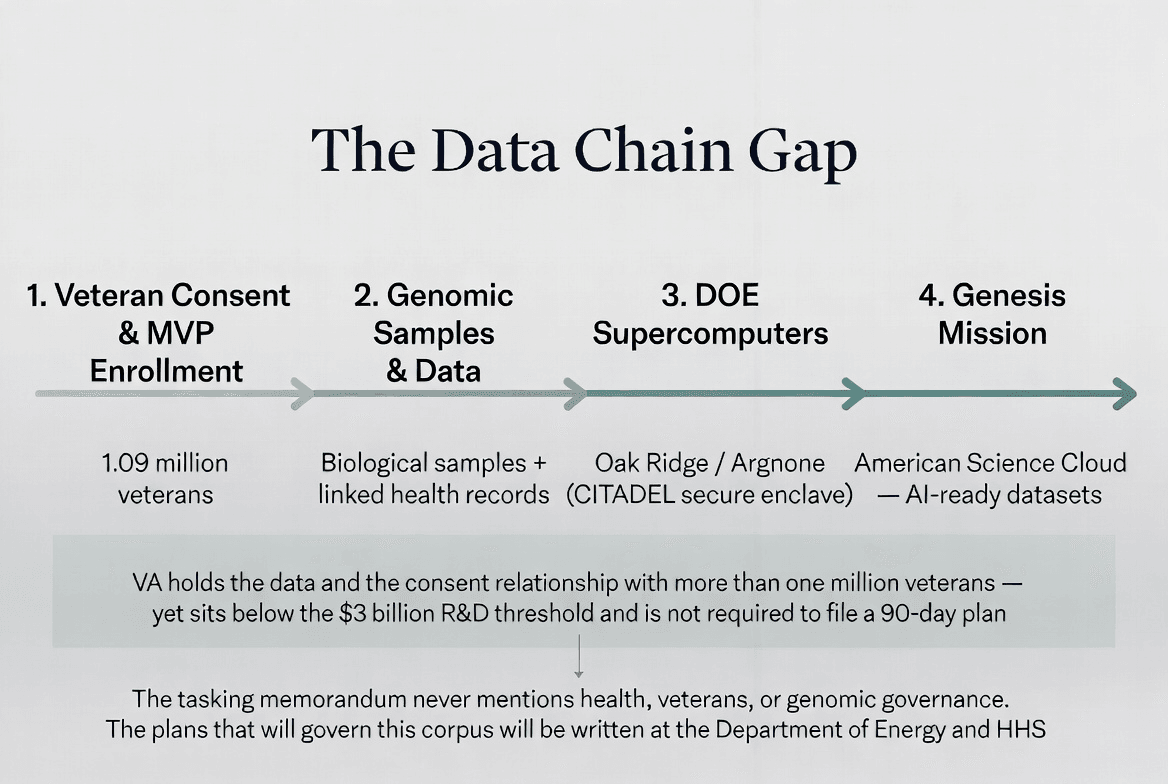
One more thing about the authorizing text. Executive Order 14363, which launched the Genesis Mission on November 24, 2025, mentions neither the VA nor health, biomedicine, or genomic data anywhere in its text. It directs Energy to build the American Science and Security Platform and assemble federal scientific datasets, foundation models, and AI agents. The health linkage comes from the Energy Secretary's public framing and from the report naming the VA. It is not in the order.
What the six are told to do
Nine priorities. Four of them land on a federal health program office this fall.
Rebalance toward physical sciences. Agencies are directed to prioritize both the absolute level and the relative share of funding going to physics, chemistry, materials science, space science, computer science, and supporting engineering and mathematics, with a qualifier attached: "especially within national security-relevant research portfolios."
Prefer biological sciences over life sciences. The exact sentence: "to support Administration priorities in biotechnology and biomanufacturing, agencies should prioritize foundational research in the biological sciences over the life sciences, a broader category not focused on foundational research."
Treat Genesis as central. Agencies are told to "prepare Federal scientific instrumentation, datasets, and compute for the AI-for-science transformation" and to "treat support for the Genesis Mission as a central R&D priority." That instruction is what makes the dataset question live rather than theoretical.
Change how the money moves. Fast grants, a few pages, decided in under a month. Golden tickets letting a single reviewer advance a proposal the panel would have rejected. Regranting that delegates funding authority to working scientists outside the agency. Long-duration awards of five years or more, funded fully in year one. Portable grants that follow the researcher between institutions. The report states the target directly: the U.S. research system "should prioritize the individual scientist over legacy institutions."
Each of those trades deliberation for speed, which is the intended effect. Each also thins the record a program manager stands on when an award gets questioned later by an inspector general, a committee staffer, or a losing applicant. The memo requires that new mechanisms stay inside existing legal authorities and conflict-of-interest policies and meet Gold Standard Science rigor. Sound guardrails. Writing them into a solicitation, staffing the review, and documenting a single-reviewer decision well enough to survive scrutiny is somebody's assignment this fall, on top of the day job.
The objection worth taking seriously
The strongest response to all of that is that I am connecting two things that are not connected.
The memo governs R&D budget authority and budget formulation. It is a planning instrument. Data stewardship runs through a separate body of law: the Privacy Act and its system of records notices, the Common Rule at 45 CFR 46, VA's own research regulations, and the interagency agreement itself. MVP has an institutional review board, a consent process, and a decade of published research conducted under it. Nothing in the memo repeals any of that, and VA remains free to file a plan voluntarily. Budget thresholds and governance boundaries are separate instruments that happen to share a document.
That objection is correct, and it is the beginning of the analysis rather than the end of it.
Those instruments share an architecture. They work by describing a use, approving it, and holding the data holder accountable to the description. A system of records notice enumerates routine uses. A protocol states a research question. A consent form tells a veteran what his sample will be used for. Each assumes the use can be named at the time of approval.
A foundation model works the other way around. Its value lies in downstream applications that cannot be enumerated when the training corpus is assembled, which is why anyone builds one. The report says as much, describing domain-specific scientific foundation models and AI agents that generate hypotheses and design experiments.
Put those together and the question is not whether VA's protections exist. They do, and they are real. The question is whether an approval architecture built around named uses extends cleanly to an artifact defined by unnamed ones, and whether obligations attached to VA's conduct follow a copy of the corpus into a DOE enclave operating under an interagency agreement and partnered with 24 outside organizations.
That question has an answer. Somebody has to write it down.
Where health does appear
The report engages health substantively once. Reading that passage closely is worth the five minutes.
Chapter V argues that the promise of AI-enabled science rests on a foundation that is, at present, potentially unsound. Between one-half and two-thirds of psychology studies failed replication attempts. More than a third of celebrated experimental economics results failed. Irreproducible findings in preclinical biomedical research alone misdirect an estimated $28 billion annually.
The framing is a market failure. Funding and prestige flow to novel claims, while verification carries weak incentives because little glory comes from confirming someone else's work, and earlier replication efforts collapsed under the need for armies of specialists checking studies by hand. Then the report names the risk plainly: Genesis is a science generator, and without a verifier of equal rigor and scale, false findings multiply, because producing a plausible result is about to become far cheaper than checking one.
The recommended response is infrastructure. Machine-auditable replication packages. Open standards that plug into journal submission systems and grant reporting platforms. Prizes for researchers who replicate or disprove influential results. NIH has already started building toward it, with an agency-wide Replication and Reproducibility Initiative, a central resource page live since February, and an $850,000 Replication Prize run with the NASA Tournament Lab.
In that argument biomedical research is a source of error to be corrected, with no data, no subjects, and no stewards attached to it. The $28 billion figure is the most specific health number anywhere in the report, and what it measures is waste.
The coding exercise that decides the portfolio
The same blind spot shows up operationally, in a requirement that will consume more program-office hours than anything else in the memo.
"In their FY 2028 Budget submissions to OMB, agencies should note the R&D character classification of proposed activities as a percentage of their R&D funding portfolio and identify the specific programs through which the agency proposes to shift its portfolio toward earlier-stage work. Where agencies propose to significantly expand later-stage development activities, they should justify why such activities would not occur absent Federal support."
Every activity in the portfolio gets coded. Basic, applied, development. The agency reports the mix as a percentage and names which programs will move it earlier. Then, for anything on the later-stage side that is growing, someone writes a justification explaining why private capital would not have funded it.
Federal health research is weighted toward exactly the work that lands on the wrong side of those lines. Health services research. Implementation science. Comparative effectiveness. Clinical trials in operational populations. Deployment of tools into care delivery. That work is applied by design, because its purpose is to change what happens to a patient, and it does not become foundational research by being reclassified.
The memo does list the favored biological sciences: molecular, cellular and structural biology; biochemistry and chemical biology; genetics, genomics, and synthetic and engineering biology; neuroscience; microbiology and quantitative biology. Genomics is on that list. Getting a genomic result in front of a prescriber is nowhere on it.
Hostility to health research is not required for this to bite. A coding exercise, applied consistently across a portfolio, produces a portfolio that looks different at the end. Whoever writes the classification guidance inside HHS this fall will make decisions that outlast the memo, under a deadline, without having asked for the assignment.
Why the memo matters more than the appropriation
Congress rejected the deep cuts. The FY2026 request sought roughly 40 percent from NIH and better than half of NSF. Enacted FY2026 put NIH near $48.7 billion with all 27 institutes preserved, and the 15 percent indirect-cost cap was blocked in court and affirmed by the First Circuit on January 5, 2026.
Then execution lagged. By early 2026, NIH had issued about 30 percent of its typical grant volume and NSF about 20 percent. The FY2027 request came in April and asked again.
The topline gets restored on Capitol Hill. Direction gets set in guidance documents, execution timing, and priority memoranda that never go to a vote.
Defense health shows the same divergence, and the headline numbers hide it. In the FY2027 request the Defense Health Program is discontinued and split into Combat Operational and Medical Readiness at $20.342 billion discretionary and a Private Sector Care Program at $22,175,472 thousand. That second figure is a transfer rather than growth: the J-book states it was previously COMP Budget Activity Group 2, Private Sector Care, and that COMP operations and maintenance drops by roughly $19.99 billion largely because of the move. The same purchased-care money, given its own line.
The research line is where something actually changed. Defense Health Program RDT&E drops from $2.47 billion in FY2026 to just over $1 billion in FY2027, in the same year the White House directs agencies to raise the share of research going to physical sciences, especially within national security-relevant portfolios. Different offices, different reasons, same direction.
The distance between the corpus and the chart
Somewhere in the VA system there is a veteran whose pharmacogenomic result already exists. It was ordered, run, and reported. It says something specific about how he metabolizes a drug his physician is about to prescribe.
It lives in a reference laboratory outside the VA's record system.
VA's own innovation documentation names the root cause as a lack of interoperability and integration between its electronic health record and that laboratory. It describes the current process as manual and error-prone. It says clinicians looking for a result work through PDF files.
That result is the same class of data the report proposes to unlock at national scale.
The program producing it is not marginal. PHASER has expanded to a 22-gene panel, VA has cut turnaround from about six weeks to two, and VA states that one in two veterans is prescribed a medication under pharmacogenetic control. The largest genomic dataset linked to any health system in the world sits behind it. The science is done. The result stops one system short of the prescriber.
The Defense Health Agency has already written down what it is building. The MHS Digital Transformation Strategy, published in March 2025, defines a digital patient twin as virtual representations of patients generated from patient data, population data, and real-time updates from patient and environmental data, used to model the implications of various care. Two entries down the same glossary, it defines interoperability as the ability of different technology systems to connect and exchange information with each other.
Both definitions live in the same document. The joint record platform that VA and the Department of War adopted was supposed to be what connected them, one common system holding the data on both sides of a service member's transition. At VA, Oracle Health was live at six sites in late 2025 against a target near 170. At DHA, MHS GENESIS has reached full deployment, the Healthcare Management System Modernization line received no funds in the FY2027 request, and integration is moving in-house as Leidos comes off the program between now and July 2027.
We can run a million veterans' genomes against 44 million variants on a supercomputer at Oak Ridge. We cannot move one of those veterans' metabolizer results out of a contract laboratory and into the chart of the physician writing his prescription.
We built half a twin. Genesis funds the half that generates.
The ask, and the date
Six agencies owe OMB an action plan by roughly October 19. Two specific things belong in them, and both sit inside the drafting discretion of the people writing them right now.
Energy and HHS: a provenance and consent-scope statement. Each plan identifies datasets being prepared for the American Science Cloud. For any human-subject dataset on that list, the plan should state which authority permits the use, what the original consent described, and whether foundation-model training falls inside it. One paragraph covers it. Its absence in October becomes the precedent in FY2028.
VA: file anyway. The $3 billion threshold sets a floor, not a ceiling. Nothing prevents the Secretary from submitting an action plan, or a data-steward annex to Energy's, describing the terms under which VA-originated human-subject data reaches the platform. VA holds the consent relationship and no obligation in this process to defend it. Filing voluntarily is how the steward's terms get on the record before the compute agencies write theirs.
For anyone outside government, those plans are the clearest forward view of federal research direction that will be published this year, and the classification guidance inside HHS is the document that decides what applied health research gets called for the rest of the decade.
The part that stays fixed
A veteran walked into a VA facility, sat through a consent briefing, gave blood, and answered a survey. More than a million of them did. The consent was for research to improve veteran health care, run by the agency that treats them.
That data now sits on Department of Energy supercomputers under an interagency agreement, feeds a production suicide-risk model, and has been named in a White House report as an asset for a national AI discovery platform partnered with 24 outside organizations.
Every step in that chain was legal, documented, and defensible on its own terms. One piece of it sits in the report. The unlocking sits in an executive order that never mentions health, and the tasking sits in a memo that never mentions veterans. Nothing describes the chain end to end.
October 19 is when six agencies say in writing what they intend to do. The veteran does not get a filing deadline.
Let's roll.
— Mary
Mission Meets Tech
The views expressed in this newsletter are my own and do not represent the official position of any organization. This content is for informational purposes only.
MMT Premium
This issue reads the tasking. The companion Capture Corner works the window: which of the six action plans to read first and what to look for in each, how the classification guidance inside HHS reshapes the applied-research market through FY2028, the verification and replication services category and who is already circling it, how to position against fast grants and golden tickets when past performance is your main asset, the DHA transition dates that open services-layer competition as the integrator role ends, and the three questions to put to a program office before the October filing closes.
Founding Member rate: $199/year, locked permanently for the first 100 subscribers.
Standard rate: $249/year or $29/month.
Premium adds 48-hour early access to deep-dive analysis, monthly Capture Intelligence Sheets with sourced action windows, direct Q&A access (reply to any premium issue), and tool discounts: ProposalPulse $14.99 per assessment, MarketPulse $35 per brief.
Subscribe at missionmeetstech.com/pricing.
Sources
[1] Office of Science and Technology Policy, Science: A New Golden Age, Michael Kratsios, Director, July 2026. https://www.whitehouse.gov/wp-content/uploads/2026/07/Science-A-New-Golden-Age.pdf
[2] White House, "OSTP Releases Science: A New Golden Age," July 21, 2026. https://www.whitehouse.gov/releases/2026/07/45470/
[3] White House, Fiscal Year 2028 Administration Research and Development Budget Priorities Memorandum (NSTM-5 / M-26-16), Michael J. Kratsios and Russell T. Vought, July 21, 2026. https://www.whitehouse.gov/wp-content/uploads/2026/07/White-House-Fiscal-Year-2028-RD-Priorities-Memorandum.pdf
[4] House Committee on Science, Space, and Technology, "Unleashing a Golden Age of Science," hearing, July 22, 2026. https://science.house.gov/2026/7/full-committee-hearing-unleashing-golden-age-science-ostp-research-enterprise-priorities-fy27
[5] Executive Order 14363, "Launching the Genesis Mission," November 24, 2025. https://www.whitehouse.gov/presidential-actions/2025/11/launching-the-genesis-mission/
[6] Department of Energy, "American Science and Security Platform." https://www.energy.gov/undersecretaryforscience/genesis-mission/american-science-and-security-platform
[7] Department of Energy, "Energy Department Announces Collaboration Agreements with 24 Organizations to Advance Genesis," December 18, 2025. https://www.energy.gov/articles/energy-department-announces-collaboration-agreements-24-organizations-advance-genesis
[8] Congressional Research Service, R48694, "Federal Research and Development Funding: FY2026," December 2025. https://www.congress.gov/crs_external_products/R/PDF/R48694/R48694.9.pdf
[9] Military.com, "Inside the Million Veteran Program's Growth and What It Means for VA Health Care," November 21, 2025. https://www.military.com/feature/2025/11/21/inside-million-veteran-programs-growth-and-what-it-means-va-healthcare.html
[10] JAMIA Open, MVP-CHAMPION program description ($79.6 million collaboration; Summit and Andes at Oak Ridge; more than 2,000 conditions across 44 million variants). https://pmc.ncbi.nlm.nih.gov/articles/PMC11540161/
[11] Department of Veterans Affairs, Million Veteran Program, "Analytics and Tools" (Knowledge Discovery Infrastructure; CITADEL security framework). https://www.mvp.va.gov/pwa/analytics-and-tools
[12] Argonne Leadership Computing Facility, "Scaling Genomic Variant Callers on Leadership-Class Systems: A Collaboration Between VA and DOE." https://www.alcf.anl.gov/science/projects/scaling-genomic-variant-callers-leadership-class-systems-collaboration-between-va
[13] PubMed, MVP-CHAMPION Phase II clinical priority projects. https://pubmed.ncbi.nlm.nih.gov/42035288/
[14] Privacy Act of 1974, 5 U.S.C. § 552a (system of records notices and routine uses); Federal Policy for the Protection of Human Subjects (Common Rule), 45 CFR Part 46; VA research regulations, 38 CFR Part 16.
[15] NIH Extramural Nexus, "NIH Launches New Central Resource to Support Replication and Reproducibility," February 5, 2026; NIH Common Fund, "Replication to Enhance Research Impact Initiative" and Replication Prize ($850,000 purse with NASA Tournament Lab). https://commonfund.nih.gov/replication-initiative
[16] American Institute of Physics FYI, "Congress Set to Finalize Science Budgets, Rejecting Trump Cuts," January 2026. https://www.aip.org/fyi/congress-set-to-finalize-science-budgets-rejecting-trump-cuts
[17] Nature, "US Science Funding Delayed Despite Congress Rejecting Cuts," 2026 (NIH at approximately 30 percent and NSF at approximately 20 percent of typical grant volume by early 2026). https://www.nature.com/articles/d41586-026-00601-0
[18] Venable, "First Circuit Holds NIH Rate Caps Unlawful," January 2026. https://www.venable.com/insights/publications/2026/01/first-circuit-holds-nih-rate-caps-unlawful
[19] Federal News Network, "DoD Seeks to Split Defense Health Program into Two Accounts in Fiscal 2027," April 2026 (RDT&E just over $1 billion versus $2.47 billion in FY2026; Healthcare Management System Modernization unfunded). https://federalnewsnetwork.com/budget/2026/04/dod-seeks-to-split-defense-health-program-into-two-accounts-in-fiscal-2027/
[20] Military Health System FY2027 Budget Justification, J-Book Volume 1 (COMP/PSCP), Office of the Under Secretary of War (Comptroller). https://comptroller.war.gov/Portals/45/Documents/defbudget/FY2027/budget_justification/pdfs/09_Military_Health_System/MHS_PB27_J-Book-Vol1-COMP_PSCP.pdf
[21] Department of Veterans Affairs Marketplace, "FastTrack PGx: Pharmacogenomic Testing" (lack of interoperability between VA's electronic health record and the reference laboratory; manual, error-prone uploading; results stored as PDF files). https://marketplace.va.gov/innovations/pharmacogenomic-pgx-testing-enabling-the-va-provider-to-tailor-prescriptions-based-on-the-veteran-s-genetic-profile-no-more-one-size-fits-all-approach
[22] Department of Veterans Affairs, PHASER program record (22-gene panel; turnaround reduced from approximately six weeks to two; one in two veterans prescribed a medication under pharmacogenetic control). https://marketplace.va.gov/innovations/phaser
[23] Defense Health Agency, MHS Digital Transformation Strategy, March 26, 2025 (glossary definitions of "Digital patient twin" and "Interoperability"). https://www.health.mil/Reference-Center/Publications/2025/03/26/MHS-Digital-Transformation-Strategy
[24] Federal News Network, "VA in 2026 Looks to Get EHR Rollout Back on Track, Embark on Health Care Reorganization," December 2025 (six sites live against a target near 170). https://federalnewsnetwork.com/veterans-affairs/2025/12/va-in-2026-looks-to-get-ehr-rollout-back-on-track-embark-on-health-care-reorganization/
[25] Washington Technology, "How DHA Plans to End Leidos' Run as the Military's Health Record Integrator," June 12, 2026 (full deployment and sustainment; five sole-source contracts; transition dates through July 2027). https://www.washingtontechnology.com/contracts/2026/06/how-dha-plans-end-leidos-run-militarys-health-record-integrator/414160/
[26] Executive Order 14347, "Restoring the United States Department of War," September 5, 2025. https://www.whitehouse.gov/presidential-actions/2025/09/restoring-the-united-states-department-of-war/