The Marine Corps Answered Him First
On August 11 in New Orleans, the Director of the Defense Health Agency told an industry audience that the character of warfare is shifting and health IT is part of that shift. The FY2027 request his enterprise submitted asks Congress for $1.019 billion in medical research, forty-seven million above last year's ask. A Marine Corps procurement line called Field Medical Equipment went from $15.7 million to $227.8 million across the same two budgets.
Friends,
Marine Corps budget line item 6522 is titled Field Medical Equipment. Two years ago it carried $15.664 million. The FY2027 request asks for $227.761 million. [5]
On August 11, in a ballroom in New Orleans, Vice Adm. Darin K. Via told an industry audience that warfare is changing fast, and he named the things changing it: artificial intelligence, drones, unmanned aerial vehicles, sensor saturation. The character of warfare is shifting under our feet, he said, and health IT is not on the sidelines of that shift. [1]
He is right. The budget already moving on it belongs to somebody else.
Via called health IT a warfighting function and separated it from support work explicitly. He told industry that the specific IT solutions are secondary to the outcomes, that DHA is changing how it acquires products and services, and that the agency is soliciting commercial solution offerings through a faster process. [1][2] That is the right diagnosis, delivered by the right person, in a room full of the companies that will be asked to act on it.
It is also checkable. The Department published its FY2027 request in April, and a budget request is the only document where an enterprise states in numbers what it believes it needs. I spent the weekend in it. The speech and the books are describing two different tempos, and the gap between them is where this issue lives.
What the request actually asks for
Start with the number most of this month's coverage is going to get wrong. The Combat and Operational Medicine Program requests $1.02 billion in research, development, test and evaluation for FY2027, against FY2026 enacted of $2.47 billion. [3] Put those side by side and you get a 59 percent reduction in military medical research. That number will appear in a lot of coverage this month, and it describes something that did not happen.
Exhibit PB-31D says something else. The FY2026 President's Budget request for RDT&E was $972.7 million. Congress then added exactly $1.5 billion as a distributed adjustment, and that adjustment is how the enacted figure reached $2.47 billion. [3]
The comparison that means anything is request against request. Last year the Department asked for $972.7 million. This year it is asking for $1.02 billion, an increase of $46.7 million.
Call it 4.8 percent, in the year its senior officer stood in New Orleans and said the ground is moving. The J-book states the pattern in its own voice. Funds are appropriated to RDT&E each year above the budget request to support Congressional Special Interest items. [3] The money has an address, too. One program element, Medical Development, carries $1.76 billion in FY2026 and $360.8 million in FY2027, and nearly the entire two-year swing lives inside that single line. [4] It is the line the Congressionally Directed Medical Research Programs flow through.
In FY2026, Congress added $1.5 billion to a $972.7 million request, which is 60 percent of what was finally enacted. Roughly $1.27 billion of that went to the Congressionally Directed Medical Research Programs, about half the enacted research total on its own. [3][19] The J-book describes the practice as annual rather than exceptional. [3] My read is that the request has been built around the expectation that Congress keeps doing it, and a request built on that expectation is a statement about priority whether or not anyone intended it as one.
The line that moved
Now open the procurement book, where the services buy the equipment that ends up in a rucksack. One line in it moved harder than anything in the health program.
Marine Corps, Procurement, line 49, budget line item 6522, titled Field Medical Equipment. FY2025 actual, $15.664 million. FY2026, $58.768 million. FY2027 request, $227.761 million. [5]
Fourteen and a half times in two years.
Navy Medical Support Equipment ran the same direction over the same span, from $10.1 million to $54.9 million. Army Combat Support Medical climbed from $72.2 million to $100.6 million, then settled at $93.7 million in the FY2027 request, the one line of the three that flattened. [5]
Add them. The three service field-medical procurement lines total $97.9 million in FY2025 and $376.3 million in FY2027.
The entire Combat and Operational Medicine Program procurement account for FY2027 is $366.7 million. [3]
Three lines in three service books now carry more procurement dollars than the health program's whole procurement appropriation, and they got there in twenty-four months while the health program's request stayed roughly where it was. What that appropriation actually buys is written down. The J-book describes capital equipment in military treatment facilities, initial outfitting for newly constructed or modernized health care facilities, replacement of uneconomically reparable items, and MHS IT requirements. [3] That account outfits hospitals. The equipment that deploys with a shock trauma platoon is being bought somewhere else, by somebody else, at four times the rate.
What the flagship program is building
The Defense Healthcare Management System Modernization office publishes a fact sheet. The current one is dated February 2026, cleared for public release, and it lists five focus areas. [6]
Ambient Listening Expansion. Next Generation Patient Portal. Projects Supporting Billing and Collections. Outpatient Pharmacy Billing. Dental in Power Chart.
Every one of those is defensible on its own terms. Ambient listening takes documentation load off clinicians who are drowning in it, and DHMSM began full enterprise deployment in February 2026 after completing limited fielding the year before. [6] Pharmacy billing accuracy is real money. A patient portal that works is the difference between a family getting care and a family giving up.
Every one of those also happens inside a building with a parking lot. MHS GENESIS reached worldwide deployment in 2024 across 9.5 million beneficiaries, 194,000 users, and 3,800 military and federal partner facilities, and the program then shifted to a product-based structure for lifecycle management. [6] The direct care system it serves runs 46 government-owned inpatient hospitals, 556 ambulatory and occupational health clinics, and 105 dental clinics. [3] That is a large, complicated, garrison health system, and modernizing it is a legitimate multi-year job.
The question is what happens to the record when the patient is not in a building.
What DHA did fund, stated fairly
The operational side of the request is not empty, and treating it as empty would be dishonest reporting. Inside the FY2027 O&M increases: $42.5 million to the Combat Support Agency Blood Program for freeze-dried plasma, pre-deployment blood donor screening, and Armed Services Blood Program staffing and modernization. $38.6 million to modernize combat casualty care data and trauma systems, including standing up a Joint Trauma Education and Training Directorate in compliance with the FY2017 NDAA. $21.1 million to accelerate a federated data ecosystem for time-sensitive clinical, operational, and readiness decisions across a distributed enterprise. [3]
On the research side, the increases include $51 million for Combat Support Agency requirements, of which $46 million is Joint Trauma System and $5 million is Blood on Demand, plus $10 million for the DHA Data Ecosystem. [3]
Those are the right lines. Read the clinicians who have worked the Russo-Ukrainian war and the list they produce is blood, cold chain, documentation, and legal authority for interoperability across an alliance. John Quinn, writing from the OSCE monitoring mission, argues that advanced resuscitation has to be planned, governed, and available before a casualty reaches a hospital, and that infection prevention forward of Role 1 is a warfighting function rather than a paperwork drill. [7] The Army's own medical lessons-learned report from Ukraine puts protection of medical assets, evacuation implications, and the absence of portable imaging at Role 1 among its eight observations. [8]
CNA's read on Russian military medicine lands on the hardest sentence in the literature. With extended holding at the point of care, many critically injured patients will not survive to higher levels of care. [9] The same analysis notes that unmanned casualty evacuation requires operational protection in a fight defined by drone warfare and contested logistics, and NATO's medevac work reaches the same place from the alliance side: forward-positioned capability matters more, secure casualty tracking is an open problem, and robotic evacuation is worth exploring. [9][17]
Every one of those findings has a data dependency buried in it. A casualty held forward for six hours generates a clinical history that has to travel with the patient. Blood moved through a cold chain has to be tracked to be trusted. An unmanned evacuation platform has no crew to give a verbal handoff at the ramp.
Freeze-dried plasma and a funded trauma registry are direct answers to the first two. The third is a documentation problem, and documentation is the part the health enterprise owns.
Now set those increases next to the other one in the same exhibit. Digital health capabilities inside the direct care system receive $200.4 million, funding ambient listening implementation, expanded video visits, and Tele-Critical Care. [3] Information Management O&M rises from $2.27 billion to $2.6 billion, growth of $328.4 million. [3]
The garrison digital health increase alone is larger than the blood program increase, the trauma data increase, the federated data ecosystem increase, and the entire Joint Trauma System research increase combined.
One decrement belongs in the record with its justification attached. The request cuts $27.9 million from science and technology projects, and the stated reason is to meet the Secretary of War's highest priorities, modernizing capabilities and sustaining the force. [3]
The honest counterargument
Four defenses of this budget are real, and a GS-15 comptroller will raise all four before the coffee gets cold. Take them in order.
Title 10 assigns organize, train, and equip to the services. DHA is a combat support agency. Field medical equipment for a Marine infantry battalion has always been a Marine Corps procurement responsibility, and a growing Marine Corps line is the system working as designed.
CDMRP is largely disease and condition research directed by Congress, some of it a long way from warfighter medicine. A Department declining to request $1.5 billion of it is taking a defensible policy position about what belongs in a health program.
A single-year procurement jump can be one program buy landing at full rate. The Marine Corps figure may be a fielding decision reaching its peak year, and the FY2028 request is where that gets settled.
And the appropriation types are not equivalent. Procurement dollars and RDT&E dollars do different work, and most of the delivery money for both DHMSM and JOMIS runs through Information Management O&M rather than through a research line. Comparing a service procurement line to a health program research line has a real limit, and I am naming it rather than hoping you miss it.
All four defenses describe how the money is appropriated. The question they leave open is what happens where the two appropriations touch.
Where the two books have to meet
Via's argument at DHITS was that data is the problem. He said the data exists and sits in silos and repositories, not purpose-built to achieve outcomes, and that the fix is putting it in the hands of providers, medics, and corpsmen. [1] Lt. Gen. Mary Izaguirre described the same requirement from the Army side in March as a medical data layer giving commanders visibility into where beds are available, how much blood is on hand, and where the medevac is. [10]
The program office that builds that layer is Joint Operational Medicine Information Systems. Its research line is $29.4 million in FY2027, against $28.7 million in FY2026 and $28.1 million in FY2025. [4] Procurement adds $31.2 million. [11]
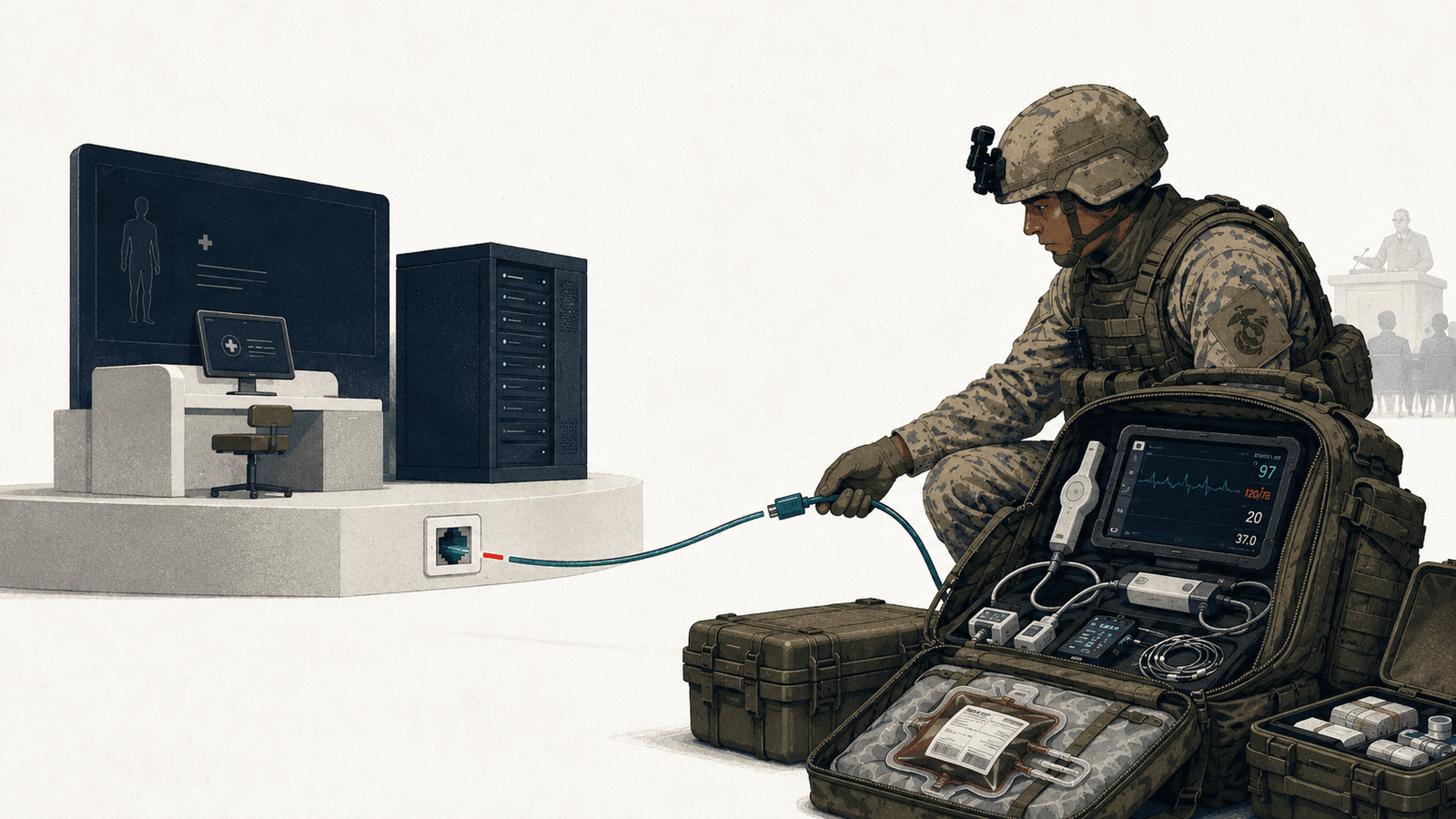
Roughly sixty million dollars, growing at about the rate of inflation. That portfolio covers six managed applications across five operational medicine functions: healthcare delivery, medical command and control, medical situational awareness, medical logistics, and patient movement. The point-of-injury record. The forward casualty documentation path. The theater instance of the EHR, and the medical common operating picture a combatant commander looks at. It also holds the seam into MHS GENESIS in garrison, the place the record has to land for any of it to follow the service member home.
Sixty million dollars a year, for all of that, while a single service procurement line for the equipment feeding it grew by more than two hundred million in the same period.
PEO DHMS holds executive management authority for three programs: DHMSM, JOMIS, and the Defense Medical Information Exchange and Enterprise Intelligence and Data Solutions line. [3] Their FY2027 research lines read $5.1 million, $29.4 million, and $8.5 million. [4] Those are small numbers because delivery runs on O&M, and that is the fair reading of them. They are also the only place in the request where you can see the relative weight the enterprise assigns to three different jobs.
Two weeks ago the Army approved BATDOK-J for Army-wide fielding. What made that decision work was integration: medical documentation riding the same tactical network as fires and ISR, landing in the same display the commander was already looking at. The software itself had been in operational use with Air Force pararescuemen since 2019.
Hold the two budget movements next to each other. The services are buying field medical equipment at roughly four times the rate they were two years ago. The health enterprise owns the record architecture, the data standards, and the layer that equipment has to feed. The service lines quadrupled. The JOMIS lines moved with inflation.
A monitor bought on a Marine Corps procurement line and a record architecture funded on a Defense Health Agency research line have to meet somewhere, and the meeting is a governance problem before it is an engineering problem. The April 2026 reorganization moved DHA to a Portfolio Acquisition Executive structure and consolidated the data and innovation offices under the Office of Warfighter Health Advantage. [12] It settled ownership inside DHA. The arbitration between DHA and a service buying its own kit sits outside what that reorganization touched.
RADM Tracy Farrill told the DHITS audience that OWHA will serve as DHA's lead for data-driven decision-making, performance optimization, and innovation, with a corps of experts spanning strategy, data and analytics, health informatics, and digital platforms. [1] That charter is internal. She moderated a panel of service medical leadership at the same symposium, including the Joint Staff Surgeon and the deputy commanding general of Army Medical Command. [1] A panel is where the interface gets discussed. A memorandum of agreement is where it gets decided, and I have not seen one. My read is that the interface has no owner because no single organization loses anything when it fails, and that is the condition that produces expensive surprises about thirty months later.
What to watch before the FY2028 request
Four markers will tell you whether August 11 described a change already underway or a change the Department intends to fund later, and all four resolve inside the next six months.
The FY2027 appropriations markup on the RDT&E line. If Congress adds $1.5 billion again, the pattern holds for a fourth straight year and the Department has confirmed by omission whose job it thinks medical research growth is.
The Marine Corps Field Medical Equipment line in FY2028. Sustained near $227 million, it is a doctrine change with money attached and a durable market. Falling back toward $60 million, it was a buy that finished.
ESS Next. The Commercial Solutions Opening Phase 1 deadline is August 20, and the structure carries the signal: fixed price only, no level of effort, no labor hour, payment tied to delivered results, with two non-government advisers reviewing submissions, Boston Consulting Group and Andrew Morgan Consulting. [13] The solicitation record uses Enterprise Support Services and Enterprise Software Services interchangeably; this issue uses the first. Via said DHA is changing how it buys. That solicitation is the change, in writing, with a date on it.
The Reverse Industry Day on August 25 and 26. The topic is medical training data across simulators, live exercises, and enterprise training systems, with stated interest in longitudinal proficiency tracking, edge processing, and alignment with the DoD Trauma Registry. [14] Edge processing and trauma registry alignment inside a training-data market survey is the enterprise working the same interface problem from the other end.
Industry should read the $300 million PEO DHMS Deployment Solutions IDIQ awarded July 31 for what it covers, which is deployment, training, change management, and sustainment for PEO DHMS products across CONUS and OCONUS through August 2031. [15] Twelve firms hold it against twenty-nine offers. The task orders are where the tempo shows up.
What to do Monday
Three moves, depending on which side of the table you sit on.
If you are inside the enterprise, the budget lever for this year is already gone. Components sent the FY2028 POM and budget estimate submission to OSD in late July. What remains live between now and December is program and budget review, which is where issue papers and reclama still move money, and the FY2029 build that starts this fall. If a data layer increase is going to exist, it gets written into the FY2029 POM in the next four months by somebody who decides to write it.
The more durable lever is not in the budget at all. It sits in requirements documents and source selection. A capability requirement that specifies what a fielded medical device must emit, in what format, against a named standard, outlives any single POM and binds every buy that follows it, including the ones made by a service program office that does not report to DHA. An evaluation factor that scores interoperability does the same thing one solicitation at a time. Neither requires a memorandum of agreement between commands, which is the part that takes two years and a general officer.
The timing argument is what makes it urgent. Equipment bought in FY2027 fields in FY2028 and FY2029. A record architecture funded in FY2029 arrives after the kit it was supposed to receive, and retrofitting data output onto equipment already hand-receipted is a different and worse program.
If you sell into the health enterprise, check which account you have been calling on. COMP procurement at $366.7 million buys capital equipment for military treatment facilities, initial outfitting, and replacement of items too worn to repair. [3] The growth sits in three service lines that are bought by three different chains. Marine Corps Field Medical Equipment runs through Marine Corps Systems Command. Navy Medical Support Equipment and Army Combat Support Medical run through their own service acquisition structures. Different contracting offices, different vehicles, different competition strategies, and in several cases different small business goals than the DHA vehicles your capture plan is probably built around. A team calling exclusively on Falls Church is calling on the flat line.
If you sell the equipment itself, price the data output. A device that emits to a documented standard and can be ingested by a JOMIS-managed application is worth more to this enterprise than a device that displays a number to whoever is standing over the casualty, and that difference is not yet a scored evaluation factor in most of these buys. The Reverse Industry Day on August 25 and 26 is a market survey on medical training data with stated interest in edge processing and DoD Trauma Registry alignment. [14] Saying it out loud in a market survey costs nothing and shapes the requirement that gets written next.
There is one question anybody can answer this week without a clearance or a meeting. Take any medical device in your portfolio or your formation and ask what it emits, in what format, to what standard, and who has agreed to receive it. If the answer stops at the display, you are holding a paper problem with a battery in it.
What this costs in practice
Three wartime efforts ran over the past year: Operations Midnight Hammer, Absolute Resolve, and Epic Fury. [18] Pat Flanders, DHA's CIO, has said publicly that during Epic Fury the agency used its accredited large language model tenant to track patient movement, working a complicated calculus of transport mode, drop-off point, and injury type against data from multiple sources. [16]
That is the enterprise doing the work with what it has, in a live operation, and it is the strongest argument in the agency's favor. It is also the argument for funding the layer underneath it before the next operation.
Rear Adm. Rick Freedman gave the future condition its plainest statement at the Society for Federal Health Professionals meeting in March. It was not unusual, he said, to see an injured Marine, Soldier, Sailor, or coalition member in a trauma bay within an hour of injury, receiving lifesaving resuscitation that may not exist in a future environment. We won't have those advantages. [10]
A corpsman in that environment will hold a casualty longer than any corpsman has held one since Korea, carrying better equipment than any corpsman has ever carried, bought on a line item that quadrupled in twenty-four months.
Whether the numbers coming off that equipment reach the surgeon, the commander, and the permanent record depends on a data layer funded at twenty-nine million dollars a year.
The equipment is arriving on schedule. The wire it plugs into is still waiting for a budget line that matches the speech.
Let's roll.
— Mary
Mission Meets Tech
The views expressed in this newsletter are my own and do not represent the official position of any organization. This content is for informational purposes only.
MMT Premium
This issue reads the FY2027 request against the DHITS message. The companion Capture Corner works the money: where the $328.4 million Information Management growth lands and which offices control it after the April reorganization, how the ESS Next fixed-price structure changes bid math against a traditional labor-hour capture, the task order competition now opening under the $300 million PEO DHMS Deployment Solutions IDIQ, what the Reverse Industry Day topic signals about a medical training data acquisition in FY2027, the three service procurement lines that now exceed the health program's own procurement account and how to position against them, and the FY2028 markers that will confirm or kill the trend.
Founding Member rate: $199/year, locked permanently for the first 100 subscribers. Standard rate: $249/year or $29/month.
Premium adds 48-hour early access to deep-dive analysis, monthly Capture Intelligence Sheets with sourced action windows, direct Q&A access (reply to any premium issue), and tool discounts: ProposalPulse $14.99 per assessment, MarketPulse $35 per brief.
Subscribe at missionmeetstech.com/pricing.
Sources
[1] Defense Health Agency, "Data, technology, people vital for warfighter health advantage, says Defense Health Agency director," DVIDS, August 13, 2026. Source for Vice Adm. Darin K. Via's DHITS keynote quotations on the changing character of warfare, data in silos, the warfighting function framing, and acquisition changes; for RADM Tracy Farrill's OWHA remarks; and for the surgeons general panel Farrill moderated on August 11. https://www.dvidshub.net/news/572343/data-technology-people-vital-warfighter-health-advantage-says-defense-health-agency-director
[2] ExecutiveGov, "DHA Director VADM Via Outlines Health IT Initiatives," August 14, 2026. Source for the outcomes-over-products acquisition framing and the faster commercial acquisition process. https://www.executivegov.com/articles/darin-via-dha-director-health-it
[3] Department of War, Office of the Under Secretary of War (Comptroller), "Military Health System Fiscal Year (FY) 2027 Budget Estimates, Volume 1: Justification Estimates and Data Book, Combat and Operational Medicine Program (COMP, 0130D) and Private Sector Care Program (PSCP, 0146D)," April 2026. Primary source for: the FY2027 RDT&E request of $1,019,362 thousand and FY2026 enacted of $2,472,712 thousand (Exhibit O-1); the FY2026 President's Budget RDT&E request of $972,712 thousand and the $1,500,000 thousand distributed congressional adjustment (Exhibit PB-31D); FY2027 procurement of $366,728 thousand; Information Management O&M growth from $2,271,798 thousand to $2,600,177 thousand; the $200.4 million digital health increase, $42.5 million blood program increase, $38.6 million combat casualty care data and trauma systems increase, $21.1 million federated data ecosystem increase, $51.0 million Combat Support Agency RDT&E increase (Joint Trauma System $46M, Blood on Demand $5M), $10.0 million DHA Data Ecosystem increase, and the $27.9 million science and technology decrease with its stated justification (Exhibit PBA-19); the description of what COMP procurement funds; the PEO DHMS three-program executive management authority; and the 46 inpatient hospitals, 556 ambulatory and occupational health clinics, and 105 dental clinics figure. https://comptroller.war.gov/Portals/45/Documents/defbudget/FY2027/budget_justification/pdfs/09_Military_Health_System/MHS_PB27_J-Book-Vol1-COMP_PSCP.pdf
[4] Department of War, FY2027 R-1 Exhibit, RDT&E Programs. Figures in the issue are rounded to millions; exact appropriated amounts in thousands under account 0130D are: 0603115DHA Medical Development ($1,755,684 thousand FY2026, $360,845 thousand FY2027); 0605045DHA Joint Operational Medicine Information System ($28,095 / $28,707 / $29,353 thousand FY2025 / FY2026 / FY2027); 0605026DHA Information Technology Development, DoD Healthcare Management System Modernization ($5,141 thousand FY2027); 0605039DHA DoD Medical Information Exchange and Interoperability ($8,504 thousand FY2027). https://comptroller.war.gov/Budget-Materials/
[5] Department of War, FY2027 P-1 Exhibit, Procurement Programs. Figures in the issue are rounded; exact amounts in thousands for the service field medical procurement lines are: Procurement, Marine Corps, line 49, BLI 6522 Field Medical Equipment ($15,664 / $58,768 / $227,761 thousand FY2025 / FY2026 / FY2027); Other Procurement, Navy, BLI 8109 Medical Support Equipment ($10,122 / $24,256 / $54,862 thousand); Other Procurement, Army, BLI 7500MN1000 Combat Support Medical ($72,157 / $100,567 / $93,705 thousand). https://comptroller.war.gov/Budget-Materials/
[6] Defense Healthcare Management Systems, "DOD Healthcare Management System Modernization Fact Sheet," as of February 2026, Distribution A. Source for the five DHMSM focus areas (Ambient Listening Expansion, Next Generation Patient Portal, Projects Supporting Billing and Collections, Outpatient Pharmacy Billing, Dental in Power Chart); the 2024 completion of worldwide MHS GENESIS deployment reaching 9.5 million beneficiaries, 194,000 users, and 3,800 facilities; the shift to a product-based lifecycle structure; and the February 2026 start of full DOD enterprise deployment of Ambient Listening. https://www.health.mil/Reference-Center/Fact-Sheets/2026/03/24/DOD-Healthcare-Management-System-Modernization-Fact-Sheet
[7] John Quinn, MD, "Good Medicine Is Combat Power: Clinical Innovation and the Lessons of the Russo-Ukrainian War," War on the Rocks, June 18, 2026. Source for the planned, governed, and available resuscitation argument and the infection prevention as warfighting function framing. https://warontherocks.com/good-medicine-is-combat-power-clinical-innovation-and-the-lessons-of-the-russo-ukrainian-war/
[8] U.S. Army, "Army Medical Lessons Learned Report, Ukraine," Pulse of Army Medicine, June 2025. Source for the eight observations, including protection of medical assets, evacuation implications, and the lack of portable imaging capability at Role 1. https://www.lineofdeparture.army.mil/Portals/144/PDF/Journals/Pulse-of-Army-Medicine/June%202025/Ukraine.pdf
[9] CNA, "How Russia's War on Ukraine Changed Russian Military Medicine," March 2026. Source for the extended holding at point of care finding and the unmanned casualty evacuation protection requirement. https://www.cna.org/quick-looks/2026/03/How-Russia-War-on-Ukraine-Changed-Russian-Military-Medicine.pdf
[10] Defense Health Agency, "Top military surgeons general discuss future of military medicine: 'We are ready to fight and win shoulder to shoulder together,'" DVIDS, covering the Society for Federal Health Professionals annual meeting, March 2026. Source for Rear Adm. Rick Freedman's trauma bay and future environment remarks and Lt. Gen. Mary Izaguirre on the medical data layer covering beds, blood, and medevac. https://www.dvidshub.net/news/562035/top-military-surgeons-general-discuss-future-military-medicine-we-ready-fight-and-win-shoulder-shoulder-together
[18] Defense Health Agency, surgeons general panel coverage, 2026 MHS Conference, Dallas, May 28, 2026, published July 2, 2026. Source for the reference to three wartime efforts over the past year: Operations Midnight Hammer, Absolute Resolve, and Epic Fury. https://health.mil/News/Dvids-Articles/2026/07/02/news569298
[11] Jared Serbu, "DoD seeks to split Defense Health Program into two accounts in fiscal 2027," Federal News Network, April 22, 2026. Source for the $31.2 million FY2027 procurement figure for the Joint Operational Medicine Information System and the COMP budget activity allocations. https://federalnewsnetwork.com/budget/2026/04/dod-seeks-to-split-defense-health-program-into-two-accounts-in-fiscal-2027/
[12] Defense Health Agency, Organizational Structure, and RDML Ivonne Arena official biography. Source for the current DHA senior structure following the April 2026 reorganization and the Portfolio Acquisition Executive alignment. https://dha.mil/About-DHA/Organizational-Structure · https://dha.mil/About-DHA/Organizational-Structure/Bios/RDML-Ivonne-Arena
[13] ExecutiveGov, "DHA Launches ESS Next CSO for PEO DHMS Test Infrastructure," August 7, 2026. Source for the August 20, 2026 Phase 1 deadline, the fixed-price-only structure excluding level of effort and labor hour, payment tied to delivered results, and the naming of Boston Consulting Group and Andrew Morgan Consulting as the two non-government advisers reviewing submissions. The solicitation record uses both "Enterprise Support Services" and "Enterprise Software Services." Verify against the posted CSO on SAM.gov before submitting. https://www.executivegov.com/articles/dha-ess-next-cso-peo-dhms
[14] Central Florida Tech Grove, Defense Health Agency Reverse Industry Day announcement, August 25 and 26, 2026. Source for the medical training data modernization topic, longitudinal proficiency tracking, edge processing, and DoD Trauma Registry alignment. https://www.linkedin.com/posts/cftechgrove_defensehealthagency-dha-reverseindustryday-activity-7474931290824331264-UCBU
[15] Ross Wilkers, "DHA picks 12 for $300M product deployment contract," Washington Technology, August 3, 2026, and GovConWire, July 31, 2026. Source for solicitation HT003826RE001, the $300 million combined ceiling, the twelve awardees against twenty-nine offers, the August 2026 through August 2031 ordering period, and the deployment, training, change management, and sustainment scope for PEO DHMS products across CONUS and OCONUS. https://www.washingtontechnology.com/contracts/2026/08/dha-picks-12-300m-product-deployment-contract/415175/ · https://www.govconwire.com/articles/dha-peo-dhms-deployment-support
[16] Tom Trezza, transcript of Pat Flanders remarks, Federal Executive Forum, July 2026, published via LinkedIn. Source for the DHA CIO's account of using the agency's accredited large language model tenant during Epic Fury to track patient movement across transport mode, drop-off point, and injury type. https://www.linkedin.com/posts/tomtrezzajr_pat-flanders-chief-information-officer-activity-7486052621372342272-ZOD6
[17] "New NATO Medical Evacuation Report Examines Ukraine Lessons for Future Large-Scale Combat Operations," HSToday, May 7, 2026. Source for forward-positioned medical capability findings, secure casualty tracking as an open problem, and the recommendation to explore robotic and unmanned evacuation systems. https://www.hstoday.us/ukraine/new-nato-medical-evacuation-report-examines-ukraine-lessons-for-future-large-scale-combat-operations/
[19] Congressional Research Service, "Defense Health Program: Congressionally Directed Medical Research Programs," IF10349. Source for the FY2026 congressional insertion of approximately $1.27 billion for CDMRP, roughly half of Defense Health Program RDT&E. https://www.congress.gov/crs-product/IF10349
Sources verified as of August 17, 2026.