The Casualty Record That Starts Over at the Aid Station
The FY2027 budget cut combat-medicine research 59 percent and moved the work into an autonomy account growing toward a reported $55 billion. The machines that account funds read a wounded soldier's vitals off a drone and write them into a de-identified research file. The federal office that owns record modernization has not been tasked with the record the battlefield now generates.
Friends,
In the FY2027 request, the Defense Health Program's combat and operational medicine research account fell from $2.47 billion to $1.02 billion. That is a 59 percent cut in one year, and $1.39 billion of it came out of a single line, Medical Development. The request also ends the Defense Health Program as one account and splits it into two, a Combat and Operational Medicine Program and a Private Sector Care Program, with all of the military health system's research sitting on the combat side and the private-care account carrying no research dollars at all. Two smaller lines inside that shrinking account finish the picture. The program element that moves medical records across the military's own systems went from $8.337 million to $8.504 million. The one meant to carry the record into theater, the Joint Operational Medicine Information System, went from $28.7 million to $29.4 million. The lines that move a service member's medical data did not move.
Read on its own, the top-line cut looks like the Pentagon walking away from combat casualty care. Follow the work and it is a relocation. The Department's total FY2027 research request runs near $344 billion, up from about $213 billion the year before, and the fastest-growing piece of it, a reported $55 billion, is autonomy: drones, counter-drone, unmanned systems. Combat casualty triage sits inside that money now. At DARPA's Biological Technologies Office, a three-year prize competition called the Triage Challenge is putting unmanned aircraft and ground robots against the oldest problem the medic has, finding the wounded and sorting them faster than a human can when there are more casualties than hands. The Army's own casualty-care laboratory, TATRC, is a verification and validation partner on it, building the courses and the sensing standards the competing teams are measured against. The doctors who spent their careers building telemedicine and tele-critical care inside the Army are increasingly doing that work at DARPA and in the universities DARPA funds. The work changed buildings.
None of this is drift. The Defense Health Agency has spent the past two years recasting itself as a combat support agency whose first job, in its own words, is preparing for war daily. The FY2027 split of its $72 billion, 9.4-million-beneficiary system follows that logic to the letter, walling combat and operational medicine off from the private-sector care that used to compete with it for money. The research cut reads the same way. The dollars that survived went to the readiness mission, and the readiness mission increasingly lives at DARPA.
The lab, and where it was always headed
TATRC is older than most of the technology filed under its name. It began on November 1, 1991, when an Army officer named Fred Goeringer was assigned to move a medical image from one place to another without a piece of film, a joint effort with the Air Force. By 1993 that project was a formal office, the Medical Advanced Technology Management Office, with the Navy joined in. In 1994 the Assistant Secretary of Defense for Health Affairs named the Army the executive agent for telemedicine, and the office became the Defense Department's Telemedicine Test Bed. In 1998 it was renamed TATRC. After September 11, as the trauma bays in Iraq and Afghanistan filled, its work bent hard toward combat casualty care. In 2021 it became a formal command under the Army Medical Research and Development Command, inside the Defense Health Agency.
Look at how the lab is built today and the destination is obvious. Its four core areas are data sciences, human-technology teaming, robotics and engineering, and innovation management. Its written mission is to automate casualty care by fusing data, humans, and machines into trustworthy solutions that optimize medical performance and casualty outcomes. That is an autonomy laboratory that happens to sit inside the health enterprise, and it has been one for years. When the applied-research money on the health side shrank and the autonomy money at DARPA grew, the mission did not need to be redirected. It was already pointed at the door.
What the machines make
DARPA did not pick triage at random. In a mass-casualty event the thing that runs out first is attention. A handful of medics cannot lay eyes on a hundred wounded fast enough to sort the soldier who bleeds out in ten minutes from the one who can wait an hour, and the wrong call at that fork kills people who were savable. That is the bottleneck the drones are built to break, putting a first assessment on every casualty in the minutes no human could cover.
Look at what these systems actually do. In the Triage Challenge, a team's drone lifts off over a mass-casualty scene, locates a casualty from a stand-off distance, reads the physiological signatures of injury off him without touching him, and passes a triage assessment to a medic in close to real time. DARPA calls that primary triage. A second competition, secondary triage, tracks the casualty as he moves toward care and predicts which patients will need a life-saving intervention hours before a clinician would otherwise see it coming. The first event ran in September 2024 at Guardian Centers in Perry, Georgia. The second ran from September 26 to October 3, 2025, on courses built to mimic a C-130 crash and a night ambush, degraded with smoke and darkness, and for the first time the machines and live medic teams worked a casualty scene together in real time. A systems team called DART took the top mark on the physical course, a data team called MSAI took the algorithm competition, and a self-funded team, Coordinated Robotics, earned a $300,000 prize. The DARPA-funded side of the data competition runs through teams at Arete, Battelle, Kitware, the University of Vermont, and Michigan Tech, all of them hunting the same thing, the physiological signatures that flag a hemorrhage or a closing airway before a medic could otherwise catch it. The 2026 final is the last event in the three-year run.
Triage is only one piece of what casualty care looks like at DARPA now. The same office runs a program to field a shelf-stable whole-blood substitute that keeps a hemorrhaging soldier alive where there is no blood bank, and another to buy time on catastrophic injuries by oxygenating a body through a single intravascular device. Fielding the treatments, moving the data, finding the wounded, the applied edge of combat casualty care is increasingly a DARPA portfolio, funded from an autonomy account, run by people who used to run it from a health one.
Every one of those platforms is a sensor, and in a mass-casualty event they will generate more physiological data about more wounded people, faster, than any battlefield in history has produced. The data the algorithms learn from is stripped of identity on purpose. The secondary-triage competition trains on a DARPA dataset called RITMO, the Research Infrastructure for Trauma with Medical Observations, built from de-identified physiological records of real trauma patients across diverse settings. Removing identity is how you run trauma research inside the rules. It also means the research lives in one place and the individual's medical record lives in another, and the two were never built to connect.
The pipes to move that data forward already exist, and they were built for someone else. On June 30, 2026, Amazon Web Services named the defense company Anduril a preferred edge provider, and the two put a product on the Defense Department's cloud marketplace called Menace-I with AWS Outposts. It is a data center in a shipping container that two people stand up in under ten minutes and run in a place with no connectivity, moved by truck, rail, aircraft, or helicopter sling, accredited from unclassified through the highest levels. Anduril describes the largest build, up to 168 servers across four Outpost racks, as an AI factory for sensor fusion and targeting, and the Menace family has logged more than 50,000 field hours across all four services. It sits on the Defense Department's cloud marketplace now, which means a program office can buy one today. The military read that as a targeting story, and it is one. It is also proof that this institution can push data and compute to the wounded end of a battlefield the day it decides the data is worth moving.
The record and the research never meet
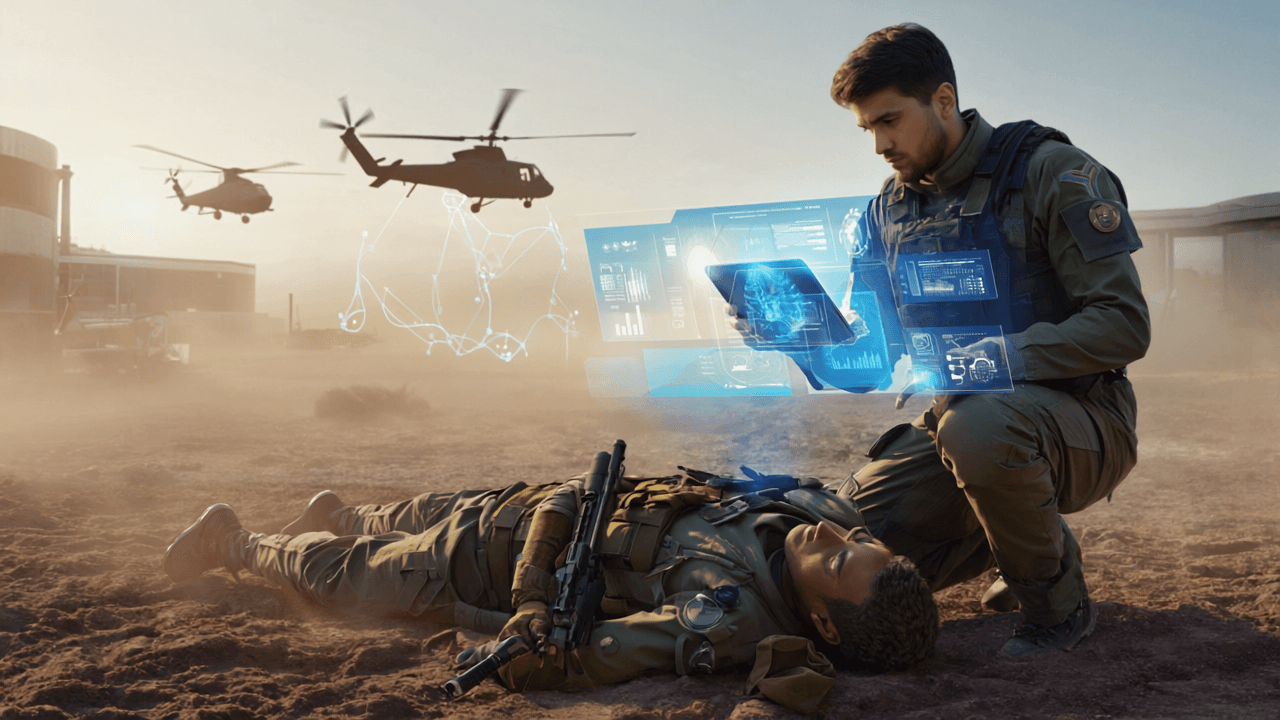
So the pipes exist, the sensors are coming, and the data is de-identified by design. Now follow one wounded soldier through what happens next. A machine finds him, reads his vitals, sets his triage category, and hands it to the medic who reaches him first because of it. From the point of injury he moves to a Role 1 aid station, then to a Role 2 forward surgical team, then to a Role 3 hospital, then onto an aircraft home. Trauma medicine calls the window that decides whether he lives the golden hour, and the drone's read is the only record of what his body was doing inside it. At every one of those handoffs, the picture the machine built of him in his worst minutes could travel with him. At every one of them, it stops.
It never reaches his medical record.
That is the gap, and it is the same one the health enterprise has failed to close for twenty years, the one we file under interoperability and then study again. The military and the VA have spent two decades and a stopgap viewer built to let one department read the other's records trying to make a single service member's history follow him from active duty into retirement, and it still does not travel cleanly. This is that same failure one echelon earlier, at the point of injury, before the record even exists. We can track a missile across three time zones in real time. We cannot tell a separating service member what happens to her medical data when she closes her laptop. Now the Department is funding a generation of machines that will produce more casualty data than any war before it, built inside autonomy programs and research portfolios that were never chartered to hand it to a clinical record. The reason DARPA is racing to automate triage is the large-scale fight the Pentagon now plans for out loud, where the wounded outnumber the medics and the same data that saves one soldier trains the system to save the next thousand. That is the moment a lost record costs the most, and it is the moment the current design loses it.
Consider what that record is worth if it survives the trip. A casualty file that carried the drone's read forward would tell the next surgeon what the injury looked like in the first minute, feed the trend analysis that tells a command which wounds are killing its people, and train the next generation of triage models on real outcomes instead of proxies. The value compounds at exactly the scale the Pentagon is planning for. A record that starts over at the aid station throws all of it away.
The people building these machines want the record as much as anyone. TATRC launched a portfolio in 2023 called Autonomous Casualty Care whose stated goal is to improve documentation inside the Military Health System, down to a tool it calls AutoDoc that captures the casualty record automatically at the point of injury, running today under an approved human-subjects protocol. TATRC wrote that work to push casualty data up to higher echelons of care, to logistics and resupply, and to command situational awareness, and eventually to feed clinical decision support. The field end of this is being built by exactly the people you would want building it.
There is a longer consequence here for anyone who builds federal health technology. The center of gravity for the hardest casualty-care work is moving from an agency organized around care to one organized around autonomy, and the expertise is following the problem. The people who understand how medical data has to move are increasingly sitting in program offices measured on one thing, whether the machine finds the casualty. Whether his record ever catches up to him belongs to a different scorecard, in a different building. That is how a capability gets built with a gap in the middle of it, a gap that falls outside the scorecard of every program touching it. The mandate to make a service member's record whole across DoD and VA already exists too, in the federal electronic health record modernization office. What has not happened is anyone connecting the two. The office that owns the record has not been tasked with the data the field now generates, and the programs generating it have no authority to send it there.
What it would take
The gap is closable, and every piece it needs already exists somewhere in the enterprise. It needs an office chartered to receive the data, and the federal EHR modernization office already carries the mandate to make the record whole across systems. It needs a way to re-link what was ethically unlinked, and the token-matching pattern already used to link a veteran's records across VA, CMS, and DoD does exactly that, stripping identity for research and resolving it back to the person under authority when the record needs it. It needs a data standard so a triage category and a set of vitals captured by a drone map to the fields a clinician reads six hours later at Role 3, which is ordinary FHIR-mapping work the health IT world does every day. It needs the authority to move battlefield-collected data into a record at all, which is a consent and policy question someone has to answer instead of route around, and it is the question that has stalled every version of this fight before. None of the four is exotic. What is missing is the decision to build them as one thing, owned by one office, funded on purpose.
The soldier the record forgets
Somewhere in the next large-scale fight, a soldier is going to be lying in the dirt while a drone thirty feet up reads the failing signs in his body and tells a medic he is the one to run to first. The medic reaches him because the machine found him. A tourniquet goes on, a line goes in, and he moves to Role 1, then Role 2, then Role 3, then home. Everything the machine saw in the worst four minutes of his life, the falling pressure and the rising rate that named his injury before anyone laid hands on him, sits in a de-identified research file that cannot be traced back to him by design. His own record starts over at the aid station as if the drone had never seen him.
The machines are going to find the wounded. The office that could carry what they learn already exists, and it owns record modernization across DoD and VA. It has not been told the battlefield now writes a record of its own.
Let's roll.
— Mary
Mission Meets Tech
The views expressed in this newsletter are my own and do not represent the official position of any organization. This content is for informational purposes only.
MMT Premium
Today's free issue covers the analytical frame. Premium subscribers get the capture map underneath it: where the casualty-care money actually moved, which doors are already closed, the incumbent teams to reach, and the action windows still open before the fiscal year ends.
Founding Member rate: $199/year, locked permanently for the first 100 subscribers. Standard rate: $249/year or $29/month.
Premium adds 48-hour early access, monthly Capture Intelligence Sheets with sourced action windows, direct Q&A access, and tool discounts: ProposalPulse $14.99 per assessment, MarketPulse $35 per brief.
Subscribe at missionmeetstech.com/pricing.
Sources. FY2027 combat and operational medicine RDT&E ($2.4727B to $1.0194B), the Medical Development line (PE 0603115DHA, $1,755,684K to $360,845K), the Medical Information Exchange and interoperability line ($8,337K to $8,504K), and the Joint Operational Medicine Information System line ($28,707K to $29,353K) from the Department of War FY2027 RDT&E Programs (R-1), Exhibit R-1, Office of the Under Secretary of Defense (Comptroller). Account split into the Combat and Operational Medicine Program and Private Sector Care Program from the Military Health System FY2027 Budget Estimates (PB27 J-Book, COMP/PSCP Volume 1). Total FY2027 RDT&E near $344 billion (up from about $213 billion) from the R-1; the reported ~$55 billion autonomy figure from DefenseScoop and The Guardian, April 2026. DARPA Triage Challenge structure (primary and secondary triage; Systems and Data competitions; RITMO de-identified physiological dataset), Event 1 at Guardian Centers, Perry, Georgia, September 2024, Event 2 September 26 to October 3, 2025 with DART and MSAI as top performers and the first live human-machine teaming event, and the 2026 final from DARPA program pages and DARPA news, 2024–2025. TATRC lineage (MDIS 1991, MATMO 1993, DoD Telemedicine Test Bed 1994, renamed 1998, command under USAMRDC 2021), four core research areas, mission statement, role as verification and validation partner on the Triage Challenge, and the Autonomous Casualty Care portfolio and AutoDoc documentation work under an approved human-subjects protocol from tatrc.org and the National Library of Medicine. Menace-I with AWS Outposts (preferred edge provider designation June 30, 2026; two-person ten-minute setup; unclassified through SCI; DoD cloud marketplace; up to 168 servers across four Outpost racks; 50,000-plus field hours across all four services) from Anduril, DefenseScoop, and Defense One, June 30 to July 1, 2026.