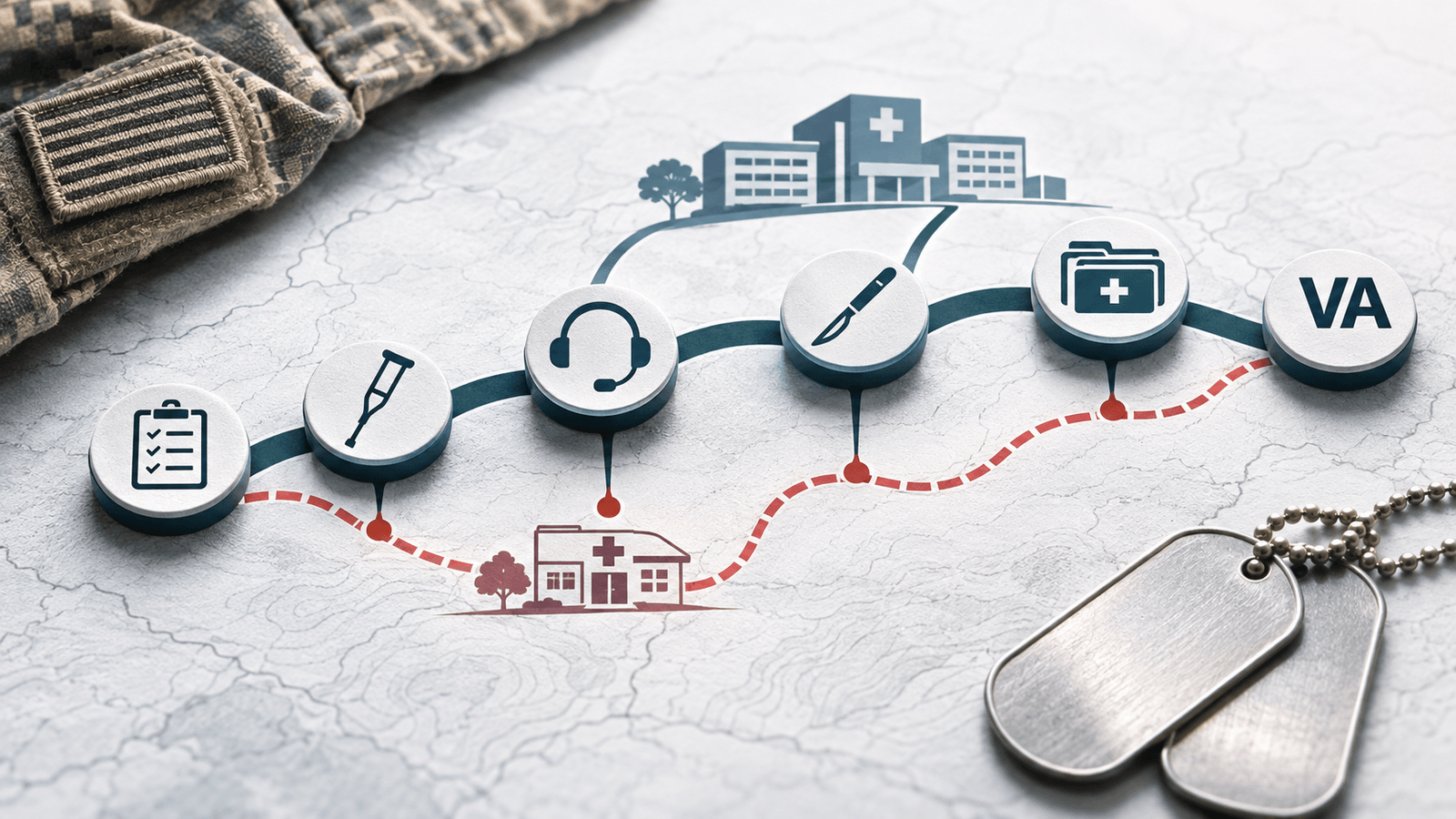
Where the Lost Days Go
A Guard sergeant hurt his knee at annual training in July. Over the past year that knee has moved through six stops in the Military Health System: the readiness exam, the duty profile, the appointment line, the surgeon, the record, and, when he separates, VA. An active-duty soldier with the same knee goes through the same six, on a shorter path through the hospital on post. DHA buys or runs each one separately and times it on its own clock. Its FY27 campaign plan now grades the whole trip by one number, lost warrior days. This issue walks both soldiers through all six and finds where the days leak out: at the handoffs, which the government already has the tools to fix.
Friends,
On Tuesday I followed a Guard staff sergeant through a request for a copy of his own health record. He is a figure I built from the regulations and GAO's reports. He tore his knee in July, under a section of bridge decking, in the second week of annual training. The Army hospital on post saw him that afternoon, X-rayed the knee, braced it, and referred him to orthopedics. Two days later he was home. Ninety miles from the post, he waited on a line-of-duty determination and on his file. [1]
The records desk was one stop. The knee did not start there and it will not end there. This issue walks the rest of the way.
It started last September, at the readiness exam that cleared him to train. It runs through the profile that took him off the deployable roster, the call that booked him with a surgeon, the surgeon's clinic in the TRICARE network, the record that had to follow him from each place to the next, and the day he hands that record to the Department of Veterans Affairs. An active-duty soldier with the same knee goes through the same six on a shorter path, inside the hospital on post. The Guard sergeant goes the long way: a civilian exam network, a private surgeon, a DEERS code.
The Defense Health Agency buys or runs each of them separately. Each has its own system and its own standard. Both soldiers live them as one trip, and so do their commanders, who want one date: when they get their squad leaders back.
My read, and the argument of this issue, is that the cheapest readiness gains left in DHA's plan sit at the handoffs between them. DHA already owns most of what it would take to fix those handoffs.
DHA's campaign plan for this fiscal year already grades the trip the commander's way. The North Star for its first line of effort is to reduce "90% of lost warrior days outside standard physiologic healing timelines" by 2028, with active-duty access targets of 1, 7, and 15 days underneath it. [2] Matt Clark, sworn in on September 21 as DHA's acquisition executive, told his workforce it would be "judged on mission outcomes and speed," and that if work is "not supporting readiness or resilience, then it doesn't belong with us." [3] That is a whole-trip yardstick laid over a piece-by-piece buy. The pieces can stay separate. The handoffs need an owner, a clock, and a measure.
The exam and the profile
Every service member takes a periodic health assessment every twelve months. [4] An active-duty soldier takes his at the clinic on post. The sergeant took his last September at a Guard readiness event, where a civilian provider under the Remote Health Readiness Program worked through his labs, immunizations, and questionnaire. [5]
Either way, the exam counted as complete the moment someone recorded the date in MEDPROS, the Army's readiness tracking system. Each service keeps its own. [6][7] His status went green. He was one of the 91.1 percent of the total force the Military Health System reported medically ready at the end of fiscal 2025, against a goal of 90. [8]
That number counts whether the exam was done on time. It says nothing about how many days a soldier on profile sits past his expected healing time, which is what the campaign plan now counts. The plan calls "seamless data exchange with service readiness systems" unfinished work. DHA's answer is PARATUS, a readiness platform it is buying through a commercial solutions opening posted in July. PARATUS is meant to replace "six Service-specific legacy systems with a unified, governed data platform" in three phases: the exam, then profiles and individual medical readiness, then waivers. [2][9] DHA describes it as a single system that gives commanders one view of medical risk to readiness. [10] The first phase covers the exam. The second and third are still ahead.
In July the knee put the sergeant on a profile. Each service writes profiles in its own system, and every profile carries a duration. [11] The active-duty soldier's profile and his care run inside one hospital. The sergeant's run ninety miles apart.
Under the campaign plan's MEND effort, DHA will load standard durations for a first set of 196 musculoskeletal conditions into the services' readiness systems by January 31, 2027. The ACL pathway is among the first three. [2][11] In The Waiting Days I found what that pathway looks like now. A reservist's ACL profile ran ten months: about four from the injury to the operating room, some of it the knee settling before reconstruction and some of it the system, and about six healing. [11] The profile clock ran through all of it without a mark between the two. The readiness system records the profile, the referral system records the appointment, and the lost-warrior-day count will inherit whichever clock it is wired to.
The first call
His referral went into the appointing system the same week. For an active-duty soldier, the first call goes to a door. In Count the Doors I found at least six of them at one base, inside what DHA itself describes as care "fragmented across over 110 separate contracts and call centers." [12] For the sergeant, the Guard could not authorize the surgery until his commander's line-of-duty determination cleared. His first stretch of waiting ran on paperwork before it ran on a schedule. [1][13]
DHA has set the standard it wants at the door: 1, 7, and 15 days. [2] It is also buying the door. A request for information on an enterprise referral and care coordination center, posted October 30, asks industry to comment on a draft work statement for "appointing, referral management, and care coordination across all DHA Military Treatment Facilities." It names "first-call resolution" as a goal and takes responses through November 13. [14]
I looked in the public PARATUS and appointing documents for a requirement that the appointing system know a caller's readiness status, or that the readiness system know the caller's place in the queue. I did not find one. Internal links may exist. In the documents, the door and the roster do not know each other.
The surgeon in the network
The active-duty soldier is seen first inside the hospital. GAO's review of fiscal 2022 referrals found first specialty visits there averaging about 16 days against DHA's 15-day goal. When the hospital is full, he goes to the TRICARE network. The sergeant's surgery happened in the network from the start, at a civilian orthopedic practice an hour from his house. Network first specialty visits averaged about 30 days from referral approval against a 28-day standard, and DHA had "not established a separate time frame" for urgent network referrals at all. [15] The department concurred. The data is four years old, so I treat it as a baseline.
The missing clock here has a name next door. VA sends veterans to the same kind of civilian practice through its community care program. When I followed one of those referrals in The Day a Doctor Said Yes, usable provider-acceptance dates existed on 3 percent of the sampled referrals, 673 of 20,463. [16] The date a surgeon's office agrees to see the patient is the handoff. Without it, the 28-day standard measures a span whose start and end are known while the middle is a guess. Whatever waiting happened there gets booked to the sergeant's profile as healing.
The file he carries out
All of it becomes a file. The exam result, the profile, the line-of-duty finding, the referral, the operative note, and the therapist's discharge summary either land in the service treatment record or they do not. When a soldier separates, VA rates him on that record. [1] For the active-duty soldier the file is written mostly inside one system. For the sergeant it is assembled from three places: the hospital, the surgeon's office, and the line-of-duty packet. The record carries every other step of the trip.
The standard is older than his enlistment. Policy gives VA a certified service treatment record within 45 business days of separation, a window built so late documents such as a civilian surgeon's notes can catch up. DoD Instruction 6040.45 requires the services to certify each record complete and to review it with the member every year. [17] The Navy counts its 45 days on the calendar. In May it reminded commands how its process works: assemble the paper record, including civilian care documents and a signed DD Form 2963 certification, and mail it to a scanning contractor. Printed GENESIS pages are excluded unless they carry a provider's pen-and-ink notes. [18]
The Navy can show a carrier group's position on a screen in the Pentagon as it moves. It mails a sailor's medical record to a scanning contractor.
HAIMS, the repository that holds more than 100 million artifacts and images, sends the record to VA through an interface "on request." [19] The baseline that policy was built to fix was audited in 2014. Of 96,224 Army records sent to VA in 2013, 77 percent were late and 28 percent were incomplete. The inspector general traced the failure to the absence of "clear or comprehensive guidance" on the transfer, including the certification step. [20] A rater rates what reached the building, and a missing operative note is an unrepaired knee on paper.
Thirteen years and one enterprise EHR later, the record still travels as a certified package. The executive order signed September 8 put three clocks on it: records to VA "immediately" at discharge, effective within 30 days, which fell on October 8; a review of both departments' IT contracts to add interoperability requirements within 120 days, about January 6; and systems for lifetime records sharing within 180 days, about March 7. [21]
DHA already has two pilots running against those clocks. Its notices call the effort a Service Treatment Record Zero Day capability. Industry, describing what appears to be the same effort, has started calling it MySTR, for My Service Treatment Record. [22] One pilot extends the record system DHA already has. The other builds a separate data layer and puts the member in the loop.
The first is a "control" pilot, awarded on a limited-source basis for "pre-implementation, user adoption, change management and cutover preparation" inside the existing EHR environment. [23] The second is an "experimental" pilot, a sole-source prototype meant to stand up a working data ecosystem "within 90 days" from GENESIS, the Military Health System Information Platform, and legacy sources. [24] The builder's public account describes a portal where the member can "review, correct, and certify" the assembled record, software agents that flag "what is missing," and a run at the scale of one million records. [25] Those results are the builder's own. I have not seen them tested by anyone else.
A control and an experiment run on the same problem is how an agency learns which design to buy, and DHA should get credit for setting it up that way. The member-certification portal is an old requirement with a new tool. The annual review with the member already sits in 6040.45, and the 2014 audit found certification was exactly where the process broke. [17][20] What public documents do not show is a selection criterion, a production decision, or a date for one. The order's March milestone arrives while the control pilot's listed period runs into the fall of 2027, so the government will be deciding on a schedule it did not set. [21][23]
The day he separates
If the knee does not come back, either soldier's trip ends at a medical board, and the file becomes the file VA rates him on. Reserve cases have historically run longer through that board, and policy allows the slack. The readiness instruction permits a 25 percent partially-ready share for the reserve component against 15 for active duty, and the 2016 record-transfer targets asked for 75 percent of reserve records on time against 95. [26][6][17] If the knee heals, he finishes his time and walks out with the same file, later.
Either way, the last step opens with an exam that has two names: the Department of War's Separation History and Physical Examination and VA's Disability Exam. [27] VA implemented the joint version in April 2023. As of May 2025 the Department of War had not, though VA's fiscal 2026 budget describes its approach as aligned with "the new DoD One Separation Health Assessment," so the department's current status is an open check. [28][29] In its first year the joint exam produced at least one positive mental health screen in 67 percent of about 50,500 members. Referrals to inTransition were accepted 48 percent of the time. [28]
inTransition is DHA's contractor-run bridge for members in mental health care. It "did not successfully connect with over 70 percent of the eligible service members it identified in 2022," in part because it relied on phone calls. [30] On the VA side, Solid Start reaches newly separated veterans at about 90, 180, and 365 days. It connected with 186,995 people in 2025, a 75.6 percent rate. [31] The two programs serve different populations in different years, so the contrast is in method: VA's outreach reaches about three in four, and DHA's missed more than seven in ten.
Warm handovers for at-risk members have the same gap. The department gave about 41,000 between April 2021 and March 2023. More than 4,300 members considered at risk did not get one, and the department did not confirm the connections happened. Its fix is due by September 2027. [32] If the sergeant's exit screen comes back positive, that is the handoff waiting for him.
One case for the whole trip
Two gaps on the reserve side closed this year, and each one was a rule. On August 10 the Under Secretary of War for Personnel and Readiness dropped the requirement that reservists prove their active service was "substantially linked" to a contingency before qualifying for 180 days of transitional coverage. He directed Reserve Affairs to adjust DEERS to match, which is the update to the problem I followed in The Keystone. [33][34] On February 1 the Air Force let approving authorities issue an in-the-line-of-duty finding for health care access without first deciding when a condition began, for reservists on longer orders with enough active federal service behind them. [35] The transitional coverage fix was a data field. The Air Force fix removed one step from a determination. Neither needed a contract.
The handoffs that remain all have the same problem. Each part of the trip keeps its own clock, and none of them can see the others. What would let them share one is a layer above the systems of record: one case per member, keyed to the DoD ID number already in DEERS, that takes an event from each part as it happens. Exam complete, profile written, referral placed and accepted, visit held, line-of-duty finding issued, record certified, record delivered to VA, VA contact confirmed. Each event is stamped against its own standard, so a lost day lands where it was lost.
The EHR, HAIMS, the readiness systems, and DEERS stay the systems of record. The case holds events and pointers and shows what is missing at every handoff. The appointing agent sees the readiness flag, the reserve medical manager sees the line-of-duty status, and VA sees the case on the day he separates.
The government has already licensed that layer, more than once. The Army awarded an Army-wide enterprise license for an enterprise engagement and case-management platform in July 2025. The follow-on contract that came in January carries a "hire to retire" scope that runs through "transitions for veterans." [36][37] The Air Force joined the same vehicle in May. [38] DHA described a care-coordination system on the same platform in a 2024 privacy assessment, keyed to DoD ID numbers. I could not confirm its current use. [39] VA calls the platform its "trusted platform as a service foundation." Its July request for information plans to consolidate its contact-center systems onto it, Solid Start among them. [40][41]
What public documents do not describe is a shared case between the two departments on the platform they both hold. Building one is a governance and configuration decision on licenses already signed. The executive order's January 6 contract review is the moment to make it. [21]
What is fair to say
Separate contracts have defenders, and parts of their case are right. Separate competitions protect small business participation, limit lock-in, and keep organizational conflicts manageable. DHA's own strategy for the work that follows its EHR contract splits it into lanes with no prime integrator, on purpose. [42] The argument here is for owning the handoffs. Merging the contracts is a different and worse idea. The connective layer is already being built, in PARATUS, the appointing center, the joint health information exchange, and a shared EHR, and the open question is whether those pieces share a clock and an identifier.
One platform means one vendor. Enterprise licenses concentrate spend with one company, and concentration raises cost and bargaining-power worries. Three guardrails answer it. The government owns the case model, the event definitions, the interface standards, and the measures. Every contract carries a clause requiring it to write to the shared case, so different contractors keep building different pieces. And the data contract has to pass a swap-out test: it survives a change of platform.
Capacity is the binding constraint. DHA projects a shortfall of more than 8,000 clinical military medical personnel, and no data standard will fill it. [12] A handoff clock adds no clinicians, which I concede plainly. It shows where the hours go, which is the first thing a short staff needs to know.
Five fixes, each with an owner
Every fix below uses something the government already owns and comes with a measure. All but one have a date already on the calendar. The owners are my proposals.
One exam standard. Publish a single PHA data standard that every exam source must write to, and make it a condition of PARATUS's first phase and of every exam-delivering contract. The program executive office for Defense Healthcare Management Systems and DHA Medical Affairs would own it. The measure is days from exam to result posted without re-keying. The date is the executive order's contract review, about January 6. [2][9][21]
An urgent network standard and an acceptance date. Set the urgent referral time frame GAO recommended, and make the provider acceptance date a required field, which is the lesson VA's 3 percent taught. The TRICARE Health Plan owns it. The measure is days from referral to acceptance to visit, by region. The vehicles are the next managed care contract modification and the provider directory language in the Senate committee's defense bill, which has not reached the floor. [15][16][43]
A decision rule for the record. Publish the evaluation criteria for the two Zero Day pilots and a production decision date tied to the order's March milestone. Score both designs on the same measures. Require from whichever wins a "what is missing" report for the member to review, as 6040.45 already intends. Make the line-of-duty determination and the remote exam result required artifacts, captured when created, so a reserve record is complete on the day he separates. [17][13] PEO DHMS and the records policy owner in Medical Affairs would own it. The measures are days from separation to a complete record in VA's hands and the share certified complete on the first pass. [21][23][24]
One case model. Publish a joint, government-owned case model and event standard for the member's trip, and require every contract to write to it through the enterprise licenses the two departments already hold. [36][41] Two of the fixes in this issue become events on that case. The readiness flag the appointing agent needs is one, and the appointing center's draft work statement, open for comment through November 13, is the first contract that could carry it. [14] The confirmed warm handover is the other: count a handover only when the receiving agency confirms contact, on Solid Start's 90, 180, and 365-day cadence. [31][32] DHA, the Army's Program Executive Office Enterprise, and VA's Office of Information and Technology would own the case through the two departments' Joint Executive Committee, whose strategic plan runs out in fiscal 2027. The measure is the share of separating members whose case VA can open on the day of separation. The date is the January 6 contract review, with the MEND report due January 31 as its first test. [44][21][2]
One number across all of it. Publish lost warrior days by step in the trip, with each waiting day charged to the place it happened, so every piece becomes accountable without being merged. That belongs to the DHA Director and the lead for the first line of effort, quarterly. The first chance to show it falls about 90 days after Clark's September swearing-in, near the end of December. [2][3]
The whole trip
The good version already exists in pieces. The exam posts to the readiness record the day it is done, whether it was taken on post or at a Guard armory. The profile carries an identifier that follows the referral, so when the surgeon's office accepts the soldier the clock marks it, and a ten-month ACL profile divides into the time the knee needed and the time the system took. The agent who takes his call sees the profile and books him to the fifteen-day standard.
The operative note comes back into his record the week it is written, next to the line-of-duty finding if he is a reservist. When he separates, VA opens the case the same day and finds a one-page list of what is still missing, which he has already read and signed. A caseworker calls him at 90 days, and someone writes down that he answered.
Every one of those steps is a standard, a field, a flag, or a date. Each serves the soldier on post and the sergeant ninety miles out, and each can be written into contracts and systems DHA is buying this winter anyway.
The sergeant is a figure I built from the regulations, the manuals, and GAO's reports, and I introduced him on Tuesday. Every stop on his trip comes from a real rule or a real report. The Waiting Days, The Keystone, Count the Doors, The Day a Doctor Said Yes, and The Desk After the Clinic were each one part of it, and this issue closes the series because the parts were never separate. DHA set out this year to be judged on the whole trip. His commander will judge it the same way, by the date he gets his squad leader back.
Let's roll.
— Mary
Mission Meets Tech
The views expressed in this newsletter are my own and do not represent the official position of any organization. This content is for informational purposes only.
MMT Premium
This issue walks one service member's trip across six lanes. Premium's Capture Corner and monthly Capture Intelligence Sheets track the decision window underneath it: the readiness platform's next phases, the appointing center's market research, the two record pilots, the executive order's contract review, and the bill text, with sourced action windows.
Founding Member rate: $199/year, locked permanently for the first 100 subscribers.
Standard rate: $249/year or $29/month.
Premium adds 48-hour early access to deep-dive analysis, monthly Capture Intelligence Sheets with sourced action windows, direct Q&A access (reply to any premium issue), and tool discounts: ProposalPulse $14.99 per assessment, MarketPulse $35 per brief.
Subscribe at missionmeetstech.com/pricing.
Sources
[1] Mission Meets Tech, "The Desk After the Clinic," November 3, 2026. Source for: the Guard staff sergeant's July knee injury at annual training, the hospital visit and orthopedic referral, the line-of-duty determination his commander owed before care could be authorized, the DD Form 2870 request, and the six systems a records processor may open to fill it. https://missionmeetstech.com/newsletter/the-desk-after-the-clinic/
[2] Defense Health Agency, FY27 campaign plan, including "Delivering Warfighter Readiness, Fiscal Year 2027," October 2026. Source for: the LOE 1 North Star of reducing "90% of lost warrior days outside standard physiologic healing timelines" and its 2028 date; the supporting effort to modernize periodic health assessments and implement "seamless data exchange with service readiness systems"; active-duty access targets of 1, 7, and 15 days for acute, routine, and first specialty care; care continuity after a PCS move; PARATUS as the single tracking platform for LOE 1; and the MEND tranche of 196 musculoskeletal conditions, with the ACL pathway among the first three, due in service readiness systems with monthly lost-warrior-day reporting by January 31, 2027.
[3] DVIDS, Defense Health Agency, "Strengthening Acquisition, Research Efforts Will Support Warfighter Readiness and Military Healthcare Services," 2026. Source for: Matt Clark's September 21, 2026 swearing-in as DHA Assistant Director for Research, Development, and Acquisition and Component Acquisition Executive, and the quotations "judged on mission outcomes and speed" and "not supporting readiness or resilience, then it doesn't belong with us." The 90-day point is the author's calculation from the swearing-in date; DHA has published no such date. https://www.dvidshub.net/news/578525/strengthening-acquisition-research-efforts-will-support-warfighter-readiness-and-military-healthcare-services
[4] Department of Defense Instruction 6200.06, "Periodic Health Assessment (PHA) Program." Source for: the requirement that service members complete a PHA every 12 months. https://www.esd.whs.mil/Portals/54/Documents/DD/issuances/dodi/620006p.pdf
[5] Health.mil, "Remote Health Readiness Program: General," frequently asked questions, and "Remote Health Readiness Program: Army Reserve." Source for: the program's coverage of Reserve Component members and TRICARE Prime Remote members through a civilian network, the services it delivers (PHAs, post-deployment reassessments, mental health assessments, immunizations, labs, dental), and funding by the service components. https://health.mil/Reference-Center/Frequently-Asked-Questions/Remote-Health-Readiness-Program-General and https://health.mil/Military-Health-Topics/Health-Readiness/Remote-Health-Readiness-Program/Army-Reserve
[6] Department of Defense Instruction 6025.19, "Individual Medical Readiness (IMR) Program." Source for: a PHA counting as complete when the completion date is recorded in the Service-specific IMR electronic tracking system; the total force medical readiness goal of at least 90 percent; and the partially medically ready ceilings of 15 percent for the Active Component and 25 percent for the Reserve Component. https://www.esd.whs.mil/portals/54/documents/dd/issuances/dodi/602519p.pdf
[7] Health.mil, "Immunization Tracking Systems." Source for: MEDPROS (Army), MRRS (Navy and Marine Corps), and ASIMS (Air Force) as the service readiness tracking systems. https://www.health.mil/Military-Health-Topics/Health-Readiness/Immunization-Healthcare/Immunization-Tracking-Systems
[8] Department of War, Office of the Under Secretary of War (Comptroller), "Military Health System, Fiscal Year 2027 Budget Estimates, Volume 1," April 2026, p. 9, and Mission Meets Tech, "The Recapture Year," October 2, 2026. Source for: total force medical readiness of 91.1 percent in Q4 FY2025 against the 90 percent goal, and the budget materials' description of T-5 transition problems as "largely resolved" by year end. https://comptroller.war.gov/Portals/45/Documents/defbudget/FY2027/budget_justification/pdfs/09_Military_Health_System/MHS_PB27_J-Book-Vol1-COMP_PSCP.pdf and https://missionmeetstech.com/newsletter/the-recapture-year/
[9] SAM.gov, Defense Health Agency, "Profiling Action and Readiness Tracking Unified System (PARATUS)," commercial solutions opening HT003826SC004, posted July 20, 2026. Source for: the goal of replacing "six Service-specific legacy systems with a unified, governed data platform"; the three areas of interest (PHA modernization, profiling and IMR, waivers); IL5 hosting with IL6 cross-domain requirements and capabilities for agentic AI, machine-learning risk scoring, and dashboards; and AOIs 2 and 3 described as anticipated, with no posted dates. https://sam.gov/opp/f0dd2693099743dda5b724f74d21c1bb/view
[10] Defense Health Agency, "DHA Operational Framework: Deliver Warfighter Medical Readiness." Source for: PARATUS described as "a single system that provides commanders with a holistic view of medical risks to readiness," and the Joint Profiling Standard. https://www.dha.mil/About-DHA/DHA-Operational-Framework/Deliver-Warfighter-Medical-Readiness
[11] Mission Meets Tech, "The Waiting Days," October 13, 2026. Source for: the service profiling systems (e-Profile, LIMDU SMART, AF Form 469); the MEND tranche of 196 musculoskeletal conditions with the ACL pathway among the first three, due in service readiness systems by January 31, 2027, with the first monthly lost-warrior-days report due the same day; a reservist's ACL profile of about ten months, about four from injury to the operating room (part clinical settling, part system waiting) and about six healing; and the Navy condition-based limited-duty guide that cut average musculoskeletal limited duty from 141.97 to 101.39 days between FY2021 and FY2022. https://missionmeetstech.com/newsletter/the-waiting-days/
[12] Mission Meets Tech, "Count the Doors," October 23, 2026. Source for: at least six appointing doors at one base; DHA's June 2026 description of appointing as "fragmented across over 110 separate contracts and call centers"; the Nurse Advice Line's booking authority for care needed within 24 hours; the enterprise referral and care coordination center award expected in Q1 FY2028; and DHA's projected shortfall of "more than 8,000 clinical military medical personnel." https://missionmeetstech.com/newsletter/count-the-doors/
[13] U.S. Army Human Resources Command, "Commander's Line of Duty Smart Card," current as of October 19, 2026, and U.S. Army Reserve Medical Management Center, frequently asked questions. Source for: the requirement that a line-of-duty investigation begin within five calendar days; the requirement for an LOD whenever a Reserve Component soldier's injury or illness needs follow-on care; and LODs as prerequisites for both care and medical evaluation board packets. https://www.hrc.army.mil/wcmt-api/sites/default/wcmtfiles/files/25752_0.pdf and https://www.usar.army.mil/Resources/Health-Wellness/Medical-Management-Center/FAQs/
[14] Cleat.ai, summary of DHA request for information RC3_20261030, "Enterprise Referral and Care Coordination Center (RC3)," posted October 30, 2026. Source for: the draft performance work statement covering "appointing, referral management, and care coordination across all DHA Military Treatment Facilities," the "first-call resolution" goal, the five-year structure, and the November 13, 2026 response date. Aggregator summary; confirm against the SAM.gov notice and any amendment before publication. https://www.cleat.ai/government/contracts/dha-enterprise-referral-care-coordination-center-contract-rc3-vptx
[15] U.S. Government Accountability Office, "Defense Health Care: DOD Should Improve Oversight of Referral Wait Times," GAO-24-106267, 2024. Source for: FY2022 averages of about 16 days for first specialty visits at military hospitals against the 15-day goal, about 30 days for network first specialty visits against the 28-day standard, about 17 days (East) and 23 days (West) for urgent network referrals, DHA having "not established a separate time frame" for urgent network referrals, and DOD's concurrence with the recommendations. https://www.gao.gov/assets/d24106267.pdf
[16] Mission Meets Tech, "The Day a Doctor Said Yes," October 27, 2026. Source for: usable provider-acceptance dates on 673 of 20,463 sampled VA community care referrals, about 3 percent. https://missionmeetstech.com/newsletter/the-day-a-doctor-said-yes/
[17] Health.mil, Defense Health Agency, "Transfer of Service Treatment Records to VA," report, March 31, 2016. Source for: the 45-business-day transfer standard; DoD Instruction 6040.45 (November 16, 2015) requirements that the services certify STRs complete and hold annual completeness reviews with members; and the targets of 95 percent of Active Component and 75 percent of Reserve Component STRs uploaded to HAIMS within 45 days. Whether 6040.45 has been reissued since 2015 is an open check. https://www.health.mil/Reference-Center/Reports/2016/03/31/Transfer-of-Service-Treatment-Records-to-VA
[18] Department of the Navy, NAVADMIN 116/26, May 15, 2026, and Navy Medicine, "Transfer Your Medical and Dental Records." Source for: the Navy's 45-calendar-day count; the paper STR assembled with civilian documentation and a DD Form 2963 certification and mailed to a Navy Medicine Records Activity scanning contractor; the exclusion of printed GENESIS and AHLTA pages unless annotated by hand; and the rule that an incomplete STR is not certified complete. https://www.mynavyhr.navy.mil/Portals/55/Messages/NAVADMIN/NAV2026/NAV26116.pdf and https://www.med.navy.mil/About-Us/Transfer-Your-Medical-and-Dental-Records/
[19] Health.mil, "Health Artifact and Image Management Solution (HAIMS)," fact sheet, March 13, 2025. Source for: more than 100 million artifacts and images, more than 8,000 active users a month across 600-plus locations, and transfer of STRs to VA through an interface on request. https://health.mil/Reference-Center/Fact-Sheets/2025/03/13/HAIMS-Fact-Sheet
[20] Department of Defense Inspector General, "Army Needs to Improve Service Treatment Record Transfer Process," DODIG-2014-097, July 31, 2014. Source for: 74,470 of 96,224 Army STRs sent to VA in 2013 (77 percent) not timely and 26,901 (28 percent) not complete, and the finding of a lack of "clear or comprehensive guidance" on the transfer process including the completeness certification. 2013 data; used as the baseline the current policy was built to fix. https://media.defense.gov/2014/Jul/31/2001713386/-1/-1/1/DODIG-2014-097.pdf
[21] Executive Order 14426, "Accelerating Access to Veterans' Benefits and Employment Opportunities," signed September 8, 2026, 91 Fed. Reg. 58003, September 11, 2026. Source for: Section 2(a)(iii), records to VA "immediately" at discharge, effective within 30 days (about October 8); Section 2(b), review and modification of existing IT contracts to add interoperability requirements within 120 days (about January 6, 2027); and Section 2(a)(i), systems and policy for lifetime records sharing within 180 days (about March 7, 2027). Dates are calculated from the signing date. https://www.govinfo.gov/content/pkg/FR-2026-09-11/pdf/2026-18738.pdf
[22] Third-quarter 2026 earnings call and release of a publicly traded federal health IT contractor, November 3, 2026. Source for: the industry name "MySTR" (My Service Treatment Record); the call does not itself tie the name to DHA's STR Zero Day notices, and the linkage is MMT's; the statement that it "is now in beta test" with work toward contract award and rollout; and that the effort began "well before the President's September 8th executive order." Company statement; the company is not named here. https://finance.yahoo.com/quote/LDOS/earnings/LDOS-Q3-2026-earnings_call-723688.html
[23] SAM.gov, Defense Health Agency, justification and approval for task order HT003826FE006, Service Treatment Record (STR) Zero Day "control" pilot, 2026. Source for: the limited-source award; the scope of "pre-implementation, user adoption, change management and cutover preparation activities in support of a 'control' pilot for a Service Treatment Record (STR) Zero Day capability"; and the tie to the existing EHR environment. The period of performance running to October 2027 comes from a contract aggregator and was not confirmed in SAM.gov or FPDS for this issue. The awardee is not named here. https://sam.gov/workspace/contract/opp/5ef6cb9793044c2bbce04f87becfcd02/view
[24] SAM.gov, Defense Health Agency, notice of intent to sole source, "DHMS/MHS GENESIS/MIP Data Acceleration Prototype," 2026. Source for: a working data-ecosystem prototype "within 90 days" built from MIP, GENESIS, and legacy DHMS sources; an estimated 180-day period of performance; its description as support for "an experimental pilot for a Service Treatment Record (STR) Zero Day capability"; and the goal of determining "the viability of this modality for future use cases." The awardee and dollar value are not named here; the value was not verified. https://sam.gov/workspace/contract/opp/80f8ea46faa24a7abbeca8417aab6276/view
[25] Public case note by the builder of the experimental STR pilot, "Assembling Health Records for Review," 2026. Source for: the design description of governed data products with lineage, software agents that answer questions across documents "including questions about what is missing," a member portal to "review, correct, and certify" the record, and a run at the scale of one million records. Vendor self-report; results have not been independently tested. MMT does not name vendors on either pilot. https://strataedge.ai/insights/assembling-health-records-for-review
[26] U.S. Government Accountability Office, "Military Disability System: Preliminary Observations on Efforts to Improve Performance," GAO-12-718T, 2012. Source for: FY2011 Integrated Disability Evaluation System averages of 394 days for active-duty cases and 420 for reserve cases. Historical; used only to show that reserve cases have run longer. https://www.gao.gov/assets/gao-12-718t.pdf
[27] Health.mil, "Separation Health Assessment." Source for: the single separation evaluation known in the Department of War as the Separation History and Physical Examination and in VA as the Disability Exam. https://www.health.mil/Military-Health-Topics/Access-Cost-Quality-and-Safety/DES/Separation-Health-Assessment
[28] U.S. Government Accountability Office, "Military Separation: DOD and VA Should Improve the Separation Health Assessment Process," GAO-25-107205, 2025. Source for: VA implementing the joint separation health assessment in April 2023; DOD not having implemented it as of May 2025 after a three-site pilot that ended in January 2025; about 50,500 joint assessments administered by VA contractors between May 2023 and April 2024, 33,814 (67 percent) with at least one positive mental health screen; inTransition referral acceptance of 48 percent; and two of five screens using validated tools. https://files.gao.gov/reports/GAO-25-107205/index.html
[29] Department of Veterans Affairs, "FY 2026 Budget Submission, Volume 3: Burial and Benefits Programs and Department Administration," June 2025. Source for: VA's statement that its separation health assessment approach "aligns with the new DoD One Separation Health Assessment." DOD's current implementation status is an open check. https://department.va.gov/wp-content/uploads/2025/06/2026-Volume-3-Burial-and-Benefits-Programs-and-Department-Administration.pdf
[30] U.S. Government Accountability Office, "Military Health Care: DOD Should Improve Oversight of the inTransition Program," GAO-24-107752, 2024. Source for: the program not successfully connecting with more than 70 percent of the eligible service members it identified in 2022, and its reliance on telephone outreach. https://www.gao.gov/products/gao-24-107752
[31] Department of Veterans Affairs, "FY 2027 Budget Submission, Volume 3," April 2026, and VA.gov, "VA Solid Start." Source for: Solid Start contacts at about 90, 180, and 365 days after separation; 186,995 veterans connected in 2025, a 75.6 percent connection rate; and the Transition Assistance Program serving more than 200,000 transitioning members a year. https://department.va.gov/wp-content/uploads/2026/04/Volume-3.pdf and https://www.va.gov/service-member-benefits/solid-start/
[32] U.S. Government Accountability Office, "Military Suicide Prevention: DOD Should Improve Oversight of Warm Handovers for Transitioning Service Members," GAO-24-106248, 2024. Source for: about 41,000 warm handovers between April 2021 and March 2023; more than 4,300 members considered at risk who did not receive one; DOD not ensuring the person-to-person connection occurred; and DOD's estimated September 2027 completion date for the related recommendation. https://www.gao.gov/products/gao-24-106248
[33] Federal News Network, "DoD changes transitional health care eligibility for reservists following lawsuit," August 2026, and National Veterans Legal Services Program, "New Military Policy Expands Entitlement of Reservists to Transitional Assistance Management Program Benefits," 2026. Source for: the August 10, 2026 USD(P&R) memorandum removing the "substantially linked" requirement for TAMP eligibility, the direction to Reserve Affairs to adjust DEERS, reimbursement for members denied on or after April 24, 2020, and the paused class action. https://federalnewsnetwork.com/defense-news/2026/08/dod-changes-transitional-health-care-eligibility-for-reservists-following-lawsuit and https://nvlsp.org/new-military-policy-expands-entitlement-of-reservists-to-transitional-assistance-management-program-benefits/
[34] Mission Meets Tech, "The Keystone," August 28, 2026. Source for: a reservist losing TAMP coverage to a DEERS coding field, and dental deficiency as the largest single reason Army Reserve Component soldiers were judged not ready. https://missionmeetstech.com/newsletter/the-keystone/
[35] Air Force Reserve Command, "Air Force issues new guidance to streamline line of duty decisions for reservists," 2026. Source for: the February 1, 2026 update to DAFI 36-2910 allowing an in-the-line-of-duty finding for health care access without determining when the condition began, for reservists on a single order of 30 days or more with at least 180 days of total active federal service, limited to health care. https://www.afrc.af.mil/News/Article-Display/Article/4416649/air-force-issues-new-guidance-to-streamline-line-of-duty-decisions-for-reservis/
[36] U.S. Army, PEO Enterprise, "PEO Enterprise awards Army-wide ELA for CRM software," Army.mil, 2025, and Department of War, "Contracts for July 30, 2025." Source for: the Army-wide enterprise license agreement for an enterprise engagement and case-management platform, awarded July 31, 2025, consolidating the Army's orders for it. The platform is not named here. https://www.army.mil/article/287706/peo_enterprise_awards_army_wide_ela_for_crm_software and https://www.war.gov/News/Contracts/Contract/Article/4259965/contracts-for-jul-30-2025/
[37] Yahoo Finance, "US Army signs multi-billion dollar deal," January 2026. Source for: the Army follow-on IDIQ with two five-year terms and a "hire to retire" scope covering "recruitment, training, deployment, benefits, and transitions for veterans." Ceiling value not printed; the platform is not named here. https://finance.yahoo.com/news/us-army-signs-multi-billion-130500652.html
[38] Nextgov, "Air Force taps Army contract for personnel modernization work," May 2026. Source for: the Air Force joining the Army's enterprise vehicle for the platform and the report that the vehicle was intended to be open to all of the department. Trade press; the platform is not named here. https://www.nextgov.com/emerging-tech/2026/05/air-force-taps-salesforces-army-contract-personnel-modernization-work/413522/
[39] Health.mil, Privacy Impact Assessment, DD Form 2930, "HealthForce Nexus," April 5, 2024. Source for: a DHA care-coordination system on the same platform's IL4 government cloud, offering "unified patient records and care coordination" and case management keyed to DoD ID numbers. 2024 document; current use and scale were not verified for this issue. https://www.health.mil/Reference-Center/Forms/2024/04/05/HealthForce-Nexus
[40] Department of Veterans Affairs, DigitalVA Product Marketplace, platform listing. Source for: VA's description of the platform as its "trusted platform as a service foundation," used across VBA, VHA, and NCA. The platform is not named here. https://digital.va.gov/marketplace/product/salesforce/?_pager=3
[41] SAM.gov, Department of Veterans Affairs, "Market Research Request: VA Customer Relationship Management (CRM) Modernization," 36C10B27Q0006, July 27, 2026. Source for: VA's plan to consolidate contact-center CRM systems, including VA Solid Start, VA Health Connect, and UDO/VOICE, onto its enterprise platform. Request for information, not an award. https://sam.gov/workspace/contract/opp/19b4631d6b5a40c3beedea27874ba443/view
[42] Mission Meets Tech, contract tracker, "HCDS: Health Care Delivery Solutions (MHS GENESIS Follow-On)." Source for: DHA's lane-based EHR follow-on strategy with no prime integrator. https://missionmeetstech.com/contracts/hcds-health-care-delivery-solutions-mhs-genesis-follow-on/
[43] Senate Armed Services Committee, "National Defense Authorization Act for Fiscal Year 2027," executive summary, 2026. Source for: provider directory accuracy requirements in future managed care contracts with random DHA Inspector General testing and a GAO review; a digital system for TRICARE complaints and feedback with three years of annual reports; and the Joint Disease and Non-Battle Injury Surveillance and Readiness System. Committee-reported bill (S. 4784). The House passed H.R. 8800 on July 22, 2026; the Senate bill stalled after a failed cloture vote on July 14 and the NDAA was pushed to the lame-duck session. https://www.armed-services.senate.gov/imo/media/doc/fy2027_ndaa_exsum.pdf
[44] Reserve Organization of America, statement to the Senate Committee on Veterans' Affairs, quoting the VA-DoD Joint Executive Committee Joint Strategic Plan for Fiscal Years 2022-2027. Source for: the plan's statement that leadership has "moved past the historically bifurcated views that DoD's role ends and VA's role begins when the Service member separates," and the plan's FY2027 end date. Quoted through a secondary source; the plan itself was not reviewed for this issue. https://www.veterans.senate.gov/services/files/36819B32-736C-45CF-8ADF-12451D726C56
Sources verified as of November 5, 2026.