Count the Doors
Part 4 of a series on DHA's FY27 campaign plan, one line of effort at a time. It is two in the morning at Eglin Air Force Base and a child has a fever. The parent has at least six ways into military medicine and no single place to start. DHA's FY27 campaign plan promises 90 percent patient satisfaction by 2028 and dates fourteen tasks that add or rebuild a way in. This issue follows that one call through the doors, the rule the plan writes for sending patients out to the civilian network, the single door DHA is designing outside the plan, and the five dated steps that would get from six doors to one with what DHA already owns.
Friends,
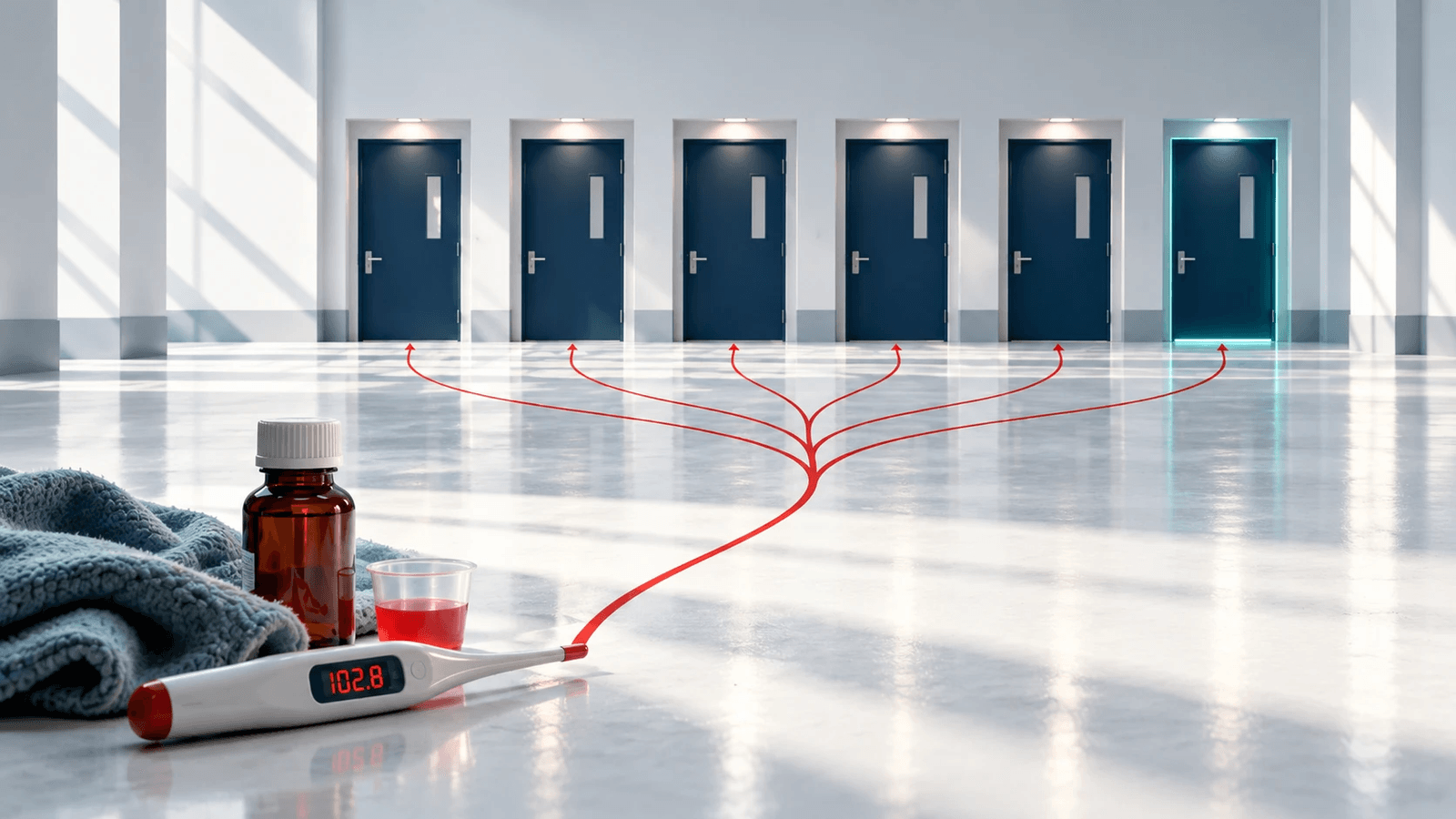
Take a TRICARE Prime family at Eglin Air Force Base. It is two in the morning, a thirteen-year-old has a fever that will not break, and the parent picks up the phone. The first decision of the night is which number to dial, and that decision is what the fourth line of effort in DHA's FY27 campaign plan is about, whether or not the plan says so.
The fourth line, the healthcare enterprise beneficiaries deserve, is led by Maj. Gen. Jeannine Ryder, and its promise for 2028 is plain: 90 percent of patients satisfied with their care, every specialty referral seen within 28 days, an A or B safety grade at every eligible military hospital, and cancer screening above national benchmarks. [1][2] The satisfaction piece has the shortest clock of anything in the plan. Inpatient satisfaction is to rise from 75 to 85 percent and outpatient by 10 points no later than December 2026, ten weeks from the day this issue publishes. [1]
This series has walked the plan one line at a time, the profile clock in Part 1, the hospital bench in Part 2, the blood shelf on Guam in Part 3. The yardstick here is the 90 percent, and the way to test it is to follow one call. The plan dates fourteen tasks that add, rebuild, or train a way in, and none that says where a family starts. By my count the family at Eglin has at least six doors. We will open them in the order the parent would.
Option one
The parent dials 1-800-TRICARE and presses one. That is the Nurse Advice Line, and a nurse picks up at any hour. The nurse asks about the fever, the breathing, and how long it has been going on, and then does one of four things: talks the parent through care at home, books a same-day appointment at the clinic, writes a referral to a civilian urgent care, or, since February, books a video visit with a military provider through a program called VIPRR, which takes patients 12 and older and opens its first slots at 6:30 in the morning Eastern. [3][4] If the fever is the kind that belongs in an emergency room, the nurse says so.
What the nurses do with those calls is the quiet success of the system. The line handles more than 530,000 calls a year, about 1,400 a day, and 82 percent of them come from families enrolled at a military hospital. [3][5] Three in ten of those callers set out for a civilian emergency room, and the nurses sent one in ten. [5] The rest went to self-care, the clinic, or urgent care, and satisfaction runs above 91 percent. [5] At a June industry day, the requirements owner for DHA's next appointing system relayed the director's own figure for the line, twelve years at 94 percent or better; it is the door DHA holds up as the model. [6]
So the plan leans on it. By December 31, DHA's communications office owes a campaign to push use of the nurse line and VIPRR up 10 percent and visits to civilian urgent care down 10 percent. [1] The bet is simple: more fevers triaged by a nurse at 2 a.m., fewer families in a civilian urgent care at 8 a.m.
Two facts about that door sit outside the family's view. The first is a rule. DHA's own instruction on the nurse line, signed in October 2019, makes it a primary care manager for advice around the clock and lets it book only appointments a nurse has judged necessary within 24 hours. Everything else stays with the hospital's appointment line, and the instruction is explicit about the boundary: "MTFs shall not refer or transfer beneficiaries who need an appointment to the NAL." [7] The nurse can book tonight and cannot book next week, and the hospital is told in writing not to send the parent back to the nurse line for it. The split between those two doors is a design with a signature on it.
The second is a clock. The incumbent contractor runs the nurse line on a bridge contract that DHA extended in June by $25.3 million, through December 17, 2026. [8] The follow-on contract took proposals a year ago, drew two protests, both dismissed, and has no announced award. [9] The plan's push to send more calls to the line is due December 31. [1] The push comes due fourteen days after the contract.
The next morning
The fever breaks by sunrise. The video visit at 6:30 ends with an antibiotic and an instruction to follow up with the child's own doctor in a week, and now the parent needs the other door. At Eglin, the hospital's appointment line runs through a regional care coordination center, one of two the plan describes as mature, and the plan gives Eglin until March 31 to deliver a regional appointment plan. [1]
The odds are against a quick slot. In FY2024, by DHA's own evaluation of the TRICARE program, the third available same-day appointment at a military hospital came 2.8 days out against a one-day standard, and at one hospital it averaged 60. [5] Families saw their own primary care manager at fewer than half of their visits, 48.8 percent, down from the year before. [5] Those are the numbers the plan is trying to move, and every one of them moved the wrong way in a single year.
The hospital cannot always see its own calendar. The first date in this line of effort is October 31, eight days from now, when the Office of Warfighter Health Advantage owes an access dashboard for every beneficiary category, and the inspector general found last year that staff at all 15 overseas hospitals it audited spent significant time working around inaccurate data in the dashboards DHA already has. [1][10] A scheduler who cannot trust the screen cannot promise the parent a slot.
If the hospital cannot see the child quickly, the plan has an answer, and it points out the door. By December 31, DHA's healthcare operations office owes guidance for adjusting deferrals, the system's word for sending a referral to the civilian network instead of filling it in-house, so that when the network's access standard beats the hospital's actual performance, the patient goes out. [1] In plain terms: when the civilian side is faster, send the family out.
Out that door, the family meets the directory. To find a civilian pediatrician or a therapist, they search the contractor's provider list, and in 2024 GAO called 342 behavioral health listings in those directories and estimated that most were inaccurate. [11] The plan's answer is a task for the contractors, due December 31, to collect beneficiary feedback on whether the directory's appointments exist. [1] The rule sends the family to a list GAO found mostly wrong for mental health, and the fix for the list is a form.
That rule rests on something awkward. In the same evaluation, Prime families with a civilian primary care manager, and beneficiaries in TRICARE Select, rated their health plan above the civilian benchmark for three straight years, while families empaneled at a military hospital rated theirs below it. [5] The survey adjusts for age and health and not for who chose what, so the gap may say as much about who gets sent out as about the care. My read is that it is still the strongest number DHA has for the deferral rule, and the most uncomfortable one for a task in the same line that compares military and civilian hospitals on safety grades "to reinforce MTF value proposition." [5][1] The plan wants the family to come in. Its own data says the families it sends out are the happier ones.
Count the doors
Suppose the family skips the phone. The patient portal books a scheduled virtual visit with the child's own clinic. [12] Quick Care Connect, a walk-in virtual urgent care that runs at Eglin and two other hospitals under the My Military Health brand, needs no appointment at all. [13] The East region managed care contractor lists eight virtual partners for urgent care, therapy, speech, and feeding support. [14] For a different kind of night, BRAVE, DHA's virtual mental health program, has its own path in. [3] Eglin is one of five venture sites for My Military Health, whose enterprise page on DHA's site has shown Page Not Found since August, as I reported last month, while Eglin's own page stays up. [15][16]
That is six, with the nurse line and the appointment line. Each was built on purpose and works for someone, and the plan adds more. Text messaging for virtual health arrives April 30 and chat May 30, regional appointment plans come due at four hospitals between December and June, and a rebuilt patient portal gets four dated tasks ending June 30, 2027. [1]
A "centralized point of access" for a warfighter's readiness requirements opens in March, and under the second line of effort the healthcare operations office owes "centralized and regionalized appointing capabilities" by January 31. [1] Fourteen tasks, by my count, owned by at least six offices and the hospitals: the communications office, healthcare operations, the warfighter health office, the IT directorate, the TRICARE health plan, the medical digital solutions office, and the networks and hospitals that run the regional centers. [1] One thing in this line does get a single door: four patient feedback tools, ICE, JOES, TRISS, and the beneficiary survey, converge onto one platform by September 30, 2027, with one owner and one date. [1] The surveys get what the doors do not.
One door or many
The strongest case against this issue is that DHA is building the front door in a different document, and it is. In February it told Congress it is expanding access through new centralized contact centers that integrate the entire enterprise. [3] In June it told industry that appointing today is "fragmented across over 110 separate contracts and call centers" and described an enterprise referral and care coordination center, one system for all patient appointments. [17] Referral appointing has had a centralized rule at the hospital and network level since 2020. [5] The call-in, click-in, and walk-in doors have not.
The counter is right, and it sharpens the point. The enterprise center is in market research, feeding an analysis of alternatives that leadership has not yet seen, and DHA's contracting officer told industry to expect a request for proposals in the second quarter of FY2027 and an award in the first quarter of FY2028. [6] Every date in the fourth line of effort comes before that award. The satisfaction deadline comes before the request for proposals. The plan dates the doors and leaves the door that joins them to the fiscal year after this one.
The office writing the requirement said as much. On whether the center would be one door or several, the requirements owner said, according to the transcript DHA posted: "It can be one, it can be multiple. We're not sure." [6] She called the concept air traffic control. [6] She also relayed the director's framing, that DHA has quite good access and needs better accessibility. [6] Accessibility is the honest word for a system with six doors at Eglin, and access, by the FY2024 numbers, moved the wrong way too.
Underneath whatever the center becomes sit four instruments, none of them a front-door standard: the 2018 empanelment rule that sets how many families a doctor carries, the 2019 nurse line instruction, the 2020 referral appointing memo, and the access practices the plan will codify as DHA-PI 6000.101 by September 30, 2027. [18][7][5][1] Each governs a door, and the nurse line instruction runs until October 2029 unless someone reissues it first. [7]
A door does not make a doctor
A front door can make the fever call easier. It cannot make the follow-up appointment exist. DHA put that limit in its own report to Congress: "while telemedicine is a modality of care delivery, it does not increase provider capacity." [3] GAO put a number on the gap. DHA projects a shortfall of more than 8,000 clinical military medical personnel across its roughly 700 facilities, and for the rest of FY2025 it could not hire civilians at all. [19] Part 2 followed that bench through the Core 15 hospitals. Every door in this line of effort opens onto it.
The plan's answer is an analysis, due December 31, in which the Defense Health Networks model hospital and network manning and identify what more they need. [1] The FY27 budget adds $200.4 million for digital health, and the justification names ambient listening first, then video visits, tele-critical care, and tablets. [20] Those are channels and clinician tools. I found no line for a router or a contact center; the cost of the door DHA described to industry may sit inside hospital operations or the managed care contracts, where the public budget does not show it. [20]
VA built the other half. A veteran's path is one number, the local medical center, with option two for scheduling and option three for a nurse, around the clock. [21] Behind it sit Clinical Resource Hubs, regional pools of clinicians who see patients by telehealth at facilities that are short, and their visits more than doubled between FY2021 and FY2024, to about 1.2 million. [22] The design has faults VA's inspector general has written down. A July review found about one call in five to the clinics it sampled went to a wrong number, and the hub audit found physicians did not consistently get credit for work done for a distant site. [23][22] One number is the right design. The credit rules behind it are the part to copy carefully, because a provider who is not credited for a video visit has every reason to keep the door that pays.
Some doors are closing while the plan adds others. Landstuhl Regional Medical Center, the only American referral center for high-risk pregnancy across Europe, western Asia, and Africa, stopped delivering babies in early March to prioritize combat casualties from the Iran conflict, and its clinic page now limits obstetric care to active-duty members "until further notice." [24][25] The plan's one task on obstetric staffing, a network process for finding and fixing regional shortfalls, is due February 28, 2027. [1] A spouse's door at Landstuhl closed in March, and the plan dates the process for noticing almost a year later.
When the night goes wrong
Say the fever call went badly, the slot never came, and the child ended up in a civilian emergency room. The complaint door is the one the plan builds first. By January 31, 2027, the J6 owes the two complaint systems, the Assistance Reporting Tool and the patient advocate tool DHA made mandatory in January, integrated "by individual beneficiary." [1][26] The advocate tool already runs on clocks a family can hold it to: an immediate response for emergent cases, 24 hours for urgent, ten business days for routine. [26] The regional appointing capability lands the same day with no integration by beneficiary attached. [1] The plan will know which family complained before it knows which door the family came through.
Congress may set that door's shape first. The Senate's FY27 defense bill, S. 4784, directs the Secretary in Section 701 to stand up within 18 months a digital system for beneficiaries at a military hospital or in the network to file a complaint, raise an issue, or leave positive feedback and to see its status at any time. [27] The House bill, H.R. 8800, orders a feasibility study instead. [28] Both wait on the lame-duck session. A December enactment would put the Senate's deadline near mid-2028, after every patient experience task in the plan has closed, and the single feedback platform due September 30, 2027 would have to meet the statute's tracking and response rules on arrival.
The path to one door
The pieces of a single front door already exist inside DHA, and most of them carry a date in this plan: a model nurse line, a referral rule since 2020, a survey consolidation that proves the agency can take four tools to one platform, a staffing model due in ten weeks, a request for proposals this winter, and a construct VA has run next door for years. [3][5][1][6][21] The Military Health System can put a nurse on the line for 1,400 families a night and send nine in ten of them somewhere other than an emergency room. It cannot yet tell the same family which number to call for the follow-up. What is missing is the order of operations. Five dated steps would supply it.
Step one, by December 17: settle the nurse line before the push. The follow-on award or the bridge extension lands before the communications campaign starts, and DHA says which in the same breath it says "call the nurse line." [8][1]
Step two, by December 31: write the one-line standard. The healthcare operations office owns both the regional appointing task and the enterprise center requirement, and it can state, in the deferral guidance due the same day, that every Prime family gets one number and one login that reach every door, with the regional centers, VIPRR, the portal, and the network partners as routes behind them. [1] That sentence belongs in the request for proposals this winter, so the FY28 award builds the router instead of one more door. [6]
Step three, by January 31: integrate both by beneficiary. When the complaint systems and the regional appointing capability land on the same day, give the appointing record the same beneficiary key, so the platform due in September 2027 can show which door failed and for whom. [1]
Step four, by March 31: rewrite the 2019 instruction. The nurse line can book only tonight because an instruction says so. Make the line the front router, with warm transfer to the appointment center, a VIPRR slot, a scheduled virtual visit, Quick Care Connect, or civilian urgent care, and write Eglin's regional plan, due the same month, to receive the transfers. [7][1] It is the cheapest single door DHA could stand up, and 82 percent of the callers are already enrolled. [3]
Step five, with the staffing model: put a bench behind the door and pay for it. The Defense Health Networks' manning analysis, due December 31, can size a regional pool of clinicians, the VA construct, for the hospitals that miss the one-day standard. [1] Credit the work where it is done, at rates at least equal to in-person, which the Defense Health Board asked for in 2023 and the plan carries no task on. [29][1] A door that opens onto a credited bench is a door that stays open.
None of this waits on the FY28 award. It needs four signatures on documents DHA already owes this winter and one sentence in a request for proposals it has already scheduled.
What to watch: the quality half
The patient the door admits lands in a hospital the other half of this line is trying to make safer, and those dates come first.
November 18 is the first test, and it is public. Leapfrog publishes its fall grades that day, against a plan target of 95 percent of military hospitals at A or B and 100 percent by spring. [30][1] Last spring 15 earned an A, at least three earned a B, and Landstuhl earned its third straight C; DHA's own evaluation shows every graded hospital at A or B in fall 2024, so the target restores a level the system has held before. [31][32][5] The hospital with the hardest grade to move is the one in Germany with the hardest mission this year.
December 31 carries about 19 deadlines in this line of effort plus the satisfaction objective itself. [1] One of them needs a reading. The plan describes expanding surgical quality reporting "from 17 to 45" hospitals, and DHA's FY2024 evaluation says the collaborative already covers 45, with 17 singled out for elevated infection rates, so the task most likely widens an infection effort across hospitals already enrolled. [1][5] Observed morbidity across 38,434 cases was 2.91 percent against the plan's 2.4 percent target, and the report says it is trending the wrong way. [5][1]
Screening is the one place the plan converges toward no door at all: HPV self-collection at every hospital by November 30 and at-home kits at the Core 15 by February 28, with mailed colorectal kits at every U.S. hospital by November 30. [33][1] On the provider side, ambient listening went from a 400-provider pilot at four hospitals last fall to enterprise use this year, with a 67 percent adoption target by May 30, 2027, and burnout is to fall 10 percent against a baseline the plan's own dashboard will not show until June 30, 2027. [34][1] This is the last of the four lines, and the FY28 request due in the spring will be the first budget written with all of them in hand.
Back to Eglin
The good version of that night is close. The parent dials one number. A nurse triages the fever, books the 6:30 video visit, and before hanging up books the follow-up with the child's own doctor, because the instruction that forbade it was rewritten in March. If the hospital has no slot that week, the deferral goes out to a directory the contractors have been made to check. If something goes wrong, the complaint record knows which door the family used. Every piece of that night is in a document DHA already owes.
DHA has told Congress it is building the front door and told industry it has not decided whether there will be one. A parent with a feverish child at two in the morning does not need the plan to settle the question. They need the first number to be the right one.
Let's roll.
— Mary
Mission Meets Tech
The views expressed in this newsletter are my own and do not represent the official position of any organization. This content is for informational purposes only.
MMT Premium
This issue follows LOE 4 through the doors. Premium's Capture Corner and monthly Capture Intelligence Sheets track the contracts and budget lines underneath it, with sourced action windows.
Founding Member rate: $199/year, locked permanently for the first 100 subscribers.
Standard rate: $249/year or $29/month.
Premium adds 48-hour early access to deep-dive analysis, monthly Capture Intelligence Sheets with sourced action windows, direct Q&A access (reply to any premium issue), and tool discounts: ProposalPulse $14.99 per assessment, MarketPulse $35 per brief.
Subscribe at missionmeetstech.com/pricing.
Sources
[1] Defense Health Agency, FY27 campaign plan, including "Delivering Warfighter Readiness, Fiscal Year 2027," October 2026. Source for: the LOE 4 North Star, its 2028 date, and its lead; the satisfaction objective and its December 2026 date; the nurse line and VIPRR communications targets due December 31; the regional appointment plans, including Eglin's March 31 date and the description of the Colorado Springs and Eglin centers as mature; the access dashboard due October 31; the deferral guidance and its condition; the provider directory feedback task; the Leapfrog comparison task and its quoted purpose; text and chat for virtual health; the patient portal tasks; the centralized point of access for readiness requirements; the LOE 2 centralized and regionalized appointing task; the LOE 1 objective language on centralized appointing delays; the count of entry-point tasks and the owning offices; the single survey platform; the access practices to be codified in DHA-PI 6000.101; the Defense Health Networks staffing analysis; the obstetric staffing task; the ART and PAART integration task; the Leapfrog targets for fall 2026 and spring 2027; the December 31 deadline count; the surgical quality task and the morbidity target; the screening tasks; the ambient listening adoption target; the burnout objective and well-being dashboard; and the absence of any task on workload credit for virtual care.
[2] Defense Health Agency, "18 military hospitals receive Leapfrog's highest Hospital Safety Grade," December 3, 2025. Source for: Maj. Gen. Jeannine Ryder's role as acting assistant director for Health Care Administration. https://www.dha.mil/News/2025/12/03/17/46/18-military-hospitals-receive-Leapfrogs-highest-Hospital-Safety-Grade
[3] Department of War, "Assessing Access to Health Care Standards," report to Congress, February 27, 2026. Source for: nurse advice line volume of over 530,000 calls a year and 82 percent of calls from MTF enrollees; BRAVE as an exclusively virtual mental health program; the statement that DHA is expanding access via new centralized contact centers integrating the entire enterprise; and the statement that telemedicine does not increase provider capacity. https://www.health.mil/Reference-Center/Reports/2026/02/27/Assessing-Access-to-Health-Care-Standards
[4] Defense Health Agency, "New virtual urgent care option for TRICARE Prime beneficiaries in the U.S.," February 11, 2026. Source for: VIPRR booking through the nurse advice line, eligibility for Prime enrollees age 12 and older in the United States, appointment hours of 6:30 a.m. to 11:30 p.m. Eastern, and care by DHA-credentialed providers. https://www.dha.mil/News/2026/02/12/15/09/New-virtual-urgent-care-option-for-TRICARE-Prime-beneficiaries-in-the-US
[5] Defense Health Agency, "Evaluation of the TRICARE Program: Fiscal Year 2024 Report to Congress," September 23, 2025. Source for: nurse advice line caller intent versus nurse advice by disposition for MTF enrollees, about 1,400 calls a day, and satisfaction above 91 percent; the third next available 24-hour appointment at 2.8 days against a 1.0-day standard and the 60-day maximum; primary care manager continuity at 48.8 percent, down from 52.2 percent; health plan satisfaction by enrollment type relative to the civilian benchmark and the survey's adjustments; DHA-IPM 18-001 centralized referral appointing with the 86 percent one-business-day result against a 90 percent standard; fall 2024 Leapfrog grades of 75 percent A and 25 percent B; the NSQIP collaborative covering 45 MTFs and the 17 MTFs with elevated infection rates; and observed all-cases morbidity of 2.91 percent across 38,434 cases, described as trending in the wrong direction. https://www.health.mil/Reference-Center/Reports/2025/09/23/Annual-Evaluation-of-the-TRICARE-Program-FY24
[6] Defense Health Agency Contracting Activity, "DHA Enterprise Referral Care Coordination Center (RC3) Reverse Industry Day," SAM.gov notice 047697bd3d9b4e6daaa85280b5631f52, with public attachments including the June 16, 2026 briefing transcript and the June 26, 2026 questions and answers. Source for: the requirements owner's remarks on the nurse advice line, on one door or several, on air traffic control and PCS moves, and on access versus accessibility; the contracting officer's anticipated RFP in the second quarter of FY2027 and award in the first quarter of FY2028; and the market research phase and analysis of alternatives. Machine-generated transcript posted by DHA. https://sam.gov/opp/047697bd3d9b4e6daaa85280b5631f52/view
[7] Defense Health Agency Procedural Instruction 6025.26, "Nurse Advice Line," October 18, 2019. Source for: the nurse line as a designated PCM for 24/7 health advice, its booking limited to appointments needed within 24 hours as determined by nurse triage, MTF central appointing retained for other appointments, the quoted bar on referring appointment callers to the nurse line, and the ten-year expiration. https://health.mil/-/media/Files/MHS/Policy-Files/DHAPI-602526-Nurse-Advice-Line-Signed-101819.ashx
[8] Department of War, "Contracts for June 17, 2026." Source for: the $25.3 million modification to the incumbent nurse line contractor's contract HT001125CE007 extending performance through December 17, 2026. https://www.war.gov/News/Contracts/Contract/Article/4520478/contracts-for-june-17-2026/
[9] HigherGov, protest record for solicitation HT0011-25-R-0044, Global Nurse Advice Line Next Generation, GAO B-423625.1 and B-423625.2, and OrangeSlices AI, "Protest filed: Defense Health Agency, Global Nurse Advice Line Next Generation." Aggregator records; verify on the GAO docket. Source for: proposals due October 31, 2025, the June 2025 pre-award protest dismissed June 30, 2025, the November 13, 2025 protest dismissed February 10, 2026, and the absence of a published award. https://www.highergov.com/protest/lts-fonemed-llc-ht001125r0044-423625/ and https://orangeslices.ai/protest-filed-defense-health-agency-global-nurse-advice-line-next-generation-gnal-ng-ht0011-25-r-0044/
[10] Department of War Office of Inspector General, "Audit of the Defense Health Agency's Management of Military Medical Treatment Facility Access to Care," DODIG-2026-025, December 8, 2025. Source for: staff at all 15 audited overseas hospitals spending significant time on inaccurate or unreliable data in DHA access-to-care dashboards. https://www.dodig.mil/In-the-Spotlight/Article/4356078/press-releaseaudit-of-the-defense-health-agencys-management-of-military-medical/
[11] U.S. Government Accountability Office, GAO-24-106588, July 2024. Source for: covert calls to 342 behavioral health provider listings in the TRICARE directories and the estimate that most listings were inaccurate. https://www.gao.gov/products/gao-24-106588
[12] TRICARE, "Scheduled Virtual Visits," My Military Health page. Source for: scheduled virtual visits booked through the MHS GENESIS Patient Portal. https://tricare.mil/mymilitaryhealth
[13] TRICARE, "Virtual Health," and Eglin Air Force Base, "My Military Health." Source for: My Military Health Quick Care Connect as a walk-in virtual urgent care available at Eglin, Wright-Patterson, and Martin, and the live Eglin program page. https://www.tricare.mil/virtualhealth and https://eglin.tricare.mil/Getting-Care/My-Military-Health
[14] TRICARE East Region, "Virtual Health," updated October 1, 2026. Source for: the East region managed care contractor's eight virtual health partners. https://www.tricare.mil/About/Regions/East-Region/Find-Care/virtualHealth
[15] Defense Health Agency, "My Military Health: Improving Mental Health Access and Readiness," May 29, 2025. Source for: Eglin as one of five My Military Health venture sites. https://dha.mil/News/2025/05/30/12/18/My-Military-Health-Improving-Mental-Health-Access-and-Readiness
[16] Mission Meets Tech, "A Question From the Floor," September 25, 2026. Author's prior work. Source for: the My Military Health enterprise page returning Page Not Found. https://missionmeetstech.com/newsletter/a-question-from-the-floor/
[17] Defense Health Agency, "DHA Enterprise Referral Care Coordination Center (RC3)," SAM.gov special notice, June 2026. Source for: appointing described as fragmented across over 110 separate contracts and call centers and the enterprise center described as a centralized system for all patient appointments. https://sam.gov/workspace/contract/opp/d03bcc2bf3c14694b237c813512863b6/view
[18] Defense Health Agency Procedural Instruction 6025.11, "Standard Processes for Primary Care Manager Empanelment and Capacity," October 9, 2018. Source for: the empanelment standard of 1,100 to 1,300 enrollees per full-time family medicine or pediatrics primary care manager. https://www.health.mil/-/media/Files/MHS/Policy-Files/SIGNED--DHAPI-602511--Standard-Processes-for-PCM-Empanelment.ashx
[19] U.S. Government Accountability Office, GAO-25-106988, July 21, 2025. Source for: DHA's projected shortfall of more than 8,000 clinical military medical personnel across about 700 facilities (p. 15) and the inability to hire civilian employees for the rest of FY2025 (p. 16). https://www.gao.gov/assets/890/881106.pdf
[20] Department of War, Office of the Under Secretary of War (Comptroller), "Military Health System, Fiscal Year 2027 Budget Estimates, Volume 1," April 2026. Source for: the $200.4 million DHA digital health increase and its named purposes (p. 79), and the absence of a named line for contact centers, routing, or appointing consolidation in the volume. https://comptroller.war.gov/Portals/45/Documents/defbudget/FY2027/budget_justification/pdfs/09_Defense_Health_Program/MHS_PB27_J-Book-Vol1-COMP_PSCP.pdf
[21] VA News, "Concern? VA Health Connect nurses are available 24/7," April 8, 2026. Source for: the single access path by local VA medical center phone number with options for pharmacy, scheduling, and a nurse. https://news.va.gov/146063/concern-va-health-connect-nurses-available/
[22] Department of Veterans Affairs Office of Inspector General, "Better Guidance and Measures Would Help Optimize Productivity of Clinical Resource Hub Physicians," 24-03319-213, September 24, 2025. Source for: hub encounters rising from about 482,000 in FY2021 to about 1.2 million in FY2024 and inconsistent credit for work documented at spoke sites. https://vaoig.gov/reports/audit/better-guidance-and-measures-would-help-optimize-productivity-clinical-resource-hub
[23] Department of Veterans Affairs Office of Inspector General, 25-03621-145, July 2026. Source for: about 573,000 of 2.9 million veteran calls to reviewed clinics reaching inaccurate numbers, about one in five. https://www.vaoig.gov/sites/default/files/reports/2026-07/vaoig-25-03621-145_final.pdf
[24] Stars and Stripes, "Landstuhl halts labor and delivery to prioritize combat casualties," March 4, 2026. Source for: the suspension of labor and delivery in early March 2026 and Landstuhl's role as the only American referral center for high-risk obstetrics across Europe, western Asia, and Africa. https://www.stripes.com/theaters/europe/2026-03-04/labor-delivery-closed-landstuhl-war-20947669.html
[25] Landstuhl Regional Medical Center, "Obstetrics and Gynecology Clinic." Source for: empanelment limited to active-duty beneficiaries until further notice. https://landstuhl.tricare.mil/Health-Services/Womens-Health-Pregnancy/Obstetrics-and-Gynecology-Clinic
[26] Defense Health Agency, "DHA launches Patient Advocate Assistance Reporting Tool," January 26, 2026. Source for: PAART's January 2026 launch as the standardized enterprise system, mandatory use by patient advocates, and response times of immediate for emergent, 24 hours for urgent, and 10 business days for routine. https://www.dha.mil/News/2026/01/26/13/23/DHA-launches-Patient-Advocate-Assistance-Reporting-Tool
[27] S. 4784, National Defense Authorization Act for Fiscal Year 2027, as reported June 15, 2026, Section 701, "Digital system for beneficiary assistance." Source for: the 18-month deadline, the complaint, issue, and positive feedback functions, status visibility, and prompt transmission to a patient advocate. https://www.congress.gov/bill/119th-congress/senate-bill/4784/text
[28] H.R. 8800, National Defense Authorization Act for Fiscal Year 2027, as reported June 15, 2026, Section 767. Source for: the study on the feasibility of a digital access-to-care system at military treatment facilities with an 18-month report deadline. https://www.congress.gov/bill/119th-congress/house-bill/8800/text/rh
[29] Defense Health Board, "Optimizing Virtual Health in the Military Health System," March 22, 2023. Source for: finding 14, that clinicians are not routinely given RVU rates for virtual care at least equal to in-person. https://health.mil/Reference-Center/Reports/2023/03/22/Optimizing-Virtual-Health-in-the-MHS
[30] The Leapfrog Group, "Key Dates and Information," Hospital Safety Grade. Source for: the fall 2026 grade release on November 18, 2026. https://www.hospitalsafetygrade.org/key-dates-and-information
[31] Defense Health Agency, "15 military hospitals receive Leapfrog's highest Hospital Safety Grade," May 6, 2026. Source for: the 15 A grades in spring 2026. https://www.dha.mil/News/2026/05/06/15/46/15-military-hospitals-receive-Leapfrogs-highest-Hospital-Safety-Grade
[32] The Leapfrog Group, Hospital Safety Grade pages for Landstuhl Regional Medical Center, Naval Medical Center San Diego, 60th Medical Group (Travis), and Tripler Army Medical Center, read October 22, 2026. Source for: Landstuhl's C in spring 2025, fall 2025, and spring 2026, and B grades at San Diego, David Grant, and Tripler in spring 2026. https://www.hospitalsafetygrade.org/h/landstuhl-regional-medical-center and https://www.hospitalsafetygrade.org/h/naval-medical-center-san-diego and https://www.hospitalsafetygrade.org/h/60th-medical-group-travis-afb and https://www.hospitalsafetygrade.org/h/tripler-army-medical-center
[33] Defense Health Agency, "New self-test for HPV," April 3, 2026. Source for: Madigan as the first DHA hospital or clinic to offer in-clinic HPV self-collection, available since March 2026. https://www.dha.mil/News/2026/04/03/15/04/New-self-test-for-HPV
[34] Defense Health Agency, "Ambient listening to support warfighters," July 6, 2026, and GovCIO Media, "Pentagon rolls out AI medical scribe in clinical care," August 2026. Source for: the limited release to about 400 providers at four MTFs from October 31 to December 11, 2025 and the subsequent enterprise expansion. https://dha.mil/News/2026/07/06/13/20/Ambient-listening-to-support-warfighters and https://govciomedia.com/pentagon-rolls-out-ai-medical-scribe-in-clinical-care/
Sources verified as of October 22, 2026.