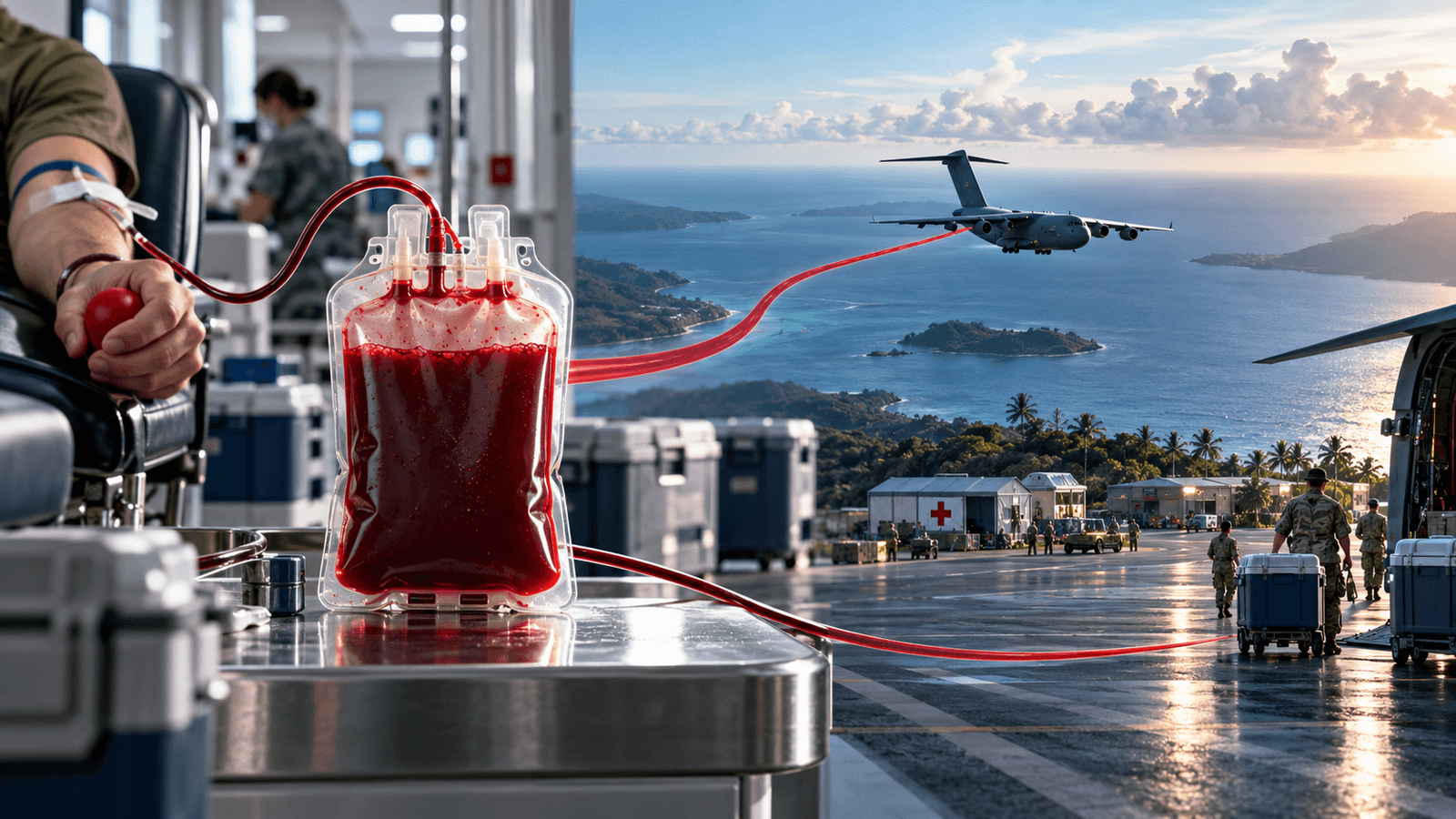
The Blood Clock
Part 3 of a series on DHA's FY27 campaign plan, one line of effort at a time. DHA's FY27 campaign plan promises that 90 percent of the blood the Joint Force will need is positioned forward by 2028, and the first deadline on that promise belongs to a Navy hospital on Guam at the end of this month. The budget that funds it says what is short, and the word it chose was understaffing. This issue follows Line of Effort 3 through the blood supply: the demand a long evacuation creates, the people and agreements the plan needs to meet it, the rules the clock runs under, and the fixes that would show whether the promise is landing.
Friends,
In January, Marine Corps Base Camp Blaz on Guam held its first blood drive of the year. Sgt. Kendell Jones and Lance Cpl. Afton Smiley organized it with the Armed Services Blood Program staff from Naval Hospital Guam, and it collected 28 units. "This is really about people looking out for one another," Jones said. [1]
The hospital matters as much as the number. Naval Hospital Guam is the only one of the island's three hospitals that takes blood donations, and it sends its samples to an outside lab for disease testing. [2] Until the hospital opened its own donor center in 2012, Guam's military blood came from Okinawa, about 1,400 miles away. [3] The last public figures, from 2015, had the center processing about 1,500 products a year and keeping about 600 on hand. [3]
The Defense Health Agency's FY27 campaign plan puts that hospital first on the clock. Its third line of effort, joint warfighting capabilities, commits DHA by 2028 to delivering the combat support functions the Joint Force needs 90 percent of the time, with all of its surge equipment and supplies and 90 percent of its blood requirements positioned forward, overseas and at the Core 15 hospitals. [4] Brig. Gen. Yolonda Summons leads it. The line runs through seven supporting efforts, from the Joint Trauma System to public health, and more than 50 tasks carrying about 120 dated deadlines, 33 of them before New Year's Day. [4] The first blood deadline is Guam's. By October 31, the hospital owes an updated protocol for releasing blood before testing is complete, adding low titer O whole blood and rapid infectious disease testing. [4] That is eleven days after this issue publishes.
This series is walking the plan one line of effort at a time. Part 1 took the profile clock in warfighter readiness, and Part 2 took the people who hold the hospitals. LOE 3 is the largest of the four, and its verbs tell you what kind of year it is. Across its tasks, establish appears 21 times, develop 18, submit 18, publish 17, and install once, for CT scanners at the medical examiner. [4] Most of FY27 builds requirements. Blood is the exception, with dated and local work due every few weeks from now through September 2027, and a budget that says in plain language what is wrong. That makes 90 percent of blood the yardstick for this issue, and it turns on two things the plan can only partly control: people to collect it and agreements to share it.
Seventy-two hours
Col. Jason Corley, who directs the Armed Services Blood Program, told a forum in June that casualty evacuation in the next fight is expected to be delayed more than 72 hours, which keeps wounded service members farther forward for longer. [5] Ukraine has shown what that looks like. Surgeons with Ukrainian special operations forces could often move casualties only to hardened sites as close as 500 meters from the point of injury and hold them there under fire, and a 2023 paper in the Journal of the American College of Surgeons concluded that American casualties "may not reach definitive care until days later." [6] A 13-month observation study in Military Medicine named blood and damage control resuscitation as a prehospital gap and recommended blood as close to the point of injury as possible. [7]
The last long war took years to learn that. One in four early deaths in Iraq and Afghanistan was potentially survivable. The Joint Trauma System eventually cut battlefield trauma deaths by 44 percent, and it needed nearly five years to make a substantial impact on the case fatality rate, with the air superiority the next war may not offer. [8] Army warfighter exercises have produced 50,000 to 55,000 casualties per 100,000 troops in eight days. [9] Those are exercise outputs, and they frame the demand. The Joint Staff Surgeon's planning factor holds that about 20 percent of casualties need transfusion, averaging eight whole blood equivalent units each, and a 2026 paper in Transfusion cites a U.S. planning estimate for a future large-scale fight of about 10,080 low titer O whole blood units a month. [10] Iwo Jima used about 12,600 units in 36 days. Scaled to those casualty rates, the authors put demand above 180,000 units a month, more than a quarter of the national type O supply. [10]
Set that against the supply. The Fort Bragg donor center, one of the program's larger sites, collected about 700 units a month in 2021, of all types, against a weekly quota of 58. [11] A corpsman on the Guam-based submarine tender USS Frank Cable put the ceiling plainly in 2018: "The Armed Services Blood Program is limited on how much they can collect, by how many units they have available to bring." [12] Whole blood keeps 21 to 35 days refrigerated, depending on the anticoagulant. [13] A 90 percent forward posture is a flow that has to be refilled about once a month, and it cannot be fed from the continental United States alone.
What the budget says is short
The FY27 request adds $42.5 million to the blood program, for freeze-dried plasma, pre-deployment donor screening, and staffing and modernization across the 20 donor centers. [14] The justification explains why in one sentence: "understaffing in blood collection and insufficient funding restricts DoW's ability to meet routine inventory needs resulting in critical inventory shortages, operational breakdowns, and a reduced capacity to save lives." [14] That is the Department describing its own blood supply in a budget document, and the word it chose first was understaffing.
The products are arriving. On July 29 the FDA licensed the first American freeze-dried plasma, Teleflex's EZPLAZ, after a development effort that DHA's Warfighter Protection and Acute Care office drove under a 2017 law. [15][16] Its label covers adults "when plasma is required and other plasma products are not available," which makes it a bridge until whole blood arrives. [17] Blood on Demand gets $5 million in research money, cold-stored and cryopreserved platelets are moving through the operational medicine program office, and the Senate's FY27 authorization report wants a briefing on DARPA's shelf-stable blood work by January 1, including a quantitative assessment of lives saved. [14][18][19]
The people are the open question, and the plan goes after them on the same October 31 date as the Guam protocol. Every donor center owes a manpower validation against its unit manning document and a plan to cover the shortfall. [4] Rosters of pre-screened walking blood bank donors follow at Fort Bragg by November 30, Eglin by December 31, and the Southern California catchment by January 31. [4] A screening system the plan calls FASTRAK reaches initial operating capability at all 20 donor centers by June 30, 2027. [4] Behind it sits a requirement from 2022. DoD Instruction 6480.04 requires blood donor screening within 120 days of any overseas deployment longer than 30 days, covering a questionnaire, disease screening, blood type, and titers for group O donors, to be implemented within 18 months of DHA's procedural guidance. [20] My read is that the screening money and the FASTRAK task are how that requirement finally gets delivered, and the share of deploying members actually screened is the number to ask for.
The rest of the calendar
Yokota Air Base gets a satellite donor center by December 31, with blueprints and plans for the permanent site due June 30, 2027. [4] Yokota held the first blood drive on Japan's main island in a decade in 2024 and collected 173 pints, and today its medical support squadron and airlift wing load donations onto aircraft bound for the donor center on Okinawa. [21][22] The build is not visible in the public budget. The $42.5 million names only plasma, screening, and staffing, and the only donor center in DHA's FY27 construction plan is a $30.5 million replacement for the Akeroyd center at Fort Sam Houston. [14][23]
March 31 brings standardized theater blood procedures, informed by an internal 2026 evaluation of the program by DHA's J8, an update to the policy that extends walking blood banks to hospitals with no donor center of their own, and a standard equipment list for those programs from the Joint Trauma System. [4] Next-generation blood products go into the budget process by May 30. Reciprocity agreements with Japan and Korea are due June 30, and in-house donor testing at the blood bank in Europe, which today ships samples out, is due September 30, 2027. [4] A DHA notice for transfusion disease testing systems at Landstuhl closes October 21, which looks like the procurement step under that last task. [24]
Two outside checks land in the middle. Monthly readiness reporting for the blood program begins in the Department's readiness system by February 28, and the Senate report directs a review of Military Health System readiness, including the blood program, by March 1. [4][19] I found no Government Accountability Office review of the Armed Services Blood Program. The nearest items are a 2002 testimony on the national blood supply and a 2014 Inspector General audit that found the enterprise blood management system "Not Ready for Full Deployment." [25][26] The oversight record on military blood is thin, and two reviews arrive in the same quarter.
Thirty-five days
The clock runs under rules written for peacetime, and they are the strongest case against the easy version of this story. Federal regulation allows blood to be released or shipped before testing is complete "only in appropriately documented medical emergency situations," with testing finished as soon as possible afterward and results sent to the receiving facility. [27] The FDA's inspection program treats a pattern of emergency releases without proper labeling or documentation as a finding. [28] Low titer O whole blood drawn from a walking blood bank is not FDA approved, while the same product shipped from a licensed donor center is, and the Joint Trauma System's own guideline flags the "potential for LTOWB supply not to meet future demand." [29] Navy policy allows non-FDA products only when they are "the only alternative during combat operations or mass-casualty events," with the decision resting on the senior medical officer present. [30]
The theater rules say the same thing in order of preference. Central Command's blood program puts cold-stored low titer O whole blood first for hemorrhagic shock, then pre-screened fresh whole blood, then type-specific whole blood, then components. A walking blood bank is "reserved for contingency situations" where failure to act is likely to result in death, and theater-collected whole blood does not fly on medevac aircraft. [31] The walking blood bank is a last resort by design, and the forward posture the plan promises is a flow of tested blood with a shelf life of 21 to 35 days. [13]
The evidence has a soft spot too. A Cochrane review found insufficient evidence to support routine prehospital transfusion, and a British trial of prehospital red cells with freeze-dried plasma showed no benefit. [32] Those trials come from civilian settings with short transports. They argue for aiming forward blood at the casualty who will be held for days, which is the casualty DHA says to expect, and they argue against treating every forward unit as a supply depot.
The plan's own design answers much of this. Rapid testing at Guam, rosters of pre-screened and titer-checked donors, a comparability list for allied blood, and shelf-stable plasma as the bridge all turn a last resort into a planned one. Whether forward blood is wise is settled. Whether the people and the agreements land on the dates is the question, and the agreements have a seam.
Ten nations and two signatures
Ten countries now have blood systems the Department deems comparable to its own, so their fully tested blood can go into an American service member without follow-up testing: Australia, Canada, France, Japan, South Korea, Taiwan, the Netherlands, the United Kingdom, Germany, and New Zealand, the last two added in March. [33] Assistant Secretary Keith Bass said fully tested foreign blood "may be the only alternative during combat operations or mass-casualty events." [33] Japan and Korea are already on the list. The plan's June 30 task asks for something more, agreements that share blood in both directions, and the sub-task to "develop process and authorities to timely execute agreements" is due August 30, two months after the agreements themselves. [4] The sequence may be a drafting artifact. It reads as a promise signed before the authority to keep it.
The same seam runs through the rest of the Pacific. The plan asks for sterile processing contingency agreements with Japanese civil authorities and the Japan Self-Defense Forces by March 31, "to mitigate Food and Drug Administration regulatory barriers," so that surgical instruments at the hospitals in Japan can be reprocessed next door in a crisis. [4] A Defense Health Cooperation Strategy is due November 30. [4] Congress authorized medical cooperation agreements with the Five Eyes allies in last year's defense bill, and Japan and Korea are outside that group. [34] In July, soldiers trained Malaysian counterparts on walking blood banks at Keris Strike, and a Guard noncommissioned officer called the practice "new to the National Guard and the Army." [35] Allied blood is already legal to use. Allied supply is still a negotiation, and the people who run the negotiation come from the same pool as everyone else in this line of effort.
The same shrinking force
GAO counted active component medical personnel at 60,479 in FY2015 and 50,590 in FY2023, a drop of about 16 percent, with the share of authorized positions filled falling from about 96 to about 86 percent. [36] LOE 3 draws on that force for donor center staff, trauma system augmentation teams that must be trained by June 30, a DHA forward element for the combatant commands by December 31, a 24-hour joint operations center, and surge staffing above current manning for the Pacific by January 31. [4] Friday's issue followed the civilian bench that holds the Core 15 when uniformed clinicians deploy, and the deployment LOE 3 plans for is the one that empties those hospitals.
The civilian backstop is still a pilot. The Military-Civilian Medical Surge Program, created by last year's defense bill and established this month, has published no findings, and its eight-site predecessor under the National Disaster Medical System has none either. [37] A Military Medicine paper on the program cites planning factors of about 1,000 patients a day, warns the nation may have "only days" to organize, and lists supply chains, licensing, data interoperability, and hospital finances as the four vulnerabilities. [38] The $51 million the FY27 request adds for military-civilian and VA partnerships is the money behind that program. [14]
Fixes that fill the quota
Publish the fill rate. Once monthly readiness reporting for the blood program starts in February, DHA can release the share of the Pacific and European quotas the program meets, by month. [4] The budget asserts "critical inventory shortages" with no numbers attached, and a number would tell everyone whether the $42.5 million is working. [14]
Sign the authorities before the agreements. Moving the August 30 task ahead of the June 30 task costs nothing and keeps the Japan and Korea agreements from waiting on their own paperwork. [4]
Screen on the way out the door. The 2022 instruction already requires donor screening before overseas deployment. Reporting the share of deploying members screened, by service, would turn FASTRAK and the walking blood bank rosters into a readiness measure a commander can see. [20]
Hire first. The budget names understaffing before anything else, and the October 31 manpower validations will show how many of the 20 centers are below their manning documents. [14][4] The Red Cross partnership signed in July 2025 can carry surge collections while the hiring catches up. [39] Every Core 15 hospital can rehearse its own walking blood bank: at Joint Base Charleston, an in-garrison drive collected about 40 units an hour, and the authors extrapolated more than 300 in an eight-hour shift. [40] A rehearsal number per hospital would belong on the readiness dashboards LOE 3 is building.
Fund the Yokota build where readers can see it. A satellite center by December is a tent until the FY28 request carries the permanent one. [23]
Position the plasma and say where. Freeze-dried plasma is licensed and funded. Publishing how many units reach Role 1 and Role 2 units, and when, would be the first forward-positioning number in LOE 3 that anyone outside the building can check. [16]
Release the scorecard. DHA's internal 2026 evaluation of the blood program and the Senate's March 1 review will land within weeks of each other. A public summary of the first, delivered with the second, would give the 90 percent promise a baseline. [4][19]
What to watch: one casualty, seven efforts
Follow one wounded service member through the plan and the other six supporting efforts get their dates. At the point of injury, the operational medicine care delivery platform reaches its first web stage at every Role 1 location by January 31, which is a fielding event. [4] Blood forward runs on the calendar above. The theater trauma system needs country and site agreements in the Pacific by April 30, and a new chief, Air Force Col. Valerie Sams, took over the Joint Trauma System in August with a plan that puts those systems and a modernized registry first. [4][41] The registry itself must capture 100 percent of casualty and trauma log data by June 30, 2027, and DHA sought sources in July for moving the Department of Defense Trauma Registry to the cloud. [4][42]
The theater hospital that receives the casualty is due to submit for Level III trauma verification: Guam by June 30, Okinawa by August 30, and the 673rd Medical Group in Alaska by September 30, 2027. [4] The Department's September report to Congress lists Guam, Okinawa, Yokosuka, and Brian Allgood in Korea as the hospitals pursuing it and does not mention Alaska, and it notes that the American College of Surgeons typically limits its surveys to hospitals in the continental United States. [43] GAO counts one Level I, four Level II, six Level III, and one Level IV trauma center in the Department as of December 2025. [44] A submission is a plan to be surveyed.
The data trail needs a classified network interface joining the Army's MEDHUB, the Maven system, and the operational medicine platform by December 31, and a summit of flag officers on the barriers to fielding that platform by February 28. [4] Evacuation gets visibility into commercial air and ground patient movement capacity by March 30, which measures capacity without adding any. [4] Reception at home means a casualty reception instruction by May 30 and mission assurance checks of the four casualty receiving hospitals, Madigan by December 31, Augusta by March 31, David Grant by June 30, and Brooke by August 31. [4] A Role 4 rehabilitation planning tool is due December 18. [4] If the worst happens, the medical examiner gets $42.1 million, a new operating system by June 27, upgraded CT scanners by June 30, and a digitized DNA specimen repository by August 30, and the Army fielded a mortuary affairs tool in July that lets specialists document remains for identification in country. [14][4][45] Behind all of it, the Medical Education and Training Campus owes a baseline report on throughput, backlogs, and unfunded shortfalls by October 31, the first public look at whether its graduation and seat targets are reachable. [4]
Of those stops, the Role 1 platform, the blood tasks, and the medical examiner's equipment are fielding events in FY27. The rest are agreements, submissions, and assessments, which is what a first year looks like. The next issue in the series takes the fourth line of effort, the healthcare enterprise beneficiaries deserve.
Back to Guam
The 28 units from Camp Blaz lasted five weeks at most. By the end of this month, the hospital that collected them is due to write down how it releases blood it has not finished testing, and every donor center in the program is due to count how many people it is short.
The plan says 90 percent of the blood will be forward by 2028. The donor center on Guam will know long before then whether the people to collect it arrived.
Let's roll.
— Mary
Mission Meets Tech
The views expressed in this newsletter are my own and do not represent the official position of any organization. This content is for informational purposes only.
MMT Premium
This issue follows LOE 3 through the blood supply. Premium's Capture Corner and monthly Capture Intelligence Sheets track the contracts and budget lines underneath it, with sourced action windows.
Founding Member rate: $199/year, locked permanently for the first 100 subscribers.
Standard rate: $249/year or $29/month.
Premium adds 48-hour early access to deep-dive analysis, monthly Capture Intelligence Sheets with sourced action windows, direct Q&A access (reply to any premium issue), and tool discounts: ProposalPulse $14.99 per assessment, MarketPulse $35 per brief.
Subscribe at missionmeetstech.com/pricing.
Sources
[1] DVIDS, "Camp Blaz hosts its first blood drive of 2026," January 2026. Source for: the drive, its coordinators, the 28 units collected with Naval Hospital Guam's Armed Services Blood Program staff, and the quotation. https://www.dvidshub.net/news/557129/camp-blaz-hosts-its-first-blood-drive-2026
[2] Pacific Daily News, "Not many options for donating blood on island," publication date not shown. Source for: Naval Hospital Guam as the only hospital on Guam that accepts donations and the off-island disease testing of samples. https://www.guampdn.com/news/local/not-many-options-for-donating-blood-on-island/article_4c6b6dec-cc57-5a18-adec-3df4634dccbd.html
[3] Navy Medicine, "Naval Hospital Guam's medical laboratory highly reliable every day," July 17, 2015. Source for: the donor center opening in 2012, Guam's prior reliance on blood from Okinawa, and the 2015 figures of about 1,500 products a year and about 600 in inventory. https://www.med.navy.mil/Media/News/Article/2609293/naval-hospital-guams-medical-laboratory-highly-reliable-every-day/
[4] Defense Health Agency, FY27 campaign plan, including "Delivering Warfighter Readiness, Fiscal Year 2027," October 2026. Source for: the LOE 3 North Star, its 2028 date, and its lead; the seven supporting efforts and the count of tasks and dated deadlines; the blood program tasks and dates, including the Naval Hospital Guam protocol, donor center manpower validation, walking blood bank rosters, the Yokota satellite donor center, theater procedures, the policy update, the equipment list, FASTRAK, Japan and Korea agreements and the authorities sub-task, and European donor testing; readiness reporting; the sterile processing agreements and Defense Health Cooperation Strategy; trauma system, trauma center, registry, data, evacuation, casualty reception, mission assurance, planning tool, fatality management, surge staffing, forward element, and education tasks and dates.
[5] Defense Health Agency, "Defense Health Agency outlines Joint Force blood therapy strategy," June 18, 2026. Source for: Col. Jason Corley's statement that casualty evacuation is expected to be delayed more than 72 hours. https://dha.mil/News/2026/06/18/18/11/Defense-Health-Agency-outlines-Joint-Force-blood-therapy-strategy
[6] Epstein et al., Journal of the American College of Surgeons, 2023, PMC10344429. Source for: Ukrainian special operations surgeons holding casualties at hardened sites as close as 500 meters from the point of injury and the quotation on definitive care. https://pmc.ncbi.nlm.nih.gov/articles/PMC10344429/
[7] Quinn et al., Military Medicine, 2024, vol. 189, issue 1-2, p. 17. Source for: the 13-month observation, the prehospital gap in blood and damage control resuscitation, and the recommendation to place blood close to the point of injury. https://academic.oup.com/milmed/article/189/1-2/17/7255885
[8] Military Review, "Saving Lives with Data," January-February 2026. Source for: one in four early GWOT deaths potentially survivable, the 44 percent reduction in battlefield trauma deaths, and the nearly five years needed to affect the case fatality rate. https://www.armyupress.army.mil/Journals/Military-Review/English-Edition-Archives/January-February-2026/Saving-Lives-with-Data/
[9] Pulse of Army Medicine, "Fighting Strength," November 2024. Source for: warfighter exercise outputs of 50,000 to 55,000 casualties per 100,000 troops in eight days. https://www.lineofdeparture.army.mil/Journals/Pulse-of-Army-Medicine/Archive/November-2024-Issue/Fighting-Strength/
[10] Baines et al., Transfusion, 2026. Source for: the Joint Staff Surgeon planning factor of about 20 percent of casualties needing transfusion at eight units each, the cited planning estimate of about 10,080 low titer O whole blood units a month, the Iwo Jima figure of about 12,600 units in 36 days, and the scaled estimate above 180,000 units a month. https://onlinelibrary.wiley.com/doi/full/10.1111/trf.70073
[11] DVIDS, "Fort Bragg Blood Donor Center: filling a need and saving lives," September 24, 2021. Source for: about 700 units a month and the 58-unit weekly quota. https://www.dvidshub.net/news/406021/fort-bragg-blood-donor-center-filling-need-and-saving-lives
[12] U.S. Navy, "Guam's biggest donor," May 10, 2018. Source for: the USS Frank Cable corpsman's quotation on collection limits. https://www.navy.mil/Press-Office/News-Stories/display-news/Article/2249415/guams-biggest-donor/
[13] 21 CFR 610.53, dating periods for whole blood and blood components. Source for: 21 days in CPD or ACD and 35 days in CPDA-1 at 1 to 6 degrees Celsius. https://www.law.cornell.edu/cfr/text/21/610.53
[14] Department of War, Office of the Under Secretary of War (Comptroller), "Military Health System, Fiscal Year 2027 Budget Estimates, Volume 1," April 2026. Source for: the $42.5 million blood program increase and its stated purposes, the understaffing quotation (p. 65), the $42.1 million AFMES increase, the $51.0 million military-civilian and VA partnership increase, and the $5 million Blood on Demand RDT&E line (p. 7). https://comptroller.war.gov/Portals/45/Documents/defbudget/FY2027/budget_justification/pdfs/09_Military_Health_System/MHS_PB27_J-Book-Vol1-COMP_PSCP.pdf
[15] U.S. Food and Drug Administration, "FDA licenses first-ever freeze-dried plasma product in U.S.," and approval letter dated July 29, 2026. Source for: the licensing of EZPLAZ. https://www.fda.gov/news-events/press-announcements/fda-licenses-first-ever-freeze-dried-plasma-product-us and https://www.fda.gov/media/193931/download
[16] Defense Health Agency, "Shelf-stable plasma for battlefield care," September 10, 2026. Source for: the Warfighter Protection and Acute Care office's role in development under P.L. 115-92 and its management of procurement with the Armed Services Blood Program. https://dha.mil/News/2026/09/10/14/59/Shelf-stable-plasma-for-battlefield-care
[17] Teleflex, EZPLAZ prescribing information. Source for: the indication in adults when plasma is required and other plasma products are not available. Manufacturer label. https://www.teleflex.com/usa/en/product-areas/military-federal/trauma/ezplaz/EZPLAZ-Prescribing-Information.pdf
[18] Defense Health Agency, "DHA's OPMED Program Management Office advances blood products to support warfighters," May 12, 2025. Source for: cold-stored and cryopreserved platelets. https://dha.mil/News/2025/05/12/14/46/DHAs-OPMED-Program-Management-Office-advances-blood-products-to-support-warfighters
[19] Senate Armed Services Committee, report language accompanying the FY2027 National Defense Authorization Act, committee filing version. Source for: the USD(R&E) briefing on DARPA shelf-stable blood by January 1, 2027, including a quantitative assessment of lives saved, and the Military Health System medical readiness review including the Armed Services Blood Program by March 1, 2027. https://www.armed-services.senate.gov/imo/media/doc/fy27_ndaa_report_language_committee_filing_version.pdf
[20] Department of Defense Instruction 6480.04, "Armed Services Blood Program Pre-Deployment Blood Donor Screening," January 7, 2022, change 1 June 29, 2023. Source for: screening within 120 days of deployments over 30 days outside the continental United States, its elements, and the 18-month implementation clock. https://www.esd.whs.mil/Portals/54/Documents/DD/issuances/dodi/648004p.pdf
[21] Stars and Stripes, "Blood drive at military bases in Japan," August 23, 2024. Source for: Yokota's first drive on Japan's main island in a decade and the 173 pints collected. https://www.stripes.com/theaters/asia_pacific/2024-08-23/blood-drive-military-bases-japan-14951497.html
[22] Yokota Air Base, "374 MDSS, 459 AS load, transport blood donations," September 2025. Source for: Yokota units moving donations to the Armed Services Blood Bank Center on Okinawa. https://www.yokota.af.mil/News/Yokota-News/Article-Display/Article/4297562/374-mdss-459-as-load-transport-blood-donations/
[23] Department of War, FY2027 Military Construction Future Years Defense Program. Source for: the $30.5 million Akeroyd Blood Donor Center replacement at Fort Sam Houston as the only blood donor center project listed for DHA, and the absence of a Yokota donor center project. https://comptroller.war.gov/Portals/45/Documents/defbudget/FY2027/budget_justification/pdfs/07_Military_Construction/15-FYDP.pdf
[24] DHA notice for integrated multi-modality transfusion-transmitted disease testing systems at Landstuhl, response date October 21, 2026, as listed by SweetSpot. Aggregator listing; verify on SAM.gov. https://console.sweetspotgov.com/federal-contracts/93e49921-fe54-54b0-b8c5-2741f98b54d5
[25] U.S. Government Accountability Office, GAO-02-1095T, "Public Health: The National Blood Supply and Emergency Preparedness," September 2002. https://gao.justia.com/department-of-defense/2002/9/public-health-gao-02-1095t/
[26] Department of Defense Inspector General, DODIG-2015-008, October 2014. Source for: the finding that the Enterprise Blood Management System was not ready for full deployment. https://media.defense.gov/2014/Oct/23/2001713416/-1/-1/1/DODIG-2015-008.pdf
[27] 21 CFR 610.40(g). Source for: release or shipment before completion of testing only in appropriately documented medical emergency situations, with testing completed as soon as possible and results provided to the consignee. https://www.law.cornell.edu/cfr/text/21/610.40
[28] U.S. Food and Drug Administration, Compliance Program 7342.001, inspection of licensed and unlicensed blood banks. Source for: a pattern of release under emergency provisions without appropriate labeling or documentation as an inspection finding. https://www.fda.gov/media/84887/download
[29] Joint Trauma System, Clinical Practice Guideline, "Type A Specific Whole Blood Transfusion," May 30, 2025. Source for: walking blood bank low titer O whole blood as not FDA approved, licensed donor center LTOWB as approved, and the supply warning. https://jts.health.mil/assets/docs/cpgs/Type_A_Specific_WB_Transfusion_30_May_2025_ID96_v1.1.pdf
[30] Bureau of Medicine and Surgery, BUMEDINST 6530.18, September 29, 2020. Source for: use of non-FDA-compliant blood products only when necessary to save lives and when they are the only alternative, and the decision authority. https://www.med.navy.mil/Portals/62/Documents/BUMED/Directives/Instructions/6530.18.pdf
[31] U.S. Central Command, CCOP01, Blood Administration Program, September 5, 2025. Source for: the order of preference for hemorrhagic shock, the walking blood bank as reserved for contingency situations, and theater-collected whole blood not supplied for medevac aircraft. https://www.centcom.mil/Portals/6/MEDICAL/CCOP01CENTCOMBloodAdministrationProgram_%205SEP2025.pdf
[32] Review article, PMC12664260, 2025. Source for: the Cochrane finding of insufficient evidence for routine prehospital transfusion and the RePHILL trial result. https://pmc.ncbi.nlm.nih.gov/articles/PMC12664260/
[33] DVIDS, Department of War announcement on allied blood comparability, March 12, 2026. Source for: the ten nations, the March additions of Germany and New Zealand, and the quotation from Assistant Secretary Keith Bass. https://www.dvidshub.net/news/printable/560390
[34] Council on Strategic Risks, "Biodefense in the FY26 NDAA," December 19, 2025. Source for: section 715 authorizing medical cooperation agreements with Five Eyes allies. https://councilonstrategicrisks.org/2025/12/19/biodefense-in-the-fy26-ndaa/
[35] U.S. Army, "U.S. and Malaysian soldiers conduct joint walking blood bank training," July 2026. Source for: Keris Strike 26 and the quotation. https://www.army.mil/article/294015/us_and_malaysian_soldiers_conduct_joint_walking_blood_bank_training
[36] U.S. Government Accountability Office, GAO-25-106988. Source for: assigned active component medical personnel of 60,479 in FY2015 and 50,590 in FY2023 and the fill rate falling from about 96 to about 86 percent. https://www.gao.gov/assets/890/881106.pdf
[37] National Institute for Defense Health Cooperation, Military-Civilian Medical Surge Program and NDMS pilot page. Source for: the eight pilot sites, the program's establishment in October 2026 under FY26 NDAA section 712, and the absence of published findings. https://nidhc.usuhs.edu/programs/ndms-mcmsp
[38] "From Surge to Sustainment," Military Medicine, advance article, 2026. Source for: the planning factor of about 1,000 patients a day, the "only days" warning, and the four vulnerabilities. https://academic.oup.com/milmed/advance-article/doi/10.1093/milmed/usag373/8760907
[39] Armed Services Blood Program, program page. Source for: the July 2025 partnership with the American Red Cross. https://dha.mil/Offices-and-Programs/ASBP
[40] Military Medicine, advance article, 2026 (usag382). Source for: the Joint Base Charleston in-garrison walking blood drive, about 40 units an hour, and the authors' extrapolation of more than 300 units in an eight-hour shift. https://academic.oup.com/milmed/advance-article/doi/10.1093/milmed/usag382/8763919
[41] Defense Health Agency, "DHA's Joint Trauma System welcomes new chief," September 17, 2026. Source for: Col. Valerie G. Sams's August 2026 start and her priorities. https://dha.mil/News/2026/09/17/16/59/DHAs-Joint-Trauma-System-welcomes-new-chief
[42] HigherGov listing of DHA sources sought HT942726QJBS3, July 24, 2026, for cloud modernization of the Department of Defense Trauma Registry. https://www.highergov.com/contract-opportunity/rfi-for-cloud-storage-support-services-for-dod-tra-ht942726qjbs3-r-45004/
[43] Department of War, "Military Medical Treatment Facility Trauma Centers," report to Congress, September 14, 2026. Source for: the hospitals pursuing Level III verification, the absence of any statement on Alaska, and the note on American College of Surgeons survey practice. https://health.mil/Reference-Center/Reports/2026/09/14/MTF-Trauma-Centers
[44] U.S. Government Accountability Office, GAO-26-107677, June 2026. Source for: one Level I, four Level II, six Level III, and one Level IV trauma centers as of December 2025. https://www.gao.gov/assets/890/888236.pdf
[45] U.S. Army, "Modernizing the sacred mission: how MARTS-V2 revolutionizes mortuary affairs," July 20, 2026. Source for: the mortuary affairs documentation tool. https://www.army.mil/article-amp/293948/modernizing_the_sacred_mission_how_marts_v2_revolutionizes_mortuary_affairs
Sources verified as of October 17, 2026.