The Desk After the Clinic
A Guard sergeant hurts his knee at annual training, goes home, and needs his health record for three people at once. Every military hospital now keeps that record in one system. Handing him a copy still takes six logins and a wait that changes with the hospital. This issue follows his request through the desk, finds the parts of the fix DHA already owns, and lays out five steps, each with a proposed owner, to finish the job the clinic started.
Friends,
A staff sergeant in an Army National Guard engineer company, sixteen years in, is on the second week of annual training in July when his knee gives out under a section of bridge decking. The Army hospital on post sees him that afternoon, takes the MRI, and writes him up. Two days later he is home, ninety miles from the post, with a propane route to drive and a knee that needs a surgeon.
Three people need his record before anything else can happen. The unit's readiness NCO needs documentation "sufficient to substantiate the medical condition" to decide whether the injury happened in the line of duty, and until that decision is made the Guard cannot authorize the surgery. [2] The orthopedic surgeon's office wants the MRI and the visit notes before it will book him. And the sergeant wants a copy himself, because for a Guard member the record is the thing that follows him home. The hospital's records desk is on post. He is not. He prints a DD Form 2870, signs it, and mails it. [3]
His record is complete and it is in one system at that hospital, which is more than a sergeant who enlisted in 2010 could have said. MHS GENESIS, the record every military hospital and clinic now runs on, finished fielding in March 2024. [4] The question his envelope puts to the system is a simple one: how long until he holds a copy. The yardstick for this issue is just as simple. One published number of days a family can plan around, and a processor who opens one system to fill the request. Both are within reach, and most of the parts are already on DHA's shelf.
What happens to his form
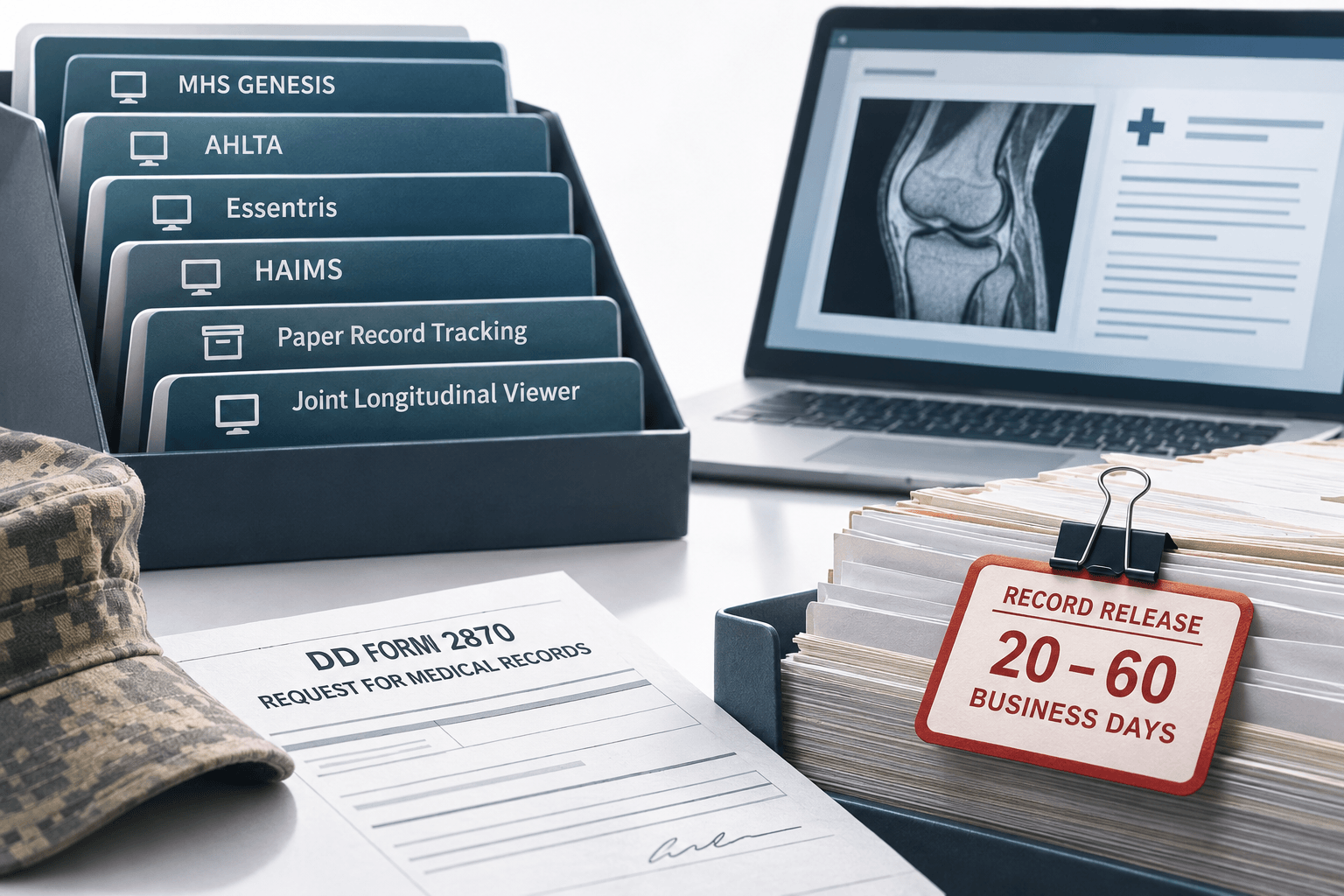
On post, a records processor opens his request and starts looking. The MRI images are in one system. The visit notes are in another. His deployment physical from 2012 sits in the system the hospital used before GENESIS, and the chart from his first enlistment may be in a box. The Government Accountability Office watched desks like this one work this year and listed what a processor opens to assemble one record: MHS GENESIS, AHLTA, Essentris, HAIMS, Paper Record Tracking, and the Joint Longitudinal Viewer. [1] Six logins for one knee.
Then every page gets read for someone else's name. Redaction is "the most cumbersome part" of the job, GAO found, especially for large or scanned files, and one facility reported a single 10,000-page record took about six days. [1] The sergeant's file is nowhere near that size, but it sits in the same queue. The patient portal does not get him around it. One official estimated the portal shows about 40 percent of a record, and the hospital pages that explain it to patients note that nothing from before GENESIS is there. [1][5]
How long he should expect to wait depends on which hospital he wrote to. DHA's manual says 30 business days. [3] Facility pages post anywhere from 20 duty days to 60 business days, and I want to be careful with those numbers, because a posted standard is a promise. [5][6][7][8] GAO asked for the measurement and could not get one: 133 of 547 facilities reported release data, and the agency could not confirm the numbers it had. [1] The desks are short-handed too. Two of the four facilities GAO visited reported staffing challenges, with hiring freezes limiting backfill, and one of them had worked out its own fix, an arrangement in which a facility with spare processors takes work from one without. [1] Hold onto that one.
So the sergeant waits on a number the system has not measured. Another copy of his record, meanwhile, moves without a desk at all.
The copy that moves on its own
If the sergeant had separated this summer instead of going home, his service treatment record would have reached VA without anyone filling out a form. When a veteran files a claim, the Veterans Benefits Administration's system requests the record from HAIMS on its own, for anyone whose service ended on or after January 1, 2014. [1] AHLTA Web Print feeds the same channel. [9] On the clinical side, the joint Health Information Exchange carries prescriptions, labs, and notes between military clinicians and civilian providers on the two big national networks, and it has reached more than 90 percent of American hospitals since 2023. Active-duty members cannot opt out of it, which is a readiness decision and the right one. [10][11]
In September the White House put a clock on that path. Executive Order 14426, signed September 8, directs the Secretary of War to send a departing member's personnel file, health record, and service treatment record to VA "immediately when a service member is discharged or released from the Armed Forces." [12] The requirement took effect within 30 days, on October 8. A review of the two departments' IT contracts for interoperability is due about January 6, and updated systems and policy about March 7. [12]
The order says nothing about the member's own copy. [12] That is fine; it was written to speed up benefits, and it does. But set the two paths side by side. The government gets the sergeant's record the day he leaves, system to system, with an executive order behind it. The sergeant mails a form and waits for a number of days that changes with the hospital. The Military Health System can move a record across a department line without a human touching it, and it can learn to hand the same record to the man it belongs to in a week. The plumbing for the first proves the second can be built, and most of that plumbing is already in the building.
What is already on the shelf
The manual starts a clock the day his request lands. DHA-PM 6025.02 tells a facility to raise any request still open on the tenth working day to the hospital director. [3] Kenner Army Health Clinic's local policy records every disclosure in the PHI Management Tool. [8] Put those two facts together and DHA already generates the data a turnaround metric needs; a day-10 escalation is a timestamp, and a disclosure log is a completion date. The numbers GAO could not get exist at the facility level. They have not been rolled up.
The six systems the processor opened are already being closed. DHA has archived the old CHCS system at 26 facilities and Essentris at 31, with AHLTA in progress, according to its archiving vendor, and its Legacy Evolutionary Analytics office exists to take retired systems off the books. [13] DHA's February privacy assessment for AHLTA says its capabilities "are expected to be fully subsumed by MHS GENESIS" no later than October 2026. [14] Whether that date held is an open check as I write, and it is the most useful date on the records desk's calendar, because every retired system is one fewer login per request. DHA has also been shopping for a Legacy Data Consolidation Solution for health information assets, one archive for what the old systems held. [15] Build it so a records processor can search it, and the sergeant's six logins become two: GENESIS and the archive.
The platform can export. Oracle Health's certified modules include an electronic health information export capability and the FHIR interfaces the federal rules require. [16] Whether DHA has turned on single-patient export inside GENESIS is a question I could not answer from public documents, and it is the first one I would ask, because an export button is most of a records desk.
The facility fix scales. The arrangement GAO found, one facility's spare processors working another's queue, is a network staffing model in miniature, and DHA's nine Defense Health Networks are the natural place to run it on purpose. [1]
And leadership has already signed up for the next step. GAO's fifth recommendation asks the Assistant Secretary of War for Health Affairs, working with the DHA Director, to fold records processing into DHA's study of its health informatics business function, and it names the options plainly: "consolidating databases or using artificial intelligence." [1] The Department of War concurred. [1] That study traces to a 2025 GAO recommendation on medical facility management, which DHA set out to complete by March 31, 2026 and had not reported finishing as of April. [17] Keith Bass, sworn in as Assistant Secretary of War for Health Affairs in January, and Vice Adm. Darin Via, who has run DHA since February, now own a study with a concrete first deliverable waiting in it. [18][19] Dr. Jesus Caban's chief data and AI office owns the tools. [20]
Two agencies next door have already shown what the finished version looks like.
Next door
VA publishes one page, on VA.gov, that tells every veteran in the country the same thing: a request for health records is filled within 30 calendar days if the record is electronic and 60 if it is paper, the veteran gets a letter if the request will run long, and a request sent by secure message is acknowledged within three business days. [21] One standard, in calendar days, with a delay notice and a digital front door. VA runs that standard on the same Oracle Health platform DHA uses, now live at 19 of its own sites with 26 more planned for 2027. [22] The two departments are converging on one record. A shared release standard is the obvious next thing to converge on.
The National Personnel Records Center shows what a surge looks like. In 2024 the National Archives announced it had cleared a backlog of more than 600,000 veteran records requests through digitization, added staff, contract labor, and a digitization partnership with VA, and it now answers most routine requests in under a week. [23] Congress had set the yardstick two years earlier: the Access for Veterans to Records Act, in the FY2023 defense bill, required a plan with metrics, counts of requests pending at 20, 90, and 365 days, and updates until 90 percent of requests were filled within 20 days. [24] That is a reporting template DHA could adopt tomorrow without waiting for anyone to write it into law.
On redaction, the step GAO called the most cumbersome, the Department of Health and Human Services is piloting AI-assisted review and redaction for its own records requests, with a human reviewer on every release. [25] The State Department ran an earlier pilot and told the FOIA Advisory Committee what it learned: the tools handle names, Social Security numbers, and email addresses well, and struggle with exemptions that need judgment. [26] A health record is the favorable case. Most of what a processor redacts from a service member's file is an identifier, and identifiers are what the tools do best.
Who else is in line behind him
The sergeant is one requester, and the people behind him in the queue are the moments a military family remembers. TRICARE tells sponsors to request their records at least a month before a permanent change of station, and Tripler Army Medical Center's page explains that records cannot be hand-carried and are moved on request from the next duty station, so a family's continuity of care on arrival runs through the desk. [27][28] A service member in the disability evaluation system is on a 180-day clock, and the Department of War's 2024 report to Congress on that system lists "timely retrieval of Service Treatment Records for MEB provider review" as a priority. [29] A veteran seeking a discharge upgrade is advised to include medical records that show a relevant diagnosis, and the Army's review boards warn that a decision can take up to a year. [30]
Then there is exposure. Service members gained direct access to their Individual Longitudinal Exposure Record in March, and veterans were to get access, with a way to request corrections, by October; VA has estimated that about 48 percent of veterans screened had at least one potential exposure. [31] GAO noted that members who find gaps in that record may be frustrated by what is missing, and the full health record is where they will go next. [31] A faster desk is part of the PACT Act's last mile, whether or not anyone planned it that way.
Congress has noticed the person's side of the record. The House's FY27 defense bill carries a pilot program on a secure, mobile personal health record for members of the Armed Forces, and the Senate's carries a capability prototype on secure access to the health record. [32] Both wait on the lame-duck reconciliation, and either would put the same question on DHA's desk that this issue does: what does a service member see, and how fast.
What is fair to say
The data is thin, and GAO says so. The six-day record and the 40 percent portal estimate are single examples, 75 percent of reporting facilities saw no consistent rise in request volume, and the agency could not confirm its own release numbers. [1] The Department of War also told GAO that its digital transformation effort, with a 2029 horizon, is where records processing will be addressed. [1]
My read is that both points argue for the fix. The data is thin because the escalations and disclosure logs the manual already requires have never been rolled up, and rolling them up is the cheapest item on the list below. A 2029 horizon is a reason to put an early milestone on the calendar, so the informatics study can show a result inside a fiscal year while the larger work continues. Volume is beside the point. The effort per request is the problem, and effort is what consolidation and tooling reduce.
Five steps, each with an owner
Every one of these builds on something DHA already owns, and the owners are my proposals, offered as a starting point.
Publish one standard. This belongs to the Assistant Secretary and the DHA Director, in the next revision of DHA-PM 6025.02: a single enterprise standard in calendar days, posted nationally the way VA posts its own, with a delay letter when a request will run long. [3][21] The measure is the share of requests closed within 30 calendar days. The sergeant reads one number before he mails the form.
Roll up the log. This belongs to DHA's Privacy and Civil Liberties Office, and it could be done by the second quarter of fiscal 2027. The day-10 escalations and the PHI Management Tool entries already exist at every facility. [3][8] Pull them into one quarterly number and publish it, and the metric GAO could not get becomes a metric DHA reports on its own terms.
Make the archive the release source. This belongs to the DHA chief information officer and the Legacy Evolutionary Analytics office, and the date is whatever the AHLTA absorption date turns out to be. [13][14] When a legacy system's data lands in the consolidation archive, the records desk should be able to search the archive, and the processor's login to the old system should be retired along with everyone else's. The measure is systems opened per request. Six today; two is the goal.
Pilot assisted redaction with a human on every release. This belongs to the chief data and AI office with the Privacy office, inside the assessment GAO's fifth recommendation asks for, with a fiscal 2027 pilot behind it. [1][20] Scope it to identifiers, which is where HHS and State found the tools reliable, and measure hours per thousand pages and the error rate on quality review. [25][26] The sergeant's MRI report has his own name on every page and perhaps a technician's; a tool can find those in seconds, and a person can approve the file in minutes.
Open a digital door and close the email one. This belongs to the Solution Delivery Division: a request submitted through the GENESIS portal's secure messaging, as VA does, and a standard secure electronic delivery back. [21] Some facilities still take requests on paper, by email, or in person, and the same report that counted improper releases found most of the Navy's came from unsecured email. [1] A digital door is a privacy control as much as a convenience.
Two things sit beside those five. The Defense Health Networks can pool release work across facilities on purpose, building on the agreement GAO found, with backlog by network as the measure. [1] And the Federal Electronic Health Record Modernization office, which already holds the two departments' joint decisions on the shared record, is the right place to write one DoW-VA release standard, aligned to the executive order's 180-day milestone in March. [12] A veteran who separated last year and a sergeant who drilled last weekend should read the same page and get the same number.
What to watch
January 6 is the executive order's deadline for the two departments to review their IT contracts for interoperability, and it is the first public moment at which the person's path could be added to the government's. [12] March 7 is the systems and policy milestone. [12] In between, three facts will settle how big the records job really is: whether AHLTA was absorbed on DHA's October target, whether veteran access to ILER launched on VA's, and whether single-patient export is live in GENESIS. [14][31][16] The informatics study has no public date; GAO's fifth recommendation gives it a first chapter. [1] And the lame-duck defense bill will decide whether the personal health record pilot survives conference. [32]
Back to the sergeant
The good version of his request is close, and every piece of it is something DHA has already built or already promised. He submits the DD 2870 through the portal from his kitchen table and gets an acknowledgment in three business days. A processor opens GENESIS and the archive, and the MRI comes with them. A tool flags the identifiers and a person approves the release. The file reaches the sergeant, the readiness NCO, and the surgeon's office by secure delivery inside the published standard, and the line-of-duty determination moves on the record instead of waiting for it. He is back on the drill floor by spring with a repaired knee and a complete file, which is the whole point of a line-of-duty system.
The sergeant is a figure I built from the regulation, the manual, and GAO's report. The desk is real, and so are the escalation rule at day ten, the archive being filled, the arrangement one facility made to help another, and the recommendation the department has already accepted. DHA finished the clinic. The desk is the same work, closer to the person, and it is the part a Guard sergeant will remember.
Let's roll.
— Mary
Mission Meets Tech
The views expressed in this newsletter are my own and do not represent the official position of any organization. This content is for informational purposes only.
MMT Premium
This issue follows one records request through the desk. Premium's Capture Corner and monthly Capture Intelligence Sheets track the archive buy, the redaction market, the standards, and the bill text underneath it, with sourced action windows.
Founding Member rate: $199/year, locked permanently for the first 100 subscribers.
Standard rate: $249/year or $29/month.
Premium adds 48-hour early access to deep-dive analysis, monthly Capture Intelligence Sheets with sourced action windows, direct Q&A access (reply to any premium issue), and tool discounts: ProposalPulse $14.99 per assessment, MarketPulse $35 per brief.
Subscribe at missionmeetstech.com/pricing.
Sources
[1] U.S. Government Accountability Office, "Service Member Records: DOD Needs to Address Improper and Delayed Releasing of Personnel and Health Information," GAO-27-107784, October 16, 2026. Source for: the systems a processor checks to assemble a health record, including MHS GENESIS, AHLTA, Essentris, HAIMS, Paper Record Tracking, and the Joint Longitudinal Viewer, and the note that pre-2014 records may be on paper (pp. 23-24 and Table 4); redaction as "the most cumbersome part," especially for large or scanned files (p. 26); the 10,000-page record that took about six days at one facility (pp. 26-27); one official's estimate that the patient portal holds about 40 percent of the record (p. 24, fn. 36); 133 of 547 facilities reporting release data and GAO's inability to confirm reliability; 75 percent of reporting facilities seeing no consistent increase in volume; staffing challenges at two of four visited facilities and hiring freezes (pp. 28-29); the cost-sharing arrangement between facilities (p. 29); VBMS requests to HAIMS for service ending on or after January 1, 2014 (Table 4); the Navy's improper releases traced largely to unsecured email; DOD's statement that its 2029 digital transformation covers records processing (p. 27); and Recommendation 5, with DOD's concurrence (p. 31). https://www.gao.gov/products/gao-27-107784
[2] Army Regulation 600-8-4, "Line of Duty Policy, Procedures, and Investigations," and Defense Health Agency, Military Medical Support Office. Source for: medical documentation "sufficient to substantiate the medical condition" in a line-of-duty determination, and the line-of-duty determination and clinical documentation required before civilian care is authorized for reserve component members. https://ga.ng.mil/Portals/49/G1/documents/SOP/2025/MEDICAL/05RCMC/AR%20600-8-4.pdf and https://health.mil/mmso
[3] Defense Health Agency Procedures Manual 6025.02, Volume 1, "DoD Health Record Lifecycle Management." Source for: DD Form 2870 as the release authorization; copies provided at no cost to the patient; the 30-business-day processing standard; and escalation of open requests to the MTF Director at the tenth working day. https://www.health.mil/-/media/Files/MHS/Policy-Files/DHAPM602502DoDHealthRecordVol1.ashx
[4] Director, Operational Test and Evaluation, "DoD Healthcare Management System Modernization (DHMSM)," FY2024 Annual Report. Source for: MHS GENESIS full deployment in March 2024. https://www.dote.osd.mil/Portals/97/pub/reports/FY2024/dod/2024dhmsm(r).pdf
[5] Carl R. Darnall Army Medical Center, Patient Administration Department. Source for: the posted 30-to-60-business-day timeline, same-day fulfillment of requests of 10 pages or fewer, and the note that pre-GENESIS encounters are not in the patient portal. https://darnall.tricare.mil/Patient-Resources/Related-Links/Patient-Administration-Department
[6] U.S. Naval Hospital Yokosuka, Medical Records. Source for: the posted 30-business-day timeline. https://yokosuka.tricare.mil/Patient-Resources/Patient-Administration-Readiness/Medical-Records
[7] Joint Base Elmendorf-Richardson, 673d Medical Group, Medical Records Release of Information. Source for: the 20-duty-day commitment. https://elmendorfrichardson.tricare.mil/Health-Services/Other/Medical-Records-Release-of-Information
[8] Kenner Army Health Clinic, HIPAA Policy 25-43. Source for: the posted 30-calendar-day timeline and the recording of disclosures in the PHI Management Tool. https://kenner.tricare.mil/Portals/64/Documents/LTC%20Bailey%20Policies/KAHC%20HIPAA%20Policy%2025-43-%20DIR%20Signed.pdf
[9] Defense Health Agency Procedures Manual 6025.02, Volume 2, "Outpatient Record Components and Dental Records." Source for: AHLTA Web Print uploads to the Veterans Benefits Administration through HAIMS. https://health.mil/-/media/Files/MHS/Policy-Files/DoD-Health-Record-Lifecycle-Management-Vol-2-Outpatient-Record-Components-and-Dental-Records.ashx
[10] Health.mil, "Joint Health Information Exchange," and DVIDS, June 28, 2024. Source for: the exchange reaching more than 90 percent of U.S. hospitals since 2023 through eHealth Exchange and CommonWell. https://www.health.mil/Military-Health-Topics/Technology/Joint-HIE and https://health.mil/News/Dvids-Articles/2024/06/28/news474999
[11] TRICARE, "Military Health Records." Source for: active-duty members' inability to opt out of the health information exchange. https://tricare.mil/PatientResources/MedicalRecords/MilitaryHealthRecords
[12] Executive Order 14426, "Accelerating Access to Veterans' Benefits and Employment Opportunities," signed September 8, 2026, 91 Fed. Reg. 58003, September 11, 2026. Source for: Section 2(a)(iii), records to VA "immediately when a service member is discharged or released from the Armed Forces," effective within 30 days; Section 2(b), the 120-day IT contract interoperability review; Section 2(a)(i), updated systems and policy within 180 days; the absence of any provision on a service member's own access; and Section 4(c) on enforceable rights. https://www.govinfo.gov/content/pkg/FR-2026-09-11/pdf/2026-18738.pdf
[13] MediQuant, "DHA Chooses MediQuant," and Health.mil, Solution Delivery Division, "Legacy Evolutionary Analytics." Source for: CHCS archived at 26 facilities and Essentris at 31 with AHLTA in progress (vendor-stated), and the office's role in retiring systems no longer in use. https://mediquant.com/dha-chooses-mediquant/ and https://www.health.mil/Military-Health-Topics/Technology/Solution-Delivery-Division/Legacy-Evolutionary-Analytics
[14] Health.mil, Privacy Impact Assessment, DD Form 2930, "Armed Forces Health Longitudinal Technology Application," February 19, 2026. Source for: "AHLTA capabilities are expected to be fully subsumed by MHS GENESIS, DoD's modernized EHR, NLT October 2026." https://www.health.mil/Reference-Center/Forms/2026/02/19/Armed-Forces-Health-Longitudinal-Technology-Application
[15] OrangeSlices AI, "DHA RFI: Enterprise Intelligence and Data Solutions (EIDS) Program, Legacy Data Consolidation Solution (LDCS) Requirement." Aggregator summary of a DHA request for information; verify against the SAM.gov notice. https://orangeslices.ai/dha-rfi-enterprise-intelligence-and-data-solutions-eids-program-legacy-data-consolidation-solution-ldcs-requirement/
[16] Oracle, "Oracle Health Certified Health IT." Source for: certified modules including electronic health information export and FHIR-based application programming interfaces. Whether single-patient export is enabled in MHS GENESIS is not stated in public DHA documents reviewed for this issue. https://www.oracle.com/health/certified-health-it/
[17] U.S. Government Accountability Office, "Defense Health Care: Actions Needed to Address Long-Standing Management Challenges with Medical Facilities," GAO-25-107432. Source for: the recommendation to study DHA's business functions, DOD's March 31, 2026 target, and the absence of a reported update as of April 2026. https://www.gao.gov/products/gao-25-107432
[18] Health.mil, "Bass Appointment," January 12, 2026. Source for: Keith Bass sworn in as Assistant Secretary of War for Health Affairs. https://www.health.mil/News/Articles/2026/01/12/Bass-Appointment-DOW
[19] Defense Health Agency, "'We Are a Combat Support Agency,' says new DHA Director," February 12, 2026. Source for: Vice Adm. Darin K. Via assuming the role of DHA Director on February 2, 2026. https://dha.mil/News/2026/02/12/18/57/We-Are-a-Combat-Support-Agency-says-new-DHA-Director
[20] Defense Health Agency, Chief Data and Artificial Intelligence Office. Source for: Dr. Jesus Caban as DHA's chief data and AI officer. https://dha.mil/Offices-and-Programs/CDAO
[21] Department of Veterans Affairs, "How to get your medical records from your VA health facility," VA.gov, and VA News, "How to request your VA health records: a step-by-step guide." Source for: up to 30 calendar days for electronic records and 60 for paper, a letter if a request will take longer, and secure-message requests acknowledged within three business days. https://www.va.gov/resources/how-to-get-your-medical-records-from-your-va-health-facility/ and https://news.va.gov/147373/how-to-request-your-va-health-records-a-step-by-step-guide/
[22] Department of Veterans Affairs, Electronic Health Record Modernization, "VA deploys electronic health record system to hospitals in Cleveland, Anchorage," October 26, 2026. Source for: 13 hospitals deployed in 2026, 19 VA sites on the Federal EHR in total, and 26 planned for 2027. https://digital.va.gov/ehr-modernization/news-releases/va-deploys-electronic-health-record-system-to-hospitals-in-cleveland-anchorage/
[23] National Archives and Records Administration, press release NR24-10, 2024, and "NPRC Backlog Cleared Ceremony." Source for: the backlog of more than 600,000 requests cleared through digitization, added staff, contract labor, and a VA digitization partnership, and routine requests now answered in under a week. https://www.archives.gov/press/press-releases/2024/nr24-10 and https://www.archives.gov/news/articles/nprc-backlog-cleared-ceremony
[24] U.S. Senate, Report 117-265, accompanying the National Defense Authorization Act for Fiscal Year 2023, Access for Veterans to Records Act. Source for: the required plan with metrics, counts of requests pending at 20, 90, and 365 days, and reporting until 90 percent of requests are fulfilled within 20 days. https://www.govinfo.gov/content/pkg/CRPT-117srpt265/html/CRPT-117srpt265.htm
[25] Department of Health and Human Services, 2026 Chief FOIA Officer Report, Section 1. Source for: the AI-assisted review and redaction pilot with human review. https://www.hhs.gov/foia/reports/chief-foia-officer-reports/2026-section-1/index.html
[26] National Archives and Records Administration, Office of Government Information Services, FOIA Advisory Committee meeting minutes, September 7, 2023. Source for: the State Department pilot's finding that AI tools handle names, Social Security numbers, and email addresses well and struggle with judgment-based exemptions. https://www.archives.gov/ogis/foia-advisory-committee/2022-2024-term/meetings/foiaac-minutes-2023-09-07
[27] TRICARE, "Moving," frequently asked questions. Source for: the advice to request medical records at least one month before a permanent change of station. https://tricare.mil/FAQs/general/GEN_pcs
[28] Tripler Army Medical Center, "Medical Records." Source for: records cannot be hand-carried and are transferred on request from the next duty station. https://tripler.tricare.mil/Getting-Care/Medical-Records
[29] Department of Defense, "Accountability for Wounded Warriors Undergoing Disability Evaluation," report to Congress, March 28, 2024. Source for: the 180-day goal from referral, about 72 days for the medical evaluation board phase, and "timely retrieval of Service Treatment Records for MEB provider review" as a priority. https://www.health.mil/Reference-Center/Reports/2024/03/28/Accountability-for-Wounded-Warriors-Undergoing-Disability-Evaluation
[30] Office of the Under Secretary of War for Personnel and Readiness, Office of Legal Policy, discharge review guidance, and Army Review Boards Agency, ACTS Online frequently asked questions. Source for: the advice to include medical records showing a relevant diagnosis, and the Army board's statement that decisions can take up to 12 months. https://prhome.war.gov/Home/Organization/OXD/OLP/ and https://actsonline.army.mil/gui/PublicFAQ.aspx
[31] U.S. Government Accountability Office, "Military Health Care: Information on Use of and Access to Toxic Exposure Records," GAO-26-108483, July 22, 2026. Source for: service member access to ILER in March 2026, planned veteran access and correction requests by October 2026, VA's estimate that about 48 percent of screened veterans had at least one potential exposure, and the observation that members may be frustrated by missing or incomplete exposure information. Whether veteran access launched on schedule is not confirmed in public documents as of this issue. https://www.gao.gov/products/gao-26-108483
[32] H.R. 8800, National Defense Authorization Act for Fiscal Year 2027, as reported, Section 761, "Pilot Program on Secure, Mobile Personal Health Record for Members of the Armed Forces," and S. 4784, National Defense Authorization Act for Fiscal Year 2027, as reported, Section 721, "Development of capability prototype on secure access to health record for members of the Armed Forces." Cited at the section-title level; the two chambers are reconciling the bills informally in the lame-duck session. https://rules.house.gov/sites/evo-subsites/republicans-rules.house.gov/files/documents/h-rept-119-698-fy27-ndaa-report-as-filed.pdf and https://www.govinfo.gov/content/pkg/BILLS-119s4784rs/pdf/BILLS-119s4784rs.pdf
Sources verified as of November 2, 2026.