The Clause That Opens on January 6
EO 14426 Section 2(b) contract review · contracts in scope · how a mandatory requirement enters a live IDIQ · the identity seam no incumbent owns · the AI single-source clause as a procurement · calendar through March 2027
★ Premium Capture Corner
Executive Order 14426 gives the Secretaries of War and Veterans Affairs 120 days to review and modify every existing medical and personnel IT contract to add one word, interoperable, with no metric, no owner, and no standard behind it. This Capture Corner works the buy underneath that sentence: which contracts Section 2(b) plausibly reaches, from the Oracle EHRM agreement VA just extended by up to $17 billion while Congress subpoenas its executives, through the MHS GENESIS teardown, IPPS-A, DMDC's DEERS support and VBMS; how a mandatory requirement enters a live IDIQ under FAR Part 43 and who prices it; the identity reconciliation seam across DEERS, VADIR and the Master Person Index that no incumbent owns; the 180-day AI clause read as a procurement; the three deliverables a bilateral mod could carry; and every dated event from October 8 through March 7, 2027.
See premium plansCapture Corner is the premium BD intelligence companion to Mission Meets Tech. Public-record sourced. Independent analysis. Not a recommendation, not vendor advocacy, not capture material. Built for federal health BD, capture, and proposal leaders who need analytical depth, not headlines.
This issue is the companion to "VA's Manual Tells Raters to Enter Service That Never Happened," published this week. The public piece names where the veteran's record fails between the personnel system and the rater's desk. This one works the procurement underneath it: the one sentence in the order that reaches into existing contracts, which contracts it plausibly reaches, how a requirement gets added to a live vehicle and who prices it, the identity reconciliation seam that no current contract covers, the 180-day AI clause read as a buy, and every dated event between now and March 7, 2027.
1. The picture at a glance
| Field | Detail |
|---|---|
| Order | Executive Order 14426, signed September 8, 2026; 91 FR 58003, published September 11, 2026 [CC1][CC2] |
| Sec. 2(a)(iii) | Within 30 days (October 8, 2026) and at all times after: OMPFs, health records, and STRs shared with VA immediately at discharge or release. No reporting requirement attached [CC1] |
| Sec. 2(b) | Within 120 days (January 6, 2027): SecWar and SecVA, consulting HHS including ONC and OMB including the Federal CIO and OFPP Administrator, review and modify existing IT contracts "to the extent consistent with law and Federal procurement policy," add an interoperability requirement, and require it in all future medical and personnel IT contracts [CC1] |
| Sec. 2(a)(i) and (ii) | Within 180 days (March 7, 2027): updated IT systems and policy for permanent, prospective sharing of OMPF and STR from entry into service; and new AI digital tools delivering benefits and DOL job training in a single source [CC1] |
| Sec. 3 | Within 180 days (March 7, 2027): TAP updated so every separating member is connected to a specific open job or enrolled in training, and connected to a benefits representative [CC1] |
| Sec. 4(b) | Implementation subject to the availability of appropriations; FY2027 begins October 1 [CC1] |
| Largest contract plausibly in scope | VA EHRM with Oracle Health; August 20, 2026 modification adding up to about $17 billion, ceiling from about $10 billion to about $27 billion, period of performance through May 16, 2031 [CC3] |
| Live oversight on that contract | September 2, 2026: House Veterans' Affairs Committee voted 19 to 0 to subpoena Oracle's chairman and CEO after Oracle withdrew from the hearing; GAO told the committee VA had not fully implemented 14 of 18 recommendations. Total program cost has been reported near $48 billion, a separate figure from the $27 billion contract ceiling [CC31][CC32] |
| Largest DoD contract plausibly in scope | MHS GENESIS sustainment under the Leidos Partnership for Defense Health, in a planned teardown into direct platform contracts. DHA posted a sole-source notice of intent on June 9, 2026 naming Oracle Health, Philips, Amwell, Henry Schein, and Solventum; the target for ending Leidos's Oracle-specific role is November 2026, with performance start on the direct contracts bounded at no later than July 2027 and Leidos bridged in between [CC4][CC5] |
| Personnel systems named by category | "any other military personnel records system": IPPS-A (Army), NP2 (Navy), AFIPPS (Air Force), MCTFS (Marine Corps), Coast Guard Direct Access, and the OMPF repositories behind DPRIS [CC1][CC6] |
| The seam with no contract | Identity reconciliation across DEERS (DMDC), VADIR (VA), and VA's Master Person Index [CC7][CC8] |
Confidence: High on the order text, every deadline, and the statutory citations, read from the White House posting and the Federal Register. High on the Oracle modification, the GENESIS teardown notice, and the subpoena vote, confirmed against SAM.gov data as reported, the June 9 notice, and the committee's own release. Medium on the teardown performance dates, which are targets and outer bounds from trade reporting. Medium on the personnel-side incumbents, where a targeted search found no current enterprise-level prime for HAIMS, VBMS, DMDC support, VADIR, or FEHRM support, and the work appears fragmented across task-level awards; confirm in FPDS before anything goes on a pipeline sheet.
The lead finding for a capture team: Section 2(b) is the first executive instrument that names personnel records systems in the same sentence as health records systems and orders them made interoperable by contract. The clause carries no metric, no owner, and no reporting. The 120 days end on January 6, 2027, inside a fiscal year that started under a continuing resolution or close to it, and the modifications it produces will be bilateral, which means every incumbent gets to write the first draft of what "interoperable" means for its own system. The team that brings the definition, the measure, and the price to the contracting officer before January 6 sets the terms. The team that waits for the mod letter answers them.
Developing as this goes to press (September 13). The largest contract the Section 2(b) review reaches is the one Congress is subpoenaing executives over. VA added up to about $17 billion to the Oracle EHRM agreement on August 20 without competition. On September 2 Oracle withdrew from a House Veterans' Affairs Committee oversight hearing after accepting the invitation, and the committee voted 19 to 0 to subpoena Larry Ellison and Mike Sicilia. GAO testified that VA had not fully implemented 14 of 18 recommendations and still lacks a complete cost estimate and integrated master schedule. Military Times reported VA's total program estimate near $48 billion through 2031, which is lifecycle cost, distinct from the $27 billion contract ceiling; do not conflate them. For the January 6 review this means the incumbent with the most scope to modify has the least appetite to volunteer any, and the department with the most to gain from a real metric is the one under the sharpest oversight. [CC31][CC32]
2. What the clause says, word by word
Confidence: High. Verbatim from the order.
The operative sentence: the Secretaries "shall review and modify, to the extent consistent with law and Federal procurement policy, any existing contracts for information technology systems and software relevant to the purpose of this order, including by adding a requirement that such systems be interoperable with any other military personnel records system, health records system, or Service Treatment Records system operated by the Department of War and the Department of Veterans Affairs, and shall ensure that all future contracts for medical and personnel information technology systems and software include this requirement." [CC1]
Five things a capture team should read out of that.
"To the extent consistent with law and Federal procurement policy." That is the phrase that makes the modifications bilateral. A contracting officer cannot unilaterally add a requirement outside the scope of a competed award without inviting a scope protest, and cannot add work without an equitable adjustment where the contract's changes clause applies. The order does not attempt to override that. It defers to it. [CC1][CC9]
"Relevant to the purpose of this order." The purpose in Section 1 is personnel file and medical record sharing between the two departments. That is broad enough to reach the EHRs, the claims system, the STR repository, the identity systems, and every service personnel platform. It is also vague enough that the two Secretaries decide the list, and the list is the first deliverable to watch for. [CC1]
"Any other military personnel records system." This is the new territory. Health IT interoperability has a federal definition, a certification program, a national standard set, and a consultation partner named in the same sentence (ONC). Personnel records systems have none of that. The sentence orders the same word applied to both. [CC1][CC10]
"Operated by the Department of War and the Department of Veterans Affairs." Read literally, the interoperability target is systems operated by both departments, which excludes the Department of Labor systems the AI clause depends on and excludes Coast Guard systems under DHS unless the Secretaries read "military personnel records system" to include them. Expect a definition memo. [CC1]
"All future contracts." The forward clause is the durable one. Whatever definition the two departments adopt by January 6 becomes a standard term in every medical and personnel IT solicitation after that, which makes the definition itself the competition. [CC1]
What the sentence does not contain: a metric, an office of primary responsibility, a reporting cadence, a deadline for the modifications themselves (the 120 days is for the review), or any reference to a standard. The three deliverables in Section 6 are what a capture team can propose to fill that space.
3. Contracts plausibly in scope
Confidence: High on the Oracle EHRM row and the GENESIS teardown notice. Medium on the teardown dates. Medium on the personnel side, where IPPS-A is now confirmed and the rest are not. Every value below should be confirmed in FPDS before it goes on a pipeline sheet.
| System | Department, office | What "interoperable" would touch | Incumbent and status |
|---|---|---|---|
| VA EHRM (Oracle Health) | VA, EHRM Integration Office | Already exchanges with DoD through the joint HIE; the gap is claims-side: VBA cannot pull Oracle records into VBMS (Section 5 of the public issue). A clause here could require a VBMS-facing extract or FHIR bulk endpoint | Oracle Health; IDIQ 36C10B18D5000 from 2018, renegotiated May 2023 into one-year terms with 28 performance metrics; August 20, 2026 modification adding up to about $17 billion to a ceiling near $27 billion through May 16, 2031; executives under House subpoena as of September 2 [CC3][CC11][CC31] |
| MHS GENESIS (Oracle Health platform, Leidos integrator) | DoW, PEO DHMS / DHMSM | Same platform as VA's; the clause is largely satisfied on the clinical side. Exposure is the teardown: every direct platform contract is a "future contract" under 2(b) and must carry the forward requirement | Leidos Partnership for Defense Health, 2015 award, original ceiling $4.3 billion per CRS, later raised. June 9, 2026 sole-source notice of intent names Oracle Health, Philips, Amwell, Henry Schein, and Solventum for direct contracts. November 2026 is DHA's target to end Leidos's Oracle-specific management role; performance start on the direct contracts is bounded at no later than July 2027, with Leidos retained on sole-source bridges in between. Reported [CC4][CC5][CC12] |
| HAIMS | DoW, DHA | Authoritative repository for the STR; already answers VBMS automated requests. A clause could require system-generated completeness certification in place of DD Form 2963 signature | Incumbent not verified this session; pull from FPDS [CC13][CC14] |
| VBMS | VA, VBA Office of Business Process Integration | Owns the automated STR request to HAIMS; no equivalent to Oracle/Cerner or joint HIE. Chart Search was the named remedy in 2023 with no public deployment record | Development and sustainment contractors not verified this session; pull from FPDS [CC14][CC15] |
| DEERS / RAPIDS | DoW, DMDC | Authoritative identity and eligibility source; fed by service personnel systems; documented interface failures with IPPS-A in 2023 and 2024. A clause could require published precedence rules and a mismatch metric | DMDC support contractors not verified this session; pull from FPDS [CC7][CC16][CC17] |
| IPPS-A | Army | Definitive personnel system feeding DEERS; the January 2023 integration disenrolled 25,000 TRICARE beneficiaries; the May 2024 corrected dependent file carried about 50,000 updates | CACI, incumbent since the 2015 Increment II award. The Army's 2021 plan for a ten-year sole-source follow-on reported at up to $500 million did not execute after Accenture objected; the program ran on shorter incumbent-only extensions until April 9, 2026, when CACI announced a seven-year contract valued at up to $287 million for Agile development support under MAHC-III. The 2021 retreat from a long sole-source term after industry protest is itself a data point for how the January 6 modifications may be structured [CC17][CC18][CC19][CC33] |
| NP2, AFIPPS, MCTFS, Direct Access | Navy, Air Force, Marine Corps, Coast Guard | Same role as IPPS-A for their services. Navy's own IA guidance documents a 24 to 48 hour NSIPS-to-RAPIDS lag | Incumbents not verified this session [CC20] |
| VADIR | VA, OIT | VA's copy of DMDC data; the crosswalk between EDIPI and VA's ICN lives here and in the MPI. No contract vehicle located that owns reconciliation | VA internal; support contracts not verified [CC8] |
| FEHRM joint HIE | Joint | Exchange layer already live since April 2020; Carequality since 2023. The clause changes little here unless the departments define interoperability as participation in a named exchange | FEHRM support contracts not verified [CC21] |
Two structural observations.
First, on the health side the clause is close to already satisfied, and the departments will be able to say so on January 6 with a straight face: same vendor, same exchange, joint sharing sites. The exposure is at the claims interface and at the teardown, where every new GENESIS platform contract must carry the forward requirement.
Second, on the personnel side the clause is not satisfied and there is no standard to satisfy it with. That is the space where a definition brought to the government before January 6 has the most leverage.
A third observation is a finding, confirmed rather than assumed. A targeted search for a current enterprise-level prime on HAIMS, VBMS, DMDC's DEERS and RAPIDS support, VADIR, and FEHRM joint HIE support found none for any of the five. What surfaces is fragmented and mostly historical: Evolvent and Harris on legacy HAIMS, Booz Allen on legacy VBMS Core, D2 Government Solutions on one DEERS and RAPIDS task order, MITRE on a FEHRM evaluation contract. That fragmentation is why the identity seam in Section 5 has no owner. No single contract holds the reconciliation, so no single contractor is on the hook for it, and no single modification on January 6 can add it. Confirm in FPDS by keyword before capture use.
4. How a requirement enters a live contract
Confidence: High on the FAR mechanics. Medium on how OFPP will treat it, which has no public guidance yet.
FAR Part 43 governs. A modification that adds a requirement is either within the scope of the original competition, in which case the contracting officer can issue it under the contract's changes clause and the contractor is entitled to an equitable adjustment for the added work, or outside the scope, in which case it is a new procurement that must be competed or justified. The order's "consistent with law and Federal procurement policy" language acknowledges both paths and picks neither. [CC1][CC9]
For the IDIQs in scope, expect bilateral supplemental agreements at the task order level rather than base contract changes, because that is where the work and the money are. An interoperability requirement added to an Oracle EHRM task order is priced by Oracle. An interoperability requirement added to a GENESIS sustainment order is priced by Leidos, until the direct platform contracts replace it, at which point it is a term in a new sole-source award and priced there. [CC3][CC4]
Two precedents show the shape of a mandatory requirement added by clause.
CMMC. DFARS 252.204-7021 attached a mandatory cybersecurity requirement to new awards and was inserted into existing contracts by modification where the government chose to. It took years of rulemaking, and the requirement had a defined standard and an assessment regime behind it. [CC22]
Section 508. FAR Subpart 39.2 makes accessibility a required term in IT acquisitions, backed by a published technical standard. [CC23]
Both worked because the word in the clause pointed at a document. "Interoperable" in Section 2(b) points at nothing. The consultation partners named in the order are the tell for what it will point at on the health side: ONC administers the certification program, USCDI, and TEFCA, and a clause that says "conform to the current USCDI version and participate in a qualified exchange" is the path of least resistance for the two departments and for Oracle, which already does both. [CC10]
The personnel side has no ONC. DoD's data standards for person data live in the DMDC-administered identity architecture and in DoDI 1341.02, which names DEERS as the authoritative source and the services' systems as definitive, without a precedence rule between them when they disagree. A capture team that drafts that precedence rule, with a mismatch metric, and offers it as the personnel-side definition of "interoperable" is offering the government the document its own clause is missing. [CC7]
OFPP. The Administrator is named as a consultation partner, which signals a policy memo or a class deviation rather than a FAR case, given the timeline. Watch for it between now and January 6. Whatever it says about scope, equitable adjustment, and the forward clause text is the rulebook for every bid after. [CC1]
5. The seam nobody owns
Confidence: Medium. The system facts are from primary sources. The absence of a contract vehicle is my finding from this session and should be treated as provisional until a capture team pulls the DMDC and VA OIT award records.
The public issue's first break is the one with the least contract coverage. DEERS is authoritative for identity and eligibility. The service personnel systems are definitive for personnel data and feed DEERS. VADIR is VA's copy of DMDC data, matched on SSN, EDIPI, and date of birth under a computer matching agreement. VA's Master Person Index assigns the ICN and stores the crosswalk to EDIPI. [CC7][CC8]
No single office owns the reconciliation across those four. DMDC owns DEERS. The services own their systems. VA OIT owns VADIR and the MPI. When IPPS-A and DEERS disagreed in January 2023, the fix came from the Army and DMDC working the interface. When DEERS failed to send dependent changes back to IPPS-A through mid-2024, the fix came from DMDC adjusting its logic. Neither event produced a published mismatch rate, a precedence rule, or a standing owner. [CC16][CC17]
That is a data governance requirement without a contract. The nearest vehicles that could carry it:
- A DMDC support task order, if one exists with data quality in scope. Not verified this session.
- A DHA enterprise data task order under EIDS, which owns the MHS Information Platform and the beneficiary data feeds into it, and which has the platform to compute a DEERS-to-personnel-system mismatch count. Whether EIDS has the authority to publish one is a different question. [CC24]
- A VA OIT identity services order covering the MPI and VADIR.
- The DHA enterprise Commercial Solutions Opening, HT003826SC005, which any PAE or program office can use and which is built for a short white paper. [CC25]
The deliverable is small and specific: a precedence rulebook by data element, an event-driven update path in place of batch, and a monthly mismatch report by service. The evidence that the count is computable already exists in the May 10, 2024 corrected file of about 50,000 dependent updates. Someone counted it. Nobody was required to publish it. [CC17]
6. Three deliverables a modification could carry
Confidence: Analytical. These are the fixes proposed in the public issue, mapped to the contracts and offices that would carry them.
| Deliverable | Where it lands | The metric | What to have ready before January 6 |
|---|---|---|---|
| Precedence rulebook for identity data, with event-driven updates | DMDC (DEERS), service personnel programs (IPPS-A, NP2, AFIPPS, MCTFS), VA OIT (VADIR, MPI) | Monthly DEERS-to-personnel-system mismatch count by service; VADIR-to-MPI match rate | A two-page rule set by data element (status, dates, dependents, eligibility) with the winning system named for each; a sample report format; a price for the reconciliation run as a recurring service |
| System-generated STR completeness certification | DHA (HAIMS), MTF records cells, Reserve Health Readiness Program | VA rejection rate of certified STRs by service, quarterly, published | A query specification against HAIMS headings (STR MHS GENESIS, STR HRR, dental) that fails on a missing Guard record or civilian-provider dental exam; the 2014 and 2018 IG numbers as the baseline and the proof the mechanism moved |
| Claims-side pull of Oracle and joint HIE records into VBMS, with automated flash | VBA Office of Business Process Integration (VBMS, Chart Search), VA OIT, FEHRM | Percentage of rating decisions decided with the full health record in the eFolder, quarterly, with an owner | The M21-1 automated HAIMS request as the existing trigger; the OIG's 27 percent and its two closed recommendations as the reason a standing measure is needed; the Chart Search history as the reason the government should not accept "in development" as a status |
The common thread is that each deliverable is a measure with an owner, which is the one thing the 2018 STR follow-up audit shows moved a number: Army timeliness from 17 percent in 2014 to 86 percent for FY2016 claims after the instruction was rewritten and a program office was assigned. [CC26]
7. The AI clause, read as a buy
Confidence: Medium. The order text is primary. The platform inventory is from VA privacy impact assessments and the AI use case inventory, not fetched this session.
Section 2(a)(ii) orders, within 180 days, "new digital tools using artificial intelligence and other emerging capabilities" that put benefits applications and DOL job training in a single source. The operative text carries no privacy or security language beyond the statutes cited in 2(a)(i); the White House fact sheet adds "secure" and "consistent with applicable privacy protections," and the fact sheet is not the order. [CC1][CC2]
Read as a procurement, 180 days is not a new build. A new system with an authority to operate, a privacy impact assessment, and a Privacy Act system of records notice does not ship in six months from a standing start. Expect the deliverable to be an existing platform relabeled and extended: VA.gov's benefits flows, the VBA Automation Platform that already carries a FY2025 privacy impact assessment, and the VA AI use case inventory published in January 2026 are the candidates. DOL's contribution will be a data feed or a link. [CC27][CC28]
For a capture team the near-term work is not the AI. It is the integration: the single source needs the identity crosswalk from Section 5 to know that the person on VA.gov is the person in DEERS is the person in the DOL system. The AI clause depends on the seam that the identity clause never names.
The March 7, 2027 deadline for this clause coincides with the Section 2(a)(i) deadline for the permanent sharing architecture and the Section 3 TAP deadline, which means three deliverables from two departments land in the same week, subject to appropriations, with the FY2027 continuing resolution or omnibus as the constraint. [CC1]
8. Calendar through March 2027
Confidence: High on the order deadlines. Medium on the contract events, which are reported plans.
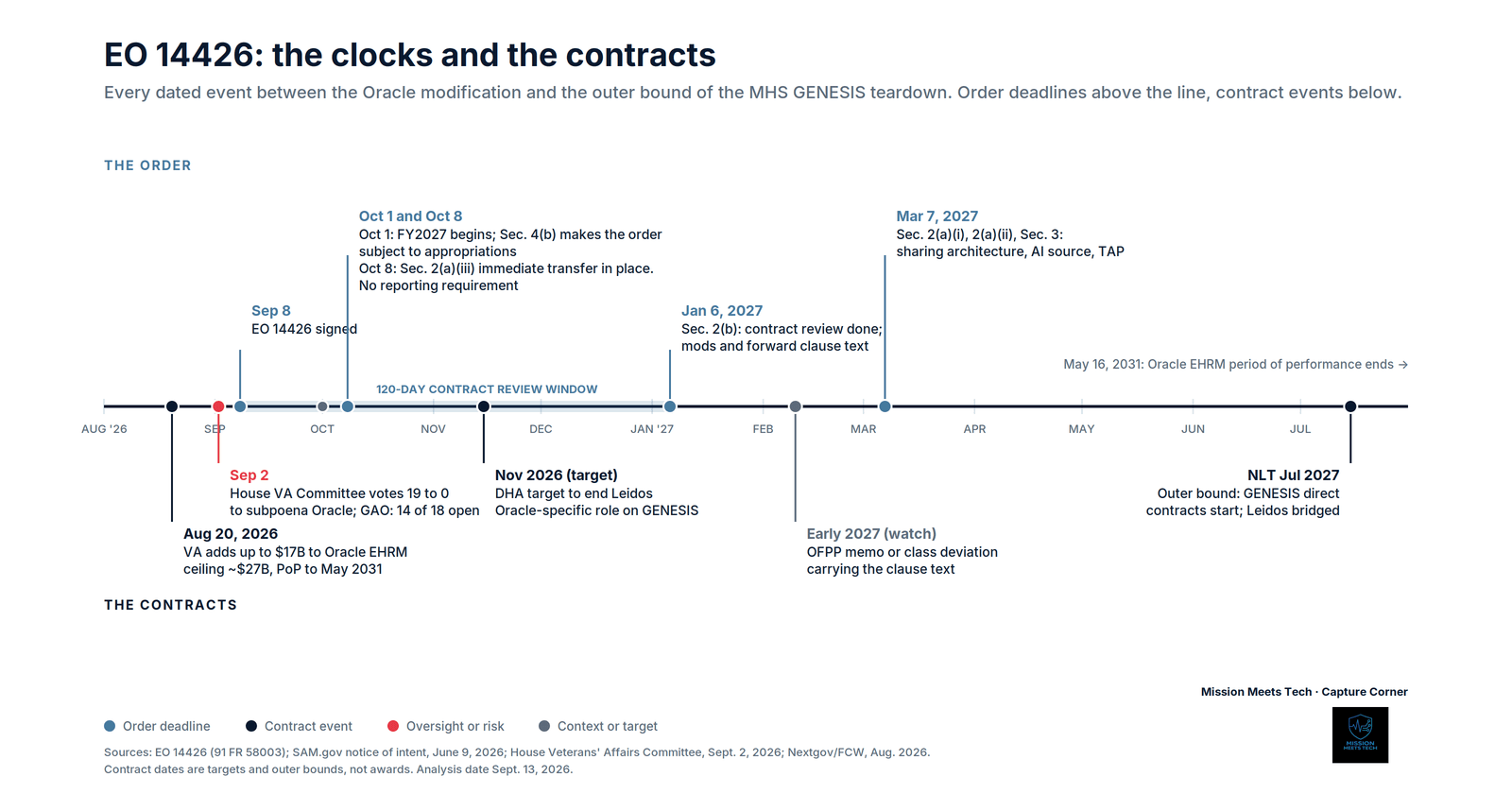
The 120-day review window runs from signature to January 6. Two contract events sit inside it: the November target to end Leidos's Oracle-specific role on MHS GENESIS, and whatever OFPP issues to carry the clause text. Everything the order requires of the departments lands by March 7; the outer bound for the GENESIS direct contracts is July.
| Date | Event | Source |
|---|---|---|
| August 20, 2026 | VA modification adding up to about $17 billion to the Oracle EHRM ceiling, three option periods, period of performance to May 16, 2031 | [CC3] |
| September 2, 2026 | House Veterans' Affairs Committee votes 19 to 0 to subpoena Oracle's chairman and CEO; GAO testifies 14 of 18 recommendations not fully implemented | [CC31] |
| October 1, 2026 | FY2027 begins; Section 4(b) makes the order subject to appropriations | [CC1] |
| October 8, 2026 | Section 2(a)(iii): immediate transfer of OMPF, health record, and STR at discharge must be in place. No reporting requirement | [CC1] |
| November 2026 | DHA target to end Leidos's Oracle-specific management role on MHS GENESIS; not the performance start of the direct contracts | [CC4][CC5] Reported |
| January 6, 2027 | Section 2(b): contract review complete; modifications and forward clause text due | [CC1] |
| Early 2027 | Watch for the OFPP memo or class deviation carrying the clause text | [CC1] Inferred |
| March 7, 2027 | Sections 2(a)(i), 2(a)(ii), and 3: sharing architecture, AI single source, TAP update | [CC1] |
| No later than July 2027 | Outer bound for performance start on the GENESIS direct platform contracts, with Leidos on sole-source bridges until then | [CC4] Reported |
| May 16, 2031 | End of the extended Oracle EHRM period of performance | [CC3] Reported |
9. The counterargument, stated fairly
Confidence: This is the strongest case the two departments can make, and parts of it are right.
The health side is done. Both departments run the same Oracle platform, the joint HIE has been live since 2020, and the joint sharing sites exist. On January 6 the departments can certify that the clinical systems are interoperable and add a forward clause that says "USCDI and a qualified exchange," which Oracle already meets. The modification costs nothing and changes nothing. That reading is available and probably the default. [CC21]
The STR process already performs. DoD can point to the 2018 follow-up audit: 86 percent timely and 92 percent complete for the Army on FY2016 claims. The public issue concedes this. The answer is that the personnel file has never been audited the same way and that the Guard and Reserve path still requires a claims processor to enter an invented period of service into VBMS to trigger a request. [CC26][CC14]
The rater gap did no harm. VA's OIG found no effect on benefits in a 30-case sample. VBA closed both recommendations. The answer is that the population was 132,770 veterans at five facilities, the sample was 30, the rollout has since restarted, and neither closed recommendation requires the rate to be computed again. [CC15]
The mods will be paper. The most likely January 6 outcome is a list of contracts, a definition memo, and a forward clause, with no metric and no money, because Section 4(b) makes everything subject to appropriations and the fiscal year started under a CR. The subpoena makes it likelier. A vendor whose chairman and chief executive have been compelled to testify about a no-bid $17 billion extension is not going to volunteer new scope into that contract in the same 120 days, and a department under that oversight is not going to open a bilateral negotiation it cannot close quietly. That is a fair prediction. It is also the reason a proposed definition with a metric, delivered before the memo is written, has leverage it would not have after. [CC31]
The order is the fourth time. NDAA FY2008 Section 1635, NDAA FY2014 Section 713, the 2013 STR agreement, and now this. The prior three produced the IPO, the FEHRM, HAIMS, and the joint HIE. They also produced the 2014 audit numbers. Mandates with a program office and a number moved; mandates with a word did not. [CC29][CC30]
10. What to do in the next ninety days
Confidence: Analytical.
Pull the changes clause and scope language for every contract on the Section 3 list you hold or want. Know before January 6 whether an interoperability requirement is within scope for each, because that determines whether it is a modification with an equitable adjustment or a new competition.
If you are an incumbent, write the definition first. A two-page proposed clause with a named standard on the health side (USCDI version, exchange participation) and a precedence rule with a mismatch metric on the personnel side, delivered to the contracting officer as an unsolicited technical input before the mod letter arrives. The government has 120 days and no text.
If you are not an incumbent, position on the seam. The identity reconciliation deliverable in Section 5 has no owner and no vehicle. A white paper under HT003826SC005 or a task order proposal under an existing VA OIT or DMDC vehicle that offers the rulebook and the monthly report as a fixed-price service is a small bid with a large forward position. [CC25]
Watch four documents. The two departments' list of contracts in scope; the OFPP memo or class deviation; the forward clause text in the first post-January solicitation for medical or personnel IT; and any DHA direct-award justification for the Oracle Health platform contract, which will be the first "future contract" to carry the requirement.
Ask the October 8 question. Nothing in the order requires the departments to report whether the 30-day transfer is in place. A FOIA request or a congressional inquiry filed October 9 for the implementing memoranda is the cheapest intelligence available on how the departments read Section 2(a)(iii), and the answer tells you how they will read 2(b).
Price the reconciliation as a service, not a project. The 2018 audit shows the number moved when someone owned it continuously. A recurring monthly report with a named owner is the deliverable the departments can fund inside a CR; a system build is not.
Sources
[CC1] Executive Order 14426, "Accelerating Access to Veterans' Benefits and Employment Opportunities," signed September 8, 2026. Source for: all section text quoted or paraphrased above, including Sec. 2(a)(i) through (iii), Sec. 2(b) verbatim, Sec. 3, and Sec. 4(b). Read from the White House posting this session. https://www.whitehouse.gov/presidential-actions/2026/09/accelerating-access-to-veterans-benefits-and-employment-opportunities/
[CC2] Federal Register, 91 FR 58003, FR Doc. 2026-18738, September 11, 2026, and White House Fact Sheet, September 8, 2026. Source for: the publication citation and the fact sheet's "secure artificial intelligence" and privacy language, which do not appear in the order text. https://www.federalregister.gov/documents/2026/09/11/2026-18738/accelerating-access-to-veterans-benefits-and-employment-opportunities and https://www.whitehouse.gov/fact-sheets/2026/09/fact-sheet-president-donald-j-trump-accelerates-veterans-access-to-benefits-and-employment-opportunities/
[CC3] Nextgov/FCW, "VA boosts EHR modernization contract with Oracle by $17B," August 2026; GovConWire, "VA Expands Oracle EHR Modernization Contract By Nearly $17B," August 2026. Source for: the addition of up to about $17 billion, total potential value near $27 billion, the period of performance through May 16, 2031, and the sole-source justification. Reported; verify in the federal award record. https://www.nextgov.com/modernization/2026/08/va-boosts-ehr-modernization-contract-oracle-17b/415548/ and https://www.govconwire.com/articles/va-oracle-ehr-modernization-contract
[CC4] SAM.gov, Defense Health Agency notice of intent to sole source, June 9, 2026, naming Oracle Health, Philips, Amwell, Henry Schein, and Solventum for direct MHS GENESIS platform contracts; Washington Technology, "How DHA plans to end Leidos' run as the military's health record integrator," June 2026, and "How Leidos is looking at the military's electronic health record plan," August 2026. Source for: the teardown into direct platform contracts, the November 2026 target to end Leidos's Oracle-specific management role, the outer bound of no later than July 2027 for performance start, and the sole-source bridge contracts to Leidos in the interim. Confirmed against the notice in the September 13 fact-check memo. https://sam.gov/workspace/contract/opp/947fe670c6184824a5def4e406548a8c/view and https://www.washingtontechnology.com/contracts/2026/06/how-dha-plans-end-leidos-run-militarys-health-record-integrator/414160/ and https://www.washingtontechnology.com/companies/2026/08/how-leidos-looking-militarys-electronic-health-record-plan/415199/
[CC5] Mission Meets Tech, "Capture Corner: The Calendar Under the Seat," September 4, 2026, item CC10. Source for: the November 2026 and July 2027 targets as carried in prior MMT analysis, now footnoted per CC4 to distinguish the end of Leidos's role from the direct contracts' performance start. Author's prior work.
[CC6] Defense Personnel Records Information Retrieval System (DPRIS), OUSD(P&R) Personnel and Readiness Information Management; VA training material on DPRIS access to service OMPF repositories (Army iPERMS, Navy EMPRS, Marine Corps ODI-RMS, Air Force ARMS). Source for: the repositories behind the OMPF and VA's access path. Reported; from the research pass, not fetched this session. https://www.slideshare.net/slideshow/dpris-defense-personnel-records-information-retrieval-system/9597535
[CC7] DoD Instruction 1341.02, "Defense Enrollment Eligibility Reporting System (DEERS) Program and Procedures," August 18, 2016. Source for: DEERS as the authoritative source for identity, affiliation, and TRICARE eligibility; the requirement that the uniformed services provide personnel information from their definitive personnel systems to DEERS; and the absence of a stated precedence rule between them. https://www.cac.mil/Portals/53/Documents/DODI-1341.2.pdf
[CC8] Department of Veterans Affairs, System of Records Notice, VA/DoD Identity Repository (VADIR), modified at 87 FR 79066, December 23, 2022, and the associated computer matching agreement with DMDC. Source for: VADIR as VA's copy of DMDC data, matching on SSN, EDIPI, and date of birth, and the ICN crosswalk held in the Master Person Index. Reported; from the research pass, not fetched this session. https://www.federalregister.gov/documents/2022/12/23/2022-27906/privacy-act-of-1974-system-of-records
[CC9] Federal Acquisition Regulation, Part 43, Contract Modifications, including FAR 43.103 (bilateral and unilateral modifications) and the Changes clauses at FAR 52.243. Source for: the mechanics of adding a requirement to a live contract, scope, and equitable adjustment. https://www.acquisition.gov/far/part-43
[CC10] Office of the National Coordinator for Health Information Technology, ONC Health IT Certification Program, United States Core Data for Interoperability, and the Trusted Exchange Framework and Common Agreement. Source for: the existence of a federal health interoperability definition, certification program, and standard set, and the absence of any equivalent for personnel records. https://www.healthit.gov/topic/certification-ehrs/certification-health-it and https://www.healthit.gov/topic/interoperability/policy/trusted-exchange-framework-and-common-agreement-tefca
[CC11] The Register, "VA, Oracle renegotiate EHR contract," May 17, 2023, and FedScoop, "$10B VA-Oracle EHRM contract will soon run out of funds and time, documents show," 2026. Source for: the 2018 IDIQ 36C10B18D5000, the May 2023 renegotiation into one-year terms with 28 performance metrics, and VA's statement that the prior ceiling would be exhausted by early FY2027. Reported. https://www.theregister.com/2023/05/17/va_oracle_renegotiate_ehr_contract/ and https://fedscoop.com/va-oracle-ehrm-contract-funds-running-out/
[CC12] Congressional Research Service, R45987, "MHS Genesis: Background and Issues for Congress," October 28, 2019. Source for: the July 2015 award to the Leidos Partnership for Defense Health with a ten-year ordering period and an initial ceiling of $4.3 billion. https://www.congress.gov/crs_external_products/R/PDF/R45987/R45987.1.pdf
[CC13] Military Health System, "HAIMS Fact Sheet," March 13, 2025. Source for: HAIMS as the authoritative data repository for the Service Treatment Record. Reported; from the research pass, not fetched this session. https://health.mil/Reference-Center/Fact-Sheets/2025/03/13/HAIMS-Fact-Sheet
[CC14] Department of Veterans Affairs, M21-1 Adjudication Procedures Manual, Part III, Subpart ii, Chapter 2, Section B, change date May 6, 2026. Source for: the automated VBMS request to HAIMS at claim establishment, the 45-day suspense, the Reserve and National Guard workflow including the instruction to enter and then remove a period of active duty to trigger a request, and the eFolder headings for MHS GENESIS and HRR content. Read this session from a mirror carrying the official text. Official: https://www.knowva.ebenefits.va.gov/system/templates/selfservice/va_ssnew/help/customer/locale/en-US/portal/554400000001018/content/554400000014119 ; mirror: https://claimraven.com/m21-1/III.ii.2.B
[CC15] Department of Veterans Affairs Office of Inspector General, Report 22-03806-162, "VA Should Ensure Veterans' Records in the New Electronic Health System Are Reviewed before Deciding Benefits Claims," August 30, 2023. Source for: the 21,057 decisions, 5,605 (27 percent) missing or late flashes, 132,770 veterans at five facilities, the 30-case sample with no effect on benefits, the Chart Search application with a February 2023 pilot that did not occur and moved to early FY2024, and the two recommendations closed January 2, 2024 and September 26, 2024. Read this session. https://www.vaoig.gov/sites/default/files/reports/2023-08/VAOIG-22-03806-162.pdf
[CC16] Senators Jon Tester and Jerry Moran, letter to Secretary of Defense Lloyd Austin, February 1, 2023; Military.com, February 3, 2023. Source for: the 25,000 TRICARE disenrollments less than a week after IPPS-A was integrated with DEERS, and the subsequent 600 officers and warrant officers. https://www.veterans.senate.gov/services/files/EE3C0457-C4C4-44C0-8FB4-887CD2D2AB11 and https://www.military.com/daily-news/2023/02/03/hundreds-more-soldiers-kicked-off-tricare-yet-another-it-blunder.html
[CC17] Integrated Personnel and Pay System-Army, COL Rebekah S. Lust, "IPPS-A UPDATE," June 24, 2024; S1Net message summary, January 19, 2023, Army Reserve Pay Message 23-01. Source for: DEERS failing to send dependent changes to IPPS-A, the May 10, 2024 corrected file of about 50,000 updates, and the January 2023 statement that the DEERS/IPPS-A interface was not working and IPPS-A had no DEERS baseline for all soldiers. Read this session. https://ipps-a.army.mil/Resources/News/Article/3814839/ and https://www.armyng.com/2023/01/s1net-message-summary-19-jan-23.html
[CC18] Washington Technology, "Can the Army justify a 10-year sole-source contract? Maybe.," January 2021. Source for: CACI's 2015 award of IPPS-A Increment II, the Army's proposed ten-year sole-source follow-on for releases 3 and 4 reported at up to $500 million, and Accenture's objection. Reported; current vehicle and value not verified this session. https://www.washingtontechnology.com/2021/01/can-the-army-justify-a-10-year-sole-source-contract-maybe/359489/
[CC19] Military.com, February 3, 2023 (as in CC16). Source for: the $600 million IPPS-A platform figure.
[CC20] U.S. Fleet Forces Command, "IA Joint Report," 11th edition, October 2020. Source for: the 24 to 48 hour NSIPS-to-RAPIDS update lag and the instruction to carry a copy of orders as proof of coverage. Read this session. https://media.defense.gov/2021/Jul/29/2002815640/-1/-1/0/IAJOINTREPORT11THEDOCT2020.PDF
[CC21] Federal Electronic Health Record Modernization office, joint health information exchange pages and "The Joint HIE Now Participates in Carequality," 2023. Source for: the April 2020 launch and the expansion to more than 90 percent of U.S. hospitals. Reported; from the research pass. https://www.fehrm.gov/joint-health-information-exchange/ and https://www.fehrm.gov/the-joint-hie-now-participates-in-carequality/
[CC22] DFARS 252.204-7021, Cybersecurity Maturity Model Certification Requirements. Source for: the precedent of a mandatory requirement attached to awards by clause and inserted into existing contracts by modification at government discretion. https://www.acquisition.gov/dfars/252.204-7021-cybersecurity-maturity-model-certification-requirements.
[CC23] Federal Acquisition Regulation, Subpart 39.2, Information and Communication Technology, and the Section 508 standards. Source for: the precedent of a required IT term backed by a published technical standard. https://www.acquisition.gov/far/subpart-39.2
[CC24] Program Executive Office, Defense Healthcare Management Systems, Enterprise Intelligence and Data Solutions program pages. Source for: EIDS ownership of the MHS Information Platform and the migration of the MDR and M2 into it. Reported; from the research pass. https://www.health.mil/Military-Health-Topics/Technology/PEO-DHMS
[CC25] Defense Health Agency, enterprise Commercial Solutions Opening HT003826SC005, posted August 2026, as analyzed in Mission Meets Tech, "Capture Corner: The Calendar Under the Seat," September 4, 2026. Source for: the vehicle's availability to any PAE or program office and its white-paper first phase. Author's prior work; verify current status on SAM.gov.
[CC26] Department of Defense Inspector General, DODIG-2018-079, "Followup Audit: Transfer of Service Treatment Records to the Department of Veterans Affairs," February 22, 2018, and DODIG-2014-097, July 31, 2014. Source for: the Army improvement from 17 percent timely and 67 percent complete in 2014 to 86 and 92 percent for FY2016 claims, the revised DoDI 6040.45, the program management office, and the 2014 audit's exclusion of personnel records from scope. Read this session. https://media.defense.gov/2018/Feb/26/2001881878/-1/-1/1/DODIG%E2%80%902018%E2%80%90079.PDF and https://media.defense.gov/2014/Jul/31/2001713386/-1/-1/1/DODIG-2014-097.pdf
[CC27] Department of Veterans Affairs, Privacy Impact Assessment, VBA Automation Platform, FY2025. Source for: the existence of an assessed VBA automation platform that could carry the AI clause. Reported; not fetched this session. https://department.va.gov/privacy/wp-content/uploads/sites/5/2025/05/FY25VBAAutomationPlatformPIA.pdf
[CC28] Department of Veterans Affairs, AI Use Case Inventory, April 2026 compliance update with a risk-management tab, linked from VA's live inventory page; supersedes the January 2026 file. Source for: the inventory of existing VA AI use cases. https://department.va.gov/ai/ai-use-case-inventory/
[CC29] National Defense Authorization Act for Fiscal Year 2008, Public Law 110-181, Section 1635. Source for: the full interoperability deadline of September 30, 2009 and the creation of the Interagency Program Office. https://www.govinfo.gov/content/pkg/PLAW-110publ181/pdf/PLAW-110publ181.pdf
[CC30] National Defense Authorization Act for Fiscal Year 2014, Public Law 113-66, Section 713. Source for: the interoperable EHR deadline of December 31, 2016. https://www.govinfo.gov/content/pkg/PLAW-113publ66/pdf/PLAW-113publ66.pdf
[CC31] Office of Rep. Maxine Dexter, press release on the committee's subpoena motion, September 2, 2026; Nextgov/FCW, "House panel subpoenas Oracle heads over VA health record overhaul's ballooning costs," September 2, 2026; Federal News Network, "House VA lawmakers to subpoena Oracle over EHR contract," September 2, 2026. Source for: the 19 to 0 vote to subpoena Larry Ellison and Mike Sicilia, Oracle's acceptance and withdrawal from the hearing, the $10 billion to $27 billion ceiling by no-bid extension with three option periods, GAO's finding that 14 of 18 recommendations were not fully implemented as of August 2026, and GAO's testimony on the missing cost estimate and integrated master schedule. Read this session. https://dexter.house.gov/media/press-releases/house-veterans-affairs-committee-unanimously-passes-rep-maxine-dexters-motion and https://www.nextgov.com/modernization/2026/09/house-panel-subpoenas-oracle-heads-over-va-health-record-overhauls-ballooning-costs/415791/ and https://federalnewsnetwork.com/veterans-affairs/2026/09/house-va-lawmakers-to-subpoena-oracle-over-ehr-contract/
[CC32] Military Times, "VA said electronic health record modernization would cost $10 billion. Now it's $48 billion," September 3, 2026. Source for: the reported total program estimate near $48 billion through 2031, comprising roughly $37 billion to complete deployment and $11 billion in sustainment, distinct from the $27 billion contract ceiling. Confirmed in the September 13 fact-check. https://www.militarytimes.com/news/pentagon-congress/2026/09/03/va-said-electronic-health-record-modernization-would-cost-10-billion-now-its-48-billion/
[CC33] CACI International, "CACI Continues to Modernize the U.S. Army's Human Capital Management System with Robust Agile Software Development," April 9, 2026; GovConWire, "CACI Lands $287M Army Contract to Support IPPS-A Modernization," April 10, 2026. Source for: the seven-year contract valued at up to $287 million for Agile software development support on IPPS-A Increment II under MAHC-III. Read this session. https://investor.caci.com/news/news-details/2026/CACI-Continues-to-Modernize-the-U-S--Armys-Human-Capital-Management-System-with-Robust-Agile-Software-Development/default.aspx and https://www.govconwire.com/articles/caci-287m-army-ipps-a-modernization-contract
Sources verified as of September 13, 2026. Items marked "read this session" were checked against the cited page. Items marked "confirmed in the September 13 fact-check memo" were verified against primary sources in that memo. Items marked "Reported" carry over from trade coverage and should be opened once before publish. No enterprise-level prime for HAIMS, VBMS, DMDC support, VADIR, or FEHRM support was found by targeted search; confirm the fragmentation finding in FPDS by keyword before capture use.
Want a custom deep-dive on any line in this brief?
This brief maps the clause, the contracts it reaches, the FAR Part 43 path a requirement takes into a live vehicle, the identity seam with no owner, and the calendar through March 2027. It stops short of your position: whether an interoperability requirement is within scope on the contracts you hold, what a proposed clause with a named standard and a mismatch metric would read like for your system, and how to price the reconciliation as a recurring service a department can fund inside a continuing resolution. A custom deep-dive picks it up there.
I will pull the additional public-record sources, read the visible signal, and write a 4–6 page custom intelligence memo on the area you select. You name the question; I do the BD-grade analysis.
Buy a Custom Deep Dive — $50 →
Examples: Deep Dive — our contract's changes clause read against a Section 2(b) interoperability modification · Deep Dive — a precedence rulebook and mismatch report priced as a service for a DMDC or VA OIT vehicle