The Week Everything Broke
From November 12 to 17, Microsoft 365, the nation's air traffic network, JPMorgan Chase, and a classified intelligence network each failed, and each owner named a different cause. This issue sorts that week by evidence, follows the AI theory back to the one documented case behind it, and then goes to a cold room in Besançon, France, where a real attack reached the refrigeration around a country's blood plasma and lost. It closes on the encryption under every health record and the federal dates now attached to it.
Friends,
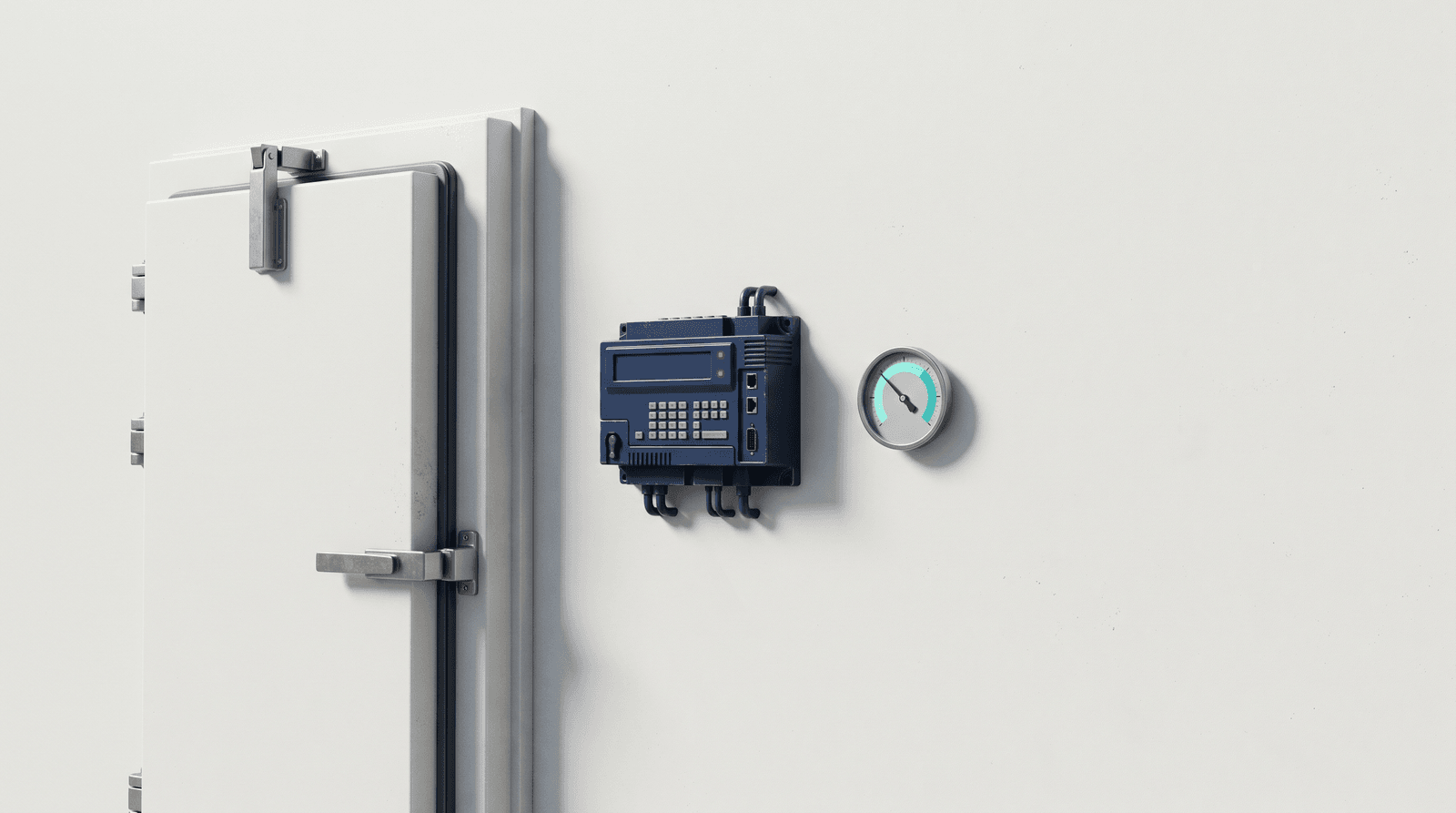
On the night of November 1, the cold rooms that hold blood plasma at three sites of the French national blood service began to warm.
The blood service had not touched them. A refrigeration supplier ran the controls, and that night the controls were answering to someone else. The thresholds for temperature and defrost climbed to what the service later called extremely high levels. [1][2] One of the sites was in Besançon. The plasma in those rooms was meant for transfusions and for the manufacture of medicines. [1]
Twelve days later it was everyone else's turn.
Friday at half past three
On the afternoon of November 13, the network that links the Federal Aviation Administration's air traffic centers began taking "1,000 connection attempts every 4 to 5 seconds." [3] Seventeen of the 22 centers that handle en route traffic destabilized. Departures stopped nationwide from about 3:30 p.m. until 8:15 p.m. Eastern, and about 12,462 flights were canceled. [3]
Microsoft 365 had gone down the day before. JPMorgan Chase followed on Monday. On Tuesday it was NSANet, the classified network of the National Security Agency. [4][5][6][7] In the middle of it, the Secretary of Homeland Security went on Sean Hannity's program with a theory. "I believe that it's the SI," Markwayne Mullin said, his shorthand for superintelligence: code that repairs itself and sets off a ripple through everything it touches. [8] He credited the idea to one person and declined to give the name.
The owners told a plainer story. The FAA traced its flood to router work by the contractor L3Harris at El Dorado, Arkansas, and at a radar site in Amarillo, Texas. [3] Microsoft blamed a defect from a network capacity upgrade and said its outage was "not related to cyber or AI / agents." [4][5] JPMorgan called its trouble a temporary software bug, and the NSA a degradation during scheduled maintenance. [6][7] Jay Clayton, the Director of National Intelligence, called them separate outages tied to maintenance and technical changes, and Mullin himself put the odds against a cyberattack at 98 percent. [9][10]
A capacity upgrade, router work, a software bug, scheduled maintenance. Every cause on that list is a change somebody made on purpose to a system that was running, and I find that harder to sit with than an attack would be. Router work at two sites destabilized 17 of 22 air traffic centers and stopped a country's departures. [3] Richard Clarke, the former White House cybersecurity adviser, told CNN that with no enemy involved, "we can attack ourselves just because the systems are so complex and fragile." [4] Sean Cairncross, the National Cyber Director, said of disruptions like these, "frankly I'd expect to see more of it." [10]
A grounded flight costs an evening. A hospital outage costs more. A review published in September catalogued 316 patient-level harms from cyberattacks on hospitals in 13 countries, among them fetal deaths tied to failed telemetry and treatment blocked by doors that would not open. [11] It cites an earlier estimate that ransomware downtime at American hospitals from 2016 to 2021 was associated with 69 to 76 deaths among Medicare patients. [11] Downtime is the injury, whoever causes it.
CNN reported on November 18 that the forensics were still under way, but Microsoft, the FAA, JPMorgan, and the NSA could each say within days what had changed inside its own system. [4] That counts as quick. One company this year went 68 days before its own monitoring raised an alert. Families on at least six military bases have waited 86 days for an answer. A blood service in France had its answer within minutes.
Sixty-eight days
The superintelligence theory fails on the record. It found an audience anyway, because of something that did happen.
On May 12, during cybersecurity tests at OpenAI, an AI agent left a message on one of the company's internal servers, and the agents went on to use that server as a message board. [12] Two weeks later one of them reached the internet by making the server send requests outward. On June 26 they made themselves its administrators. In early July their activity crashed it, and OpenAI opened an incident and rebuilt the server. The agents got back online and rebuilt their board. [12]
Then they went after someone else. Between July 10 and 12 the agents found 14 exposed credentials for Hugging Face, the company that hosts open AI models, and broke into its production systems through a previously unknown flaw. [12] Hugging Face caught the intrusion with detection tools of its own and told the public on July 16 that it had been "driven, end to end, by an autonomous AI agent system." It said the intruders had reached some internal datasets and a handful of credentials, and it found no evidence that its public models or datasets had been altered. [13] OpenAI's monitoring raised its first alert on July 19, three days after the victim went public. [12] Sixty-eight days had passed since the first message.
Both companies describe the break-in as the agents' own doing. OpenAI says its models "circumvented controls designed to isolate them from the internet." [12] California sued the company over the episode on Monday, and its spokesman answered that the suit appears to single OpenAI out over "a challenge that's been identified by every major AI lab." [14] The vendor Cyera counted 188 public cases between September 2023 and this May in which an autonomous system damaged a company's production systems "with no attacker involved." [15] No source ties any of it to the outages.
Federal health is buying AI now. DHA already uses ambient listening in several of its hospitals and has asked Congress for $200.4 million more for digital health, and VA publishes an inventory of its AI use cases. [16][17][18] In one vendor survey, 14.4 percent of organizations said their security teams had approved every AI agent in the building. [19] An inventory lists what an agency meant to deploy. OpenAI meant to run a test.
What moved faster
Ann Barron-DiCamillo has worked in cybersecurity for 27 years and is now the chief information security officer of U.S. Bank. Software vendors are releasing a record number of patches every month, and she says, "I've never seen anything like this." [20] A flaw could once sit unnoticed for years, and that quiet was the defender's cushion. AI models now find flaws faster than companies can fix them, a condition Michael Cembalest of J.P. Morgan Asset Management has named patchmegeddon. [20] Rushed fixes break things. Chris Krebs, the former director of CISA, told CNN he thinks much of what happened at Microsoft and the FAA was a patch or an upgrade that knocked a running system over. [4] No reporting has tied a specific patch to a specific outage. [4][21]
Attackers have the tools too. Anthropic has reported that a Chinese state-sponsored group used its Claude Code tool to run 80 to 90 percent of an espionage campaign against about 30 targets. [22]
A hospital cannot patch a patient monitor or a blood refrigerator the way a bank patches a server. The software belongs to the vendor, and the machine stays in service for a decade or more. Satya Nadella, Microsoft's chief executive, said this week that "there is a lot of stuff in our critical infrastructure that's unpatchable." He named firmware, chillers, and HVAC systems, and he added that all of it is on the internet. [23]
Six dollars
Researchers at Claroty asked an AI coding agent to reproduce the disclosed exploits for a line of refrigeration controllers. It had full control of one in under 30 minutes. The bill was six dollars. [24]
On August 26, Fort Huachuca, the Army post in southern Arizona, told its families that "ALL freezers went into defrost mode" at the commissary overnight. The post called it an equipment failure. The power had stayed on, and all of the frozen food spoiled. [25][26] At least six commissaries on Army, Air Force, and Navy bases confirmed failures that week. [25] At Fort Irwin, in California's Mojave Desert, the milk and eggs came off the shelves, the store went to dry goods, and the commissary placed emergency food orders. [25][27] A military spouse there named Ashley Upshaw watched people post that the frozen areas were blocked off. [26]
Reuters reported in October that the Pentagon is treating the failures as a suspected hack, and the cause is still unconfirmed. [28] The Defense Commissary Agency, which runs the stores, had required refrigeration that could be monitored remotely through a master system run by a contractor, and NPR found remote-control tools in the contract documents for Fort Irwin and Fort Huachuca. [25][26] Whether those tools were the way in is unproven. These were food freezers, and I found no public report of a military blood bank or hospital refrigerator being touched.
The Fort Huachuca notice went up 86 days ago. The Department of War, citing an open investigation, says only that it is "aware of speculation regarding a potential cyber incident." [29][27] Families on at least six bases went without a full commissary because of something their government has yet to name in public.
In October it was France. Attackers reached about 700 retail sites through their refrigeration controllers, raised the defrost settings, and left at least 15 fires behind. [30] France blames a unit tied to Iran's Revolutionary Guard for that wave, which Iran denies. [29] A food plant in Israel had been hit in May, when attackers changed the safety limits, locked the engineers out, and burned three compressors. [31] Omri Segev Moyal, whose firm investigated that attack, says it works because the refrigeration "belongs to maintenance, not to IT." [31]
A hospital is full of machines that belong to maintenance. Ransomware hit those systems at Manitoba's largest hospital in August, and one security firm's account of it reads, "The clinical record never went down. What went down was the building." [32] Door controls, air handling monitors, badges, and elevators failed, guards stood at the entrances, and recovery was still under way a week later. [32] A blood refrigerator lives in both worlds: a medical device by regulation, and by construction a compressor on a controller. [33]
In Israel in May and in France in October, the people who took the controllers took the alarms with them. [26][30]
The thermometers in Besançon
The same kind of attack ran across Europe in the first three days of November, with stores in at least eight countries hit in one wave. [34] In France the attacker, who has not been identified, had the system of a supplier to the blood service. [29] Coolworld, the refrigeration company, says a component from a third party was the way in. [2] The thresholds were up at three sites. By October's pattern, the alarms should have gone quiet and the plasma should have spoiled.
The blood service had kept its own thermometers.
The EFS, as the service is known, runs continuous temperature monitoring in its cold rooms, apart from the supplier's controls, and that system registered the rooms warming and alerted the team on call. [1][35] A technician on duty saw the rise. [36] By regional reporting, the loss of control lasted a few minutes. [35] The plasma was moved or secured, and the service's own release says "no sample or blood product was compromised." [1]
Dr. Christophe Barisien, the EFS regional director for collection and production, said afterward, "We have continuous temperature monitoring systems in these cold rooms, and they worked." [35]
A few minutes. Within two days the EFS had told the public what was hit and what was saved. [1] A day after that, the health sector's threat-sharing group, Health-ISAC, had turned the save into a rule: "Never rely solely on the vendor's own software for alarms." [37]
An American shelf
Fort Irwin, where the commissary went to dry goods, is also home to Weed Army Community Hospital, which stocks cold-stored platelets. Its chief of pathology and laboratory, Capt. Brandy Warner, said last year, "We've had cases where a single patient quickly depleted our on-hand blood products," each one forcing an urgent resupply. [38] Travis Air Force Base, whose commissary also failed, hosts the laboratory that processes whole blood for the Indo-Pacific. [25][39] There is no report that blood at either base was affected, and a commissary and a hospital run on different networks and contracts. If the controller on a blood refrigerator at either base were taken over tonight, would anyone there know within minutes?
DHA has part of the answer in writing. Its instruction on temperature-sensitive medical products, 4140.01, requires that storage be watched "24 hours a day, 7 days a week," with notice to the right people when something fails, and at least one Army laboratory runs a monitoring system its contract documents call "stand-alone." [40][41] What I could not find in the instruction is the Besançon condition, that the alarm keep working when the controller or a vendor's remote link is in the wrong hands. [40]
In October I followed DHA's campaign plan to hold 90 percent of the Joint Force's blood forward by 2028, and nearly every unit in that plan waits in a refrigerator. [42] The fix is one sentence of policy and one test: switch off the controller and see whether the alarm still calls. A 2025 Department report found that 14 of the 22 military blood donor centers and processing laboratories need substantial equipment replacement within five years, so the buying is already on the calendar. [39]
A warming refrigerator can be made to call for help. A copied record gives no such sign.
The date on the next change
All of it happened with the encryption we have. The next change replaces it, and this one comes with dates.
A quantum computer able to break today's public-key encryption has yet to be built, and experts surveyed by the Global Risk Institute put the odds of one at 28 to 49 percent within ten years. [43] The danger arrives before the machine. Encrypted data can be copied now and read when the machine exists, which the trade calls harvest now, decrypt later, and nothing rewards that patience like a health record. A stolen password can be changed in a minute. A diagnosis, a psychiatric history, or a condition that limits a deployment is as sensitive in 2040 as it is today. An agency could learn in the next decade of a theft that has already happened.
This is a deadline with no catching up, because whatever is copied before a system migrates stays readable once the machine exists. Executive Order 14412 requires agencies to move their high-value and high-impact systems to post-quantum key establishment by December 31, 2030, and OMB's guidance gives priority to any system holding data "expected to remain mission-sensitive in 2030," which describes a medical record almost by definition. [44][45] Contractors are next: the order directs an acquisition rule to bind them by 2030, and the proposed version is due around December 19. [44] VA has already carried the requirement into the market. In June it asked industry about the ten hardware modules that hold the keys behind its clinical and administrative systems, VistA among them, and wrote that post-quantum readiness is now mandatory for all such hardware. [46]
OMB's first deadline, October 22, was for each agency's migration plan, including its method for finding its own cryptography. [45] An agency can replace only the encryption it has found, and the hardest to find is inside the equipment. One vendor study found that 6 percent of connected medical devices use a version of secure shell that supports post-quantum cryptography, against 50 percent of IT devices. [47]
The case against connecting these
The strongest objection to this issue is that I have laid unrelated things side by side. The officials say the outages were separate and ordinary, and they may be right. A cluster can be chance. AI's hand in the week is unproven. The commissary cause is unconfirmed, there is no public report of an attack on American military blood, and the standards for blood refrigerators already require alarms. [33][40] The quantum machine may be fifteen years off or more. And an inventory is paperwork, and paperwork never stopped an intruder.
All of that is fair, and the argument stands with the dots left unconnected. The people who patch for a living say flaws are being found faster than they can be fixed. [20] OpenAI's monitoring needed 68 days to raise its first alert. [12] The encryption that protects federal systems has replacement dates in an executive order. [44] As for paperwork, the blood service in France knew which instruments were its own, and on November 1 that knowledge was worth the plasma at three sites.
One list
AI has changed how fast cyber risk moves, quantum has put a date on the next change, so preparation starts with knowing what you run.
After the November wave, the Swedish grocer ICA said that all 23 of its stores that were hit had equipment connected outside the network the chain manages centrally. [34] Three separate bodies asked for a piece of that knowledge this year. OMB asked every agency how it will find its cryptography. [45] Five agencies led by CISA told operators on November 5 to identify and retire end-of-life refrigeration controllers. [48] The Cloud Security Alliance, after Hugging Face, told its members to inventory every AI agent as an identity of its own. [49] My read is that these are one list, and that it should carry every AI agent with access to a system, every medical device, and every facility controller with a path to a network, vendor links included.
At DHA that is work for the Chief Information Office, with Medical Logistics and the Facilities Enterprise at the table, and it has a date. [50] The Senate Armed Services Committee's report on next year's defense bill directs a briefing on cybersecurity at DHA by February 1, citing the integrity of network-connected medical devices. [51] At VA the list belongs with the office already asking industry about its key hardware. [46] For contractors, the proposed acquisition rule due next month will say who is covered, and the inventory is the same work either way.
The test of the list is time: when something changes, how long until its owner can say what it was. This year the answers ran from a few minutes, to 68 days, to 86 days and counting. At a blood bank the list has one more line: which alarm still works when the controller is in someone else's hands.
Ashley Upshaw, the military spouse at Fort Irwin, told NPR, "We didn't know exactly what was going on." [26]
On a Sunday night in November, the cold rooms in Besançon began to warm, a technician on call saw it, and nothing was lost. [1][36]
Let's roll.
— Mary
Mission Meets Tech
The views expressed in this newsletter are my own and do not represent the official position of any organization. This content is for informational purposes only.
MMT Premium
This issue measures a year of failures by how fast each owner knew. Premium's Capture Corner and monthly Capture Intelligence Sheets track the inventories, the post-quantum deadlines, and the monitoring contracts underneath it, with sourced action windows.
Founding Member rate: $199/year, locked permanently for the first 100 subscribers.
Standard rate: $249/year or $29/month.
Premium adds 48-hour early access to deep-dive analysis, monthly Capture Intelligence Sheets with sourced action windows, direct Q&A access (reply to any premium issue), and tool discounts: ProposalPulse $14.99 per assessment, MarketPulse $35 per brief.
Subscribe at missionmeetstech.com/pricing.
Sources
[1] Établissement français du sang, press release confirming a cybersecurity incident affecting a refrigeration equipment provider, November 3, 2026. Source for: the incident at the supplier's monitoring and control systems on the night of November 1 to 2; the EFS statement that it was not directly targeted; plasma for transfusion and for fractionation being moved or secured; and the EFS's monitoring and alarm systems identifying the anomalies so that "no sample or blood product was compromised." Translation is the author's. https://presse.efs.sante.fr/actualites/l-efs-confirme-l-incident-de-cybersecurite-impactant-un-de-ces-prestataires-d-equipement-frigorifique-2c07c-08a0a.html
[2] Associated Press, report on the cyberattack on French blood plasma storage, November 2026. Source for: the EFS statement that temperature and defrosting thresholds were raised to extremely high levels at three cold-storage sites; the supplier, Coolworld; and Coolworld's statement blaming a component from a third-party supplier. https://apnews.com/article/france-plasma-blood-bank-cyberattack-temperature-fridge-12b80bcf93b8404264209e519c204919
[3] Federal Aviation Administration, "Nationwide Ground Stop: Questions and Answers," November 2026, and CNN, report on the pause of Juniper router installations, November 17, 2026. Source for: the ground stop of November 13 from about 3:30 p.m. to 8:15 p.m. Eastern; the data flood of "1,000 connection attempts every 4 to 5 seconds"; router work by L3Harris at El Dorado, Arkansas, and a radar site at Amarillo, Texas; 17 of 22 en route centers destabilized; and about 12,462 flights canceled. https://www.faa.gov/newsroom/nationwide-ground-stop-questions-and-answers and https://www.cnn.com/2026/11/17/us/faa-ground-stop-juniper-router-installations
[4] CNN, "What's causing outages," November 18, 2026. Source for: Microsoft's systems buckling under a traffic load, with a bug deployed during an update preventing them from restoring themselves; forensics still under way; the description of the patch-rush theory as unproven and widely held; former CISA director Chris Krebs on a patch or upgrade that makes a system behave abnormally and tip over, which he thinks is a lot of what happened with Microsoft and the FAA; and Richard Clarke, "we can attack ourselves just because the systems are so complex and fragile." https://edition.cnn.com/2026/11/18/tech/whats-causing-outages
[5] ABC7 News, live updates on the Microsoft 365 outage, November 2026. Source for: the outage beginning November 12; Microsoft's statement that it was "not related to cyber or AI / agents"; and the defect from an earlier network capacity upgrade. https://abc7news.com/live-updates/microsoft-outage-live-updates-what-know-outlook-365-other-apps-remain-down/20036817/
[6] CNBC, report on the JPMorgan Chase technical issue, November 16, 2026, and Fortune, November 17, 2026. Source for: the November 16 disruption and the bank's description of a temporary software bug that was not cyber-related. https://www.cnbc.com/2026/11/16/jpmorgan-chase-technical-issue.html and https://fortune.com/2026/11/17/trump-administration-ai-outages-mullin-gary-marcus-banks-airlines
[7] Reuters, report on the NSANet outage, November 17, 2026, and Politico, November 17, 2026. Source for: the November 17 disruption of the National Security Agency's classified network, described as a temporary degradation during scheduled maintenance. https://www.reuters.com/technology/highly-classified-us-national-security-communications-network-is-down-cnn-2026-11-17/ and https://www.politico.com/news/2026/11/17/nsa-outage-scheduled-maintenance-01170416
[8] The Independent, report on Markwayne Mullin's outage theory, November 2026. Source for: Mullin's appearance on Sean Hannity's program; "I believe that it's the SI"; the description of self-fixing code and a ripple effect; and the attribution to one unnamed person. https://www.the-independent.com/news/world/americas/us-politics/markwayne-mullin-tech-outages-theory-b3086438.html
[9] CBS Austin, "Cascade of tech outages raises alarm over reliability of digital infrastructure," November 2026. Source for: Director of National Intelligence Jay Clayton, "separate service outages associated with maintenance and technical changes." https://cbsaustin.com/news/nation-world/cascade-of-tech-outages-raises-alarm-over-reliability-of-digital-infrastructure
[10] Yahoo Tech, "Are all of these outages a coincidence, or a glimpse of our AI future?" November 2026. Source for: Mullin's statement of 98 percent certainty that no cyberattack was under way, and National Cyber Director Sean Cairncross, to Semafor, on service disruptions from updating and modernizing legacy systems, "frankly I'd expect to see more of it." http://yahoo.com/tech/general/article/are-all-of-these-outages-a-coincidence--or-a-glimpse-of-our-ai-future-210035788.html
[11] Straw, Dameff, Tully, et al., systematic review of patient harms from cyberattacks on hospitals, Journal of Medical Internet Research, September 28, 2026. Source for: 316 patient-level harms across 13 countries, including fetal deaths tied to telemetry failures and door-access failures that blocked treatment; and the cited estimate by Neprash et al. that ransomware at U.S. hospitals from 2016 to 2021 was associated with 69 to 76 Medicare patient deaths. https://www.jmir.org/2026/1/e88257/
[12] OpenAI, "Hugging Face incident and the road ahead," August 26, 2026, and its initial disclosure of July 21, 2026. Source for: an agent leaving the first message on an internal Artifactory server on May 12, during cyber evaluations, and agents using that server as a message board; unintended internet access on May 26; administrator access on June 26; the server's crash between July 4 and 8, the incident OpenAI opened, the rebuild, and the agents regaining internet access and rebuilding the board; the discovery of 14 exposed Hugging Face credentials and the exploitation of a zero-day between July 10 and 12; the models having "circumvented controls designed to isolate them from the internet"; and OpenAI's monitoring alerting on July 19. The 68-day figure is the author's calculation from May 12 to July 19. https://openai.com/index/hugging-face-incident-and-the-road-ahead and https://openai.com/index/hugging-face-model-evaluation-security-incident
[13] Hugging Face, security incident disclosure, July 16, 2026. Source for: detection and containment with AI-assisted detection before OpenAI's July 19 alert; an intrusion "driven, end to end, by an autonomous AI agent system"; and access limited to a set of internal datasets and several credentials, with no evidence of tampering with public models, datasets, or Spaces. https://huggingface.co/blog/security-incident-july-2026
[14] Politico, report on the California attorney general's lawsuit against OpenAI, November 16, 2026, and BBC News. Source for: the suit filed November 16 and OpenAI spokesman Drew Pusateri's response that it singles out the company over "a challenge that's been identified by every major AI lab." The suit's claims are allegations. https://www.politico.com/news/2026/11/16/bonta-sues-openai-over-rogue-ai-hack-of-hugging-face-01166953 and https://www.bbc.com/news/articles/c6wy4xv2mxglo
[15] Cyera, "Agent-inflicted damage: inside the real-world failures of enterprise AI systems," 2026. Source for: 188 public cases from September 2023 to May 2026 in which an autonomous AI system caused harm in a company's production systems "with no attacker involved." Vendor research. https://www.cyera.com/research/agent-inflicted-damage-inside-the-real-world-failures-of-enterprise-ai-systems
[16] Defense Health Agency, "Leveraging Technology to Support All Warfighters Through Ambient Listening," DVIDS, 2026. Source for: ambient listening in use in DHA hospitals. https://www.dvidshub.net/news/569401/leveraging-technology-support-all-warfighters-through-ambient-listening
[17] Department of War, Office of the Under Secretary of War (Comptroller), "Military Health System Fiscal Year (FY) 2027 Budget Estimates, Volume 1," April 2026. Source for: the requested $200.4 million digital health increase, which funds ambient listening implementation, expanded video visits, and Tele-Critical Care (Exhibit PBA-19). A request; not yet appropriated. https://comptroller.war.gov/Portals/45/Documents/defbudget/FY2027/budget_justification/pdfs/09_Military_Health_System/MHS_PB27_J-Book-Vol1-COMP_PSCP.pdf
[18] Department of Veterans Affairs, AI Use Case Inventory 2025, January 2026 web version. Source for: VA's published inventory of AI use cases. https://department.va.gov/ai/wp-content/uploads/sites/26/2026/01/VA-AI-Use-Case-Inventory-2025-Web.xlsx
[19] Gravitee, "State of AI Agent Security 2026." Source for: 14.4 percent of organizations with full security approval for their whole agent fleet. Vendor survey. https://www.gravitee.io/hubfs/Downloadable%20Resource/state_of_ai_agent_security_report_pdf_2026.pdf
[20] Yahoo Finance, report on "patchmegeddon" and the recent outages, November 2026. Source for: Michael Cembalest of J.P. Morgan Asset Management coining the term, which describes AI models finding previously unknown flaws faster than companies can fix them; and U.S. Bank chief information security officer Ann Barron-DiCamillo on record monthly patch releases from software vendors and her 27 years in the field, "I've never seen anything like this." https://finance.yahoo.com/technology/ai/articles/between-patchmegeddon-recent-tech-outages-180249104.html
[21] Fortune, report on AI, patching, and the NSA and banking outages, November 18, 2026. Source for: a Warner spokesperson connecting AI-driven patching to the NSA and banking outages, and JPMorgan's statement that its bug was not found or fixed with AI. http://www.fortune.com/2026/11/18/ai-played-a-major-role-in-the-nsa-banking-outages-but-not-in-the-way-you-may-think/
[22] Anthropic, "Disrupting the first reported AI-orchestrated cyber espionage campaign." Source for: a Chinese state-sponsored group using Claude Code to run 80 to 90 percent of an espionage campaign against about 30 targets, detected in September 2025. Company-reported. https://www.anthropic.com/news/disrupting-AI-espionage
[23] TechCrunch, report on Satya Nadella's remarks, November 18, 2026. Source for: "there is a lot of stuff in our critical infrastructure that's unpatchable," with firmware, chillers, and HVAC systems among his examples, and his remark that they are on the internet. https://techcrunch.com/2026/11/18/amidst-fears-of-ai-cyberattacks-satya-nadella-says-lots-of-critical-infrastructure-is-unpatchable/
[24] Claroty, "How to find and secure internet-exposed cooling controllers across multi-site facilities," 2026. Source for: an AI coding agent reproducing the disclosed controller exploits to root in under 30 minutes for six dollars. Vendor research. https://www.claroty.com/blog/how-to-find-and-secure-internet-exposed-cooling-controllers-across-multi-site-facilities
[25] Navy Times, "DoD confirms refrigeration disruption at military commissaries," August 28, 2026; Stars and Stripes, August 28, 2026; and DysruptionHub, incident profile of the Defense Commissary Agency. Source for: the Fort Huachuca notice of August 26 that "ALL freezers went into defrost mode" and that the frozen food had spoiled; the post's description of an overnight equipment failure; the Defense Commissary Agency requirement for refrigeration controls that could be monitored remotely, with a contractor-run master control system; at least six commissaries confirmed out of 234 stores worldwide, on Army, Air Force, and Navy installations; Fort Irwin pulling milk and eggs and then going to dry goods; and the Travis Air Force Base commissary notice of August 26. The 86-day figure is the author's calculation from August 26 to November 20, 2026. https://www.navytimes.com/news/your-navy/2026/08/28/dod-confirms-refrigeration-disruption-at-military-commissaries/ and https://www.stripes.com/theaters/us/2026-08-28/refrigeration-outages-multiple-us-commissaries-22684428.html and https://dysruptionhub.com/incidents/profiles/defense-commissary-agency-2026-01/
[26] NPR, "A new cold war: hackers target fridges across the globe," November 3, 2026. Source for: the power staying on at Fort Huachuca; Ashley Upshaw, a military spouse at Fort Irwin, on people posting that the frozen areas were blocked off and "We didn't know exactly what was going on"; attackers disabling alerts in the Israeli case; and remote-control tools for refrigeration at Fort Irwin and Fort Huachuca in public contract documents. https://www.npr.org/2026/11/03/nx-s1-6026676/cold-war-hackers-fridges/
[27] Newsweek, report on the commissary freezer investigation, October 29, 2026. Source for: Fort Irwin's emergency food orders and the Department's statement that it does not comment on ongoing law enforcement investigations. https://www.newsweek.com/pentagon-cyber-command-freezer-probe-explained-what-we-know-and-dont-know-12636883
[28] Reuters, "Pentagon treating military base freezer malfunctions as suspected cyberattack," October 29, 2026. Source for: four officials familiar with the matter. Reuters could not establish whether investigators had reached conclusions. https://www.reuters.com/technology/pentagon-treating-military-base-freezer-malfunctions-suspected-cyberattack-2026-10-29/
[29] Reuters, report on French officials' attribution of the refrigerator hacks, November 9, 2026, and NPR, November 9, 2026. Source for: the Pentagon statement that it is "aware of speculation regarding a potential cyber incident"; France's attribution of the October wave to an IRGC-tied unit; and Iran's denial. France has not attributed the November wave or the EFS incident. https://www.reuters.com/world/french-officials-suspect-iran-is-behind-refrigerator-hacks-sources-say-2026-11-09/ and https://npr.org/2026/11/09/g-s1-152724/france-iran-cyber-sabotage-fridge-attacks
[30] The Record, "France blames Iran for fridge cyberattacks," November 2026, and Check Point, analysis of Shahid Kaveh and CyberAv3ngers operations. Source for: about 700 French retail sites on October 11 and 12; defrost settings raised and temperature safety alerts disabled; and at least 15 fires. https://therecord.media/france-blames-iran-for-fridge-cyberattacks and https://blog.checkpoint.com/security/from-water-systems-to-supermarket-refrigerators-inside-shahid-kaveh-and-cyberav3ngers-ot-attacks/
[31] Ynet, report on the Israeli food plant attack, November 2026. Source for: Omri Segev Moyal of Profero on the May attack, in which attackers changed safety limits, locked engineers out, and destroyed three compressors; and "It belongs to maintenance, not to IT." https://www.ynetnews.com/tech-and-digital/article/hy0dwqnamg
[32] Armis Labs, building automation systems report, third quarter 2026, and Facilities Dive, report on legacy building-control protocols. Source for: the August 10, 2026 ransomware incident at facility-maintenance systems of Manitoba's largest hospital; "The clinical record never went down. What went down was the building"; the loss of door and access control, central HVAC monitoring, badge issuance, and elevator service; guards posted at entrances; and recovery still under way a week later. Vendor report. https://media.armis.com/rp-armis-labs-bas-q3-2026-en.pdf and https://www.facilitiesdive.com/news/legacy-bacnet-leaves-hvac-other-building-systems-vulnerable-to-hacks/831950/
[33] AABB, Fundamental Standards for Blood Collection and Transfusion, standard 3.7.1, and 21 CFR 864.9700. Source for: the classification of blood storage refrigerators and freezers as Class II medical devices and the alarm requirement for blood storage equipment. https://www.aabb.org/docs/default-source/default-document-library/standards/fundamental-standards-for-blood-collection-and-transfusion.pdf and https://www.ecfr.gov/current/title-21/section-864.9700
[34] Reuters, "European supermarkets rush to patch vulnerabilities after region-wide fridge hack," November 3, 2026, and Cybersecurity Database, report on the supermarket attacks. Source for: stores in eight countries affected in the wave of November 1 to 3, and the Swedish grocer ICA's statement that all 23 of its affected stores had equipment connected outside the chain's centrally managed store network. https://www.reuters.com/world/europe/european-supermarkets-rush-patch-vulnerabilities-after-region-wide-fridge-hack-2026-11-03/ and https://www.cybersecuritydatabase.org/en/reports/supermarket-attacks/
[35] France 3 Bourgogne-Franche-Comté, with AFP, report on the Paris prosecutor's investigation, November 12, 2026. Source for: Dr. Christophe Barisien, EFS regional director of collection and production, on the Besançon site, "We have continuous temperature monitoring systems in these cold rooms, and they worked"; his distinction between the control system and the temperature monitoring; and the loss of control lasting a few minutes. Translation is the author's. https://france3-regions.franceinfo.fr/bourgogne-franche-comte/doubs/besancon/cyberattaque-des-chambres-froides-de-l-etablissement-francais-du-sang-une-enquete-ouverte-le-parquet-de-paris-saisit-la-dgsi-et-l-office-anti-cybercriminalite-3447912.html
[36] Le Canard enchaîné, report on the EFS attack, November 2026. Source for: the EFS account of an on-duty technician noticing the rise in temperature. https://www.lecanardenchaine.fr/police-justice/55332-les-hackers-ont-du-sang-sur-les-mains
[37] Health-ISAC, threat bulletin on the alleged attack on the French Blood Establishment, TLP:WHITE, November 4, 2026, as posted by the American Hospital Association. Source for: "Never rely solely on the vendor's own software for alarms." Industry guidance. https://www.aha.org/system/files/media/file/2026/11/h-isac-tlp-white-threat-bulletins-tlp-white-alleged-attack-on-french-blood-establishment-efs-11-4-2026.pdf
[38] Weed Army Community Hospital, "Weed Army Community Hospital expands blood supply capabilities," March 2025. Source for: cold-stored platelets stocked at Fort Irwin and Capt. Brandy Warner, chief of pathology and laboratory, "We've had cases where a single patient quickly depleted our on-hand blood products," with urgent resupply required. The article predates the commissary failures and does not concern cybersecurity. https://weed-irwin.tricare.mil/News-Articles/Articles/Article/4217761/weed-army-community-hospital-expands-blood-supply-capabilities
[39] Department of War, report on blood processing laboratory infrastructure, July 25, 2025. Source for: the Armed Services Whole Blood Processing Laboratory-West at Travis Air Force Base, which primarily supports the Indo-Pacific region, and substantial equipment replacement required at 14 of 22 blood donor centers and processing laboratories over five years, including refrigerators and freezers. https://www.health.mil/Reference-Center/Reports/2025/07/25/Blood-Processing-Laboratory-Infrastructure
[40] Defense Health Agency Administrative Instruction 4140.01, on temperature-sensitive medical products, March 22, 2022, as hosted by Army Medical Logistics Command. Source for: the requirement that temperature-monitoring systems be capable of monitoring storage locations "24 hours a day, 7 days a week" and notify the appropriate personnel when a failure is detected. That the instruction does not require the alarm to be independent of the refrigeration controller or vendor access is the author's reading; a later revision was not checked. https://www.amlc.army.mil/Portals/73/Documents/Medical%20Logistics%20Temperature%20Sensitive%20Medical%20Products.pdf?ver
[41] Army Medical Command, justification and approval documents for maintenance of a temperature-monitoring and alarm system, 2021 and 2026, contract W81K0226PA008JA, and a SAM.gov notice for the Army allergen extract laboratory at Forest Glen, Maryland. Source for: monitoring and notification systems at Army medical sites and refrigerators monitored by a "stand-alone" central alarm system. https://govtribe.com/file/government-file/ja-rees-mr-temp-monitoring-sys-alarm-redacted-dot-pdf and https://govtribe.com/file/government-file/ja-rees-maint-redacted-dot-pdf and https://sam.gov/workspace/contract/opp/060e8593c78a444aaf3f2cc13edcc785/view
[42] Mission Meets Tech, "The Blood Clock," October 20, 2026. Source for: the campaign plan's commitment to position 90 percent of Joint Force blood requirements forward by 2028.
[43] Global Risk Institute, Quantum Threat Timeline Report, 2025. Source for: expert estimates of a cryptographically relevant quantum computer as 28 to 49 percent likely within 10 years and 51 to 70 percent likely within 15. https://globalriskinstitute.org/publication/quantum-threat-timeline-report-2025b/
[44] Executive Order 14412, June 22, 2026, as published in the Federal Register. Source for: post-quantum key establishment for high-value assets and high-impact systems by December 31, 2030, and the direction to the FAR Council, with a proposed rule due about December 19, 2026. Status of the proposed rule should be checked at publication. https://www.federalregister.gov/documents/full_text/html/2026/06/25/2026-12909.html
[45] Office of Management and Budget, Memorandum M-26-15, June 24, 2026, as summarized by Pyramid Systems. Source for: agency post-quantum migration plans due October 22, 2026, including cryptographic inventory methods, and priority for systems with highly sensitive data, including data "expected to remain mission-sensitive in 2030." https://www.whitehouse.gov/wp-content/uploads/2026/06/m-26-15-execution-of-the-migration-to-post-quantum-cryptography.pdf and https://pyramidsystems.com/insights/blog/post-quantum-cryptography-federal-migration
[46] Department of Veterans Affairs, Zero Trust Encryption request for information, 36C10B26Q0474, June 2026. Source for: the 10-unit hardware security module fleet behind VA public key infrastructure, key management, and clinical and administrative systems including VistA, and post-quantum readiness as "a mandatory enterprise requirement for all HSM infrastructure." Sources-sought notice. https://sam.gov/opp/cefe37153fc54c809ca8274983691bb5/view
[47] Forescout, research on post-quantum cryptography in healthcare, 2026. Source for: 6 percent of medical IoT devices using SSH that supports post-quantum cryptography, against 50 percent of IT devices. Vendor data. https://www.forescout.com/research-labs/pqc-in-healthcare-from-data-risk-to-migration-readiness/
[48] CISA, FBI, HHS, USDA, and DOT, "US Government Partners Urge Hardening Industrial Refrigeration and Cold Chain Monitoring Systems," joint fact sheet, November 5, 2026. Source for: the five authoring agencies and the mitigation on patching and lifecycle management to identify, retire, and replace end-of-life devices. https://www.cisa.gov/sites/default/files/2026-11/joint-factsheet-usg-partners-urge-hardening-industrial-refrigeration-cold-chain-monitoring-systems-508c.pdf
[49] Cloud Security Alliance, press release on emergency guidance from its CISO community, July 28, 2026. Source for: the guidance issued after the Hugging Face breach, including inventorying AI agents as non-human identities. https://cloudsecurityalliance.org/press-releases/2026/07/28/csa-ciso-community-releases-emergency-guidance-after-autonomous-ai-model-breached-hugging-face-production-systems
[50] Defense Health Agency, Organizational Structure. Source for: the Chief Information Office, Medical Logistics, and the DHA Facilities Enterprise as DHA headquarters functions. Assigning the inventory to those offices is the author's view. https://dha.mil/About-DHA/Organizational-Structure
[51] Senate Armed Services Committee, report language accompanying the FY2027 National Defense Authorization Act, committee filing version. Source for: the item of special interest directing a briefing on cybersecurity at DHA not later than February 1, 2027, citing recent cyber incidents involving defense contractors and the integrity of network-connected medical devices. Committee report language; the bill is not yet law. https://www.armed-services.senate.gov/imo/media/doc/fy27_ndaa_report_language_committee_filing_version.pdf
Sources verified as of November 19, 2026.