What the Rural Hospital Knows, and the Network the Military Already Built
Tuesday's promise: the fix for the surgeon-readiness gap is already proven. Half of it sits in the American rural-health system, which met the same volume problem first. The other half is running inside the military's own tele-critical care network, twenty time zones wide. Concentrate the cases, reach the expertise to the point of need, and pair both with operational telehealth built for the fight the force is planning for.
Friends,
Tuesday I laid out the gap. A readiness metric that says two of forty-six neurosurgeons cleared the bar, and a GAO report confirming the Department of War cannot yet count the civilian partnerships built to close it. The department named the mission and accepted the roadmap. The first step is being able to see the system.
I also promised the fix is already proven. It is, in two places, and neither is a research concept. One is the American rural hospital. The other is a Navy medical operations center in San Diego talking to an ICU at Fort Campbell and, on a good day, a clinic on an island in the middle of the Indian Ocean. Both have run for years. The military simply has not connected them to the surgical-readiness problem yet.
The same physics, in two settings
Surgery rewards volume. The more of a procedure a team does, the better the patient does. Volume is the mechanism that keeps a skill alive, and thinning it dulls the skill no matter how good the surgeon once was. This is bedrock in the surgical literature, and it is no one's failing. It is how the work works.
The rural hospital and the military hospital sit at opposite ends of the same equation.
In rural America the patients grew fewer. Towns shrank, volume fell below the line a surgical service needs, and since 2005, 196 rural hospitals have closed or converted, 108 complete closures and 88 conversions, tracked by the Cecil G. Sheps Center at the University of North Carolina. The newer Rural Emergency Hospital model keeps a door open by giving up inpatient surgery. It is an honest answer to a hard limit. Below a volume floor, the skill is difficult to hold.
In the military the cases moved. For sound reasons of access and cost, the system steered many beneficiaries to the civilian network over the years, which thinned the operating rooms inside military hospitals. Same equation, different road in. Both ended up short of the volume that makes a surgeon ready. The lesson each holds for the other is that volume is not a line to trim quietly. It is the raw material of readiness.
The model that works, and the military already runs it
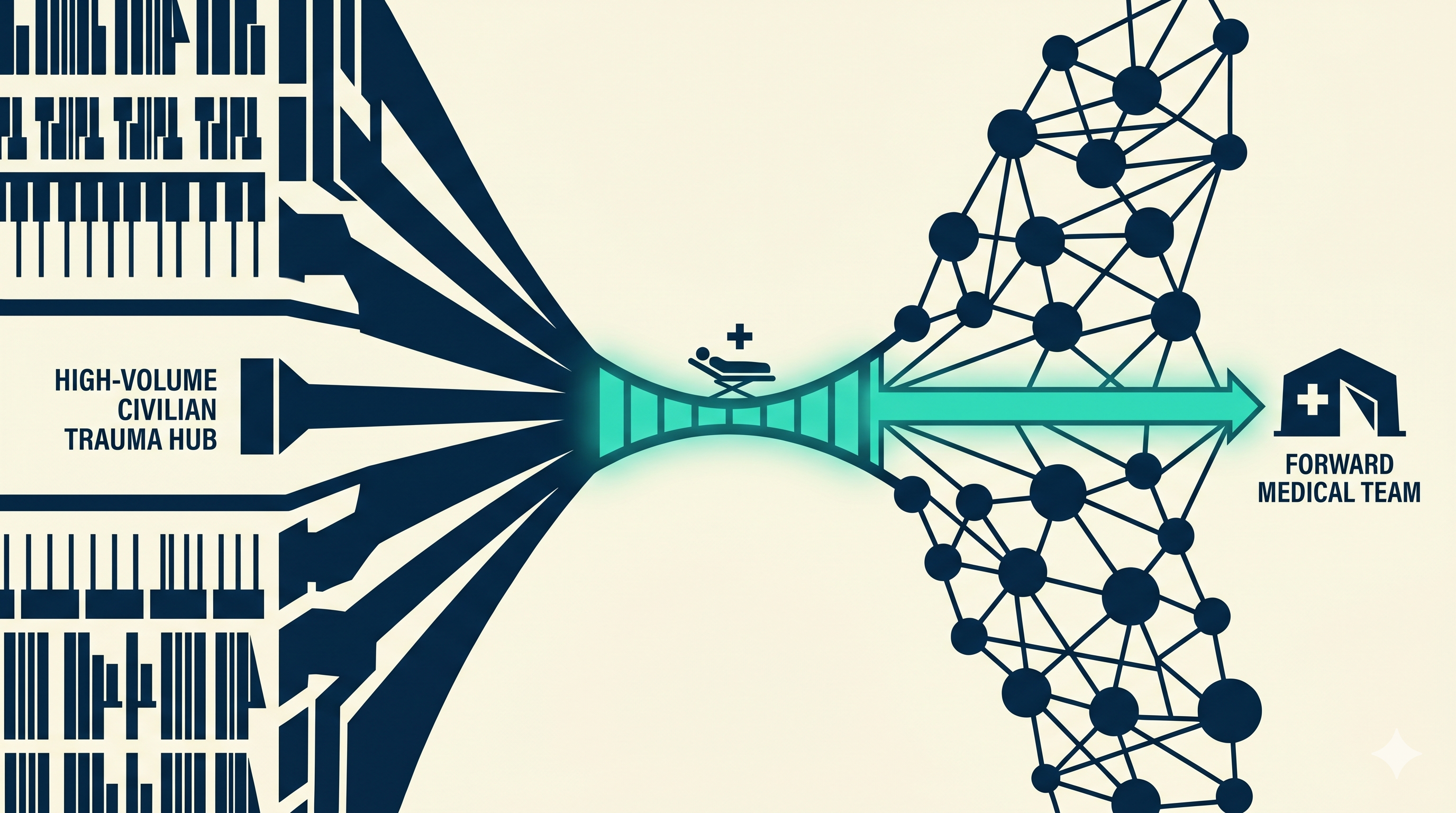
The civilian system did more than map the problem. It built the fix, and the fix is regionalization. A mature trauma system concentrates the hardest cases at high-volume hubs and lets the spokes stabilize and transfer. The hub stays sharp because the volume is pooled there on purpose, and the spokes get a clear path to move a patient who needs more than they can give. It is why the Air Force sends people to Baltimore. A rotation through one of the densest trauma caseloads in the country does in weeks what a quiet posting cannot do in years.
The military already runs that exact model. It just has not pointed it at surgical readiness yet. The Defense Health Agency's Joint Tele-Critical Care Network concentrates intensivists at hubs, Naval Medical Center San Diego, Brooke Army Medical Center, and Madigan's Virtual Critical Care Center, and reaches them around the clock into satellite intensive care units at nearly twenty military hospitals worldwide. Hub and spoke. Expertise pooled where it is strong, delivered where it is needed. A smaller hospital that would otherwise transfer a critically ill patient out can hold and treat that patient with a remote intensivist on the screen. The concept the surgical side is missing is one the critical-care side has already proven inside the building.
It reaches further than garrison ICUs. The same network has been tested as an operational capability in field exercises, supporting field surgeons, nurses, and medics with remote critical-care expertise during training, and it extends into mass-casualty response through a joint network the department runs with Health and Human Services out of San Diego. Garrison, operational, and disaster, the same hub-and-spoke spine. The military has spent years proving the architecture. The task is extending it to surgical readiness and making that side visible enough to steer.
The wartime version of the volume math is stark. British surgeons estimated that a single six-week tour in Helmand at the peak of the fighting delivered penetrating-trauma exposure on the order of three years inside a typical NHS hospital. War concentrates volume. The whole task of peacetime readiness is to manufacture that exposure without the war, and the proven way is to route the surgeon to where the cases already are. Routing well depends on Tuesday's missing piece. You cannot send people to the right hubs if you cannot see which partnerships you have or what each one delivers. The clinical model rests on the data foundation, and the foundation is the part being built now.
Telehealth has always been part of how this fight is won
The second half of the fix extends that same idea past the ICU and all the way forward, to the medic and the casualty. Telehealth.
Operational telehealth has been saving lives at the point of need for decades, and treating it as a nice-to-have misreads its history. Army virtual health has reached forward since the 1990s. The Virtual Medical Center stood up at Brooke Army Medical Center in 2018, the first of its kind, built to deliver specialist reach-back anywhere in the world, in garrison and downrange. Its operational arm, ADVISOR, gives a deployed caregiver a round-the-clock line to a specialist anywhere on earth. In a program review covering 2017 through 2022, remote experts helped local teams avoid 25 evacuations outright and downgrade 9 more, and of the casualties in that review, 66 lived and 3 died.
It looked like this in October 2025. A clinic on Diego Garcia, a remote island with no full-time specialist on station, responded to an emergency aboard a vessel in the Indian Ocean. As the team worked the casualties and lined up evacuation, it reached into the Joint Tele-Critical Care Network and pulled critical-care expertise in by video. The clinicians made faster, better-grounded decisions than the island alone could support. The expertise did not have to be on the island. It only had to be reachable.
That is the case for telehealth in combat medicine, and it is settled. The expertise does not have to be in the tent if it can reach the tent.
The friction has never been whether telehealth belongs. It has been which telehealth, and folding two different things into one word has cost the operational side years of clarity.
One is direct-to-consumer care. The scheduled video visit, the app that connects a beneficiary at home to a provider for a routine need. Those tools are valuable, and the force should keep investing in them. They are built for good broadband and a calm clinic schedule, and they do not carry over to a contested, austere, far-forward fight. They were never meant to.
The other is operational telehealth, the Virtual Medical Center and Joint Tele-Critical Care Network model, engineered for the conditions the services deploy into. It runs across a spectrum. Asynchronous portals, like the Pacific Asynchronous Telehealth Portal at Tripler, move a question and an image when bandwidth allows and need no live link at all. Synchronous teleconsultation brings a specialist in by video when the connection holds. At the far end, a trauma team manages a critical case forward in real time. The Joint Trauma System codified the deployed practice in a clinical guideline in 2023, so this is doctrine, not a pilot.
That spectrum is the sophistication direct-to-consumer tools lack, and it is exactly what a peer fight demands. A contested environment means denied, degraded, and intermittent communications and emissions control, going quiet so the enemy cannot find a unit by its signal. Synchronous reach-back needs a link that may not be there. The asynchronous end tolerates the gaps. And prolonged field care, holding a casualty far forward when evacuation is delayed, is the scenario operational telehealth was built to support and direct-to-consumer care never contemplated. Operational telehealth is designed for the comms picture the consumer model assumes away.
This is the moment for that work to move to the center. Service-driven operational telehealth and the capabilities maturing out of the Virtual Medical Center and the tele-critical care network are ready to move from the margins of the budget to the heart of how the force sustains care at the edge. The leadership to back it is in the chair. Keith Bass, sworn in this year as assistant secretary of war for health affairs, came to the job after running virtual patient care and telehealth programs across government, work that reached the VA, the Department of War, DHA, and the White House. He knows this terrain as well as anyone in the building. Support from his level on down is what turns years of service-built operational telehealth into a funded, prioritized line of effort, and the timing is right to give it.
Three services, three places the work pays off
The joint framing can hide that the three services live this differently, and each offers a clear place to put the effort.
The Army's forward surgical capability is built to disperse. Its twenty-person surgical teams operate as smaller ten-person split elements, spread across more ground. Smaller teams spread wider raise the readiness bar for each person on them, which makes individual skill sustainment, simulation, and rotations through high-volume centers more valuable, not less. The investment follows the dispersion.
The Navy and Marine Corps carry it to sea, where the distances of the Pacific make surgical readiness afloat the hardest case of all. The Navy trains its trauma teams through Los Angeles General, and reach-back like the Diego Garcia save shows how a team at the edge stays tied to expertise ashore when the link holds. The pairing is the point. A ready team aboard, and the network behind it.
The Air Force owns the evacuation backbone the other services lean on. Critical Care Air Transport and en-route care made the golden hour possible in the last wars. Sustaining that capability for a contested-airspace fight, where owning the sky is not a given, keeps the whole joint readiness model standing. It is foundational, and it is the Air Force's to lead.
One root cause runs under all three, and it is workable. Enough volume, measured well, with the expertise networked to reach forward. Solve those together and each service's version of the problem eases at once.
The map is on the table
The civilian system handed the military a finished study, and the military handed itself half the answer already. Volume is the teacher. Regionalization is the working model, and the Joint Tele-Critical Care Network proves the force can run it. Operational telehealth extends that expertise to the point of need, across a spectrum built for the fight the planners describe. And all of it steers better the moment the department can see its own partnerships clearly, which is the build order GAO wrote and the department accepted.
None of this is a blank page. It is connecting work the military has already done in pieces, and making the surgical-readiness side visible enough to manage.
The casualty, at both ends of the chain
Tuesday closed on a wounded service member reaching a surgeon. Walk one link upstream.
Before the operating table there is the point of injury. A small team, far forward. For most of a deployment the network is a call away and a specialist can reach the medic when the link holds, the way San Diego reached Diego Garcia. Then comes the hour the planners worry about. Comms down by jamming or by order. A casualty on the ground. For a stretch, no one to reach.
In that window it is the person over the wound and whatever volume of real cases they carried into theater. That is why the force builds both halves. The operational telehealth that reaches them nearly always, and the trained skill that holds in the moments nothing can reach. Get both right, and the casualty at the point of injury and the one who later reaches the surgeon are the same person, carried by a system that gave them everything it had at every link in the chain.
The civilian system proved the model. The military already runs half of it. The department accepted the roadmap to see the rest. The work is hard, and it is worth it, because the person it protects is the one who went forward on our behalf.
Let's roll.
— Mary
Mission Meets Tech
The views expressed in this newsletter are my own and do not represent the official position of any organization. This content is for informational purposes only.
MMT Premium
This is Part 2 of the clinical-readiness series. Premium subscribers get the companion Capture Corner with this issue: where the regionalization-and-measurement build-out turns into demand signals, why operational telehealth and tele-critical care (not direct-to-consumer) are where the services' requirements sit, and the service-by-service read on where the next readiness work originates.
Founding Member rate: $199/year, locked permanently for the first 100 subscribers. Standard rate: $249/year or $29/month.
Premium adds 48-hour early access to deep-dive analysis, monthly Capture Intelligence Sheets with sourced action windows, direct Q&A access (reply to any premium issue), and tool discounts: ProposalPulse $14.99 per assessment, MarketPulse $35 per brief.
Subscribe at missionmeetstech.com/pricing.
Sources
[1] Government Accountability Office, GAO-26-107677, "Defense Health Care: Actions Needed to Assess Civilian Partnerships' Contributions to Readiness," June 4, 2026 (nine recommendations; the department does not know the total number of partnerships; Recommendation 9 on clinical-activity data). https://www.gao.gov/products/gao-26-107677
[2] Cecil G. Sheps Center for Health Services Research, University of North Carolina, Rural Hospital Closures and Conversions tracker, updated May 18, 2026 (196 since January 2005: 108 complete closures and 88 converted closures). https://www.shepscenter.unc.edu/programs-projects/rural-health/rural-hospital-closures/
[3] U.S. Army / Defense Health Agency, "BACH ICU joins DHA's Joint Tele-Critical Care Network," 2023 (JTCCN integrates 24/7 intensivist coverage from hubs including Naval Medical Center San Diego, Brooke Army Medical Center, and Madigan's Virtual Critical Care Center to satellite ICUs at nearly 20 MTFs worldwide; goal of keeping patients in place rather than transferring out). https://www.army.mil/article/265601/bach_icu_joins_dhas_joint_tele_critical_care_network
[4] "Trifecta of Tele-Critical Care: Intrahospital, Operational, and Mass Casualty Applications," Military Medicine, 2021 (JTCCN service hubs at Madigan's VC3, NMCSD, and BAMC; operational tele-critical care demonstrated in field training exercises including 2018 Navy Fleet Week and Joint War Assessment 2019); and the joint National Emergency Tele-Critical Care Network run by the Department of War with Health and Human Services, San Diego (mass-casualty extension). https://doi.org/10.1093/milmed/usaa298
[5] Navy Medicine, "Joint Tele-Critical Care Network Enables BHC Diego Garcia's Urgent Medical Response," November 26, 2025 (reporting the October 2025 Indian Ocean emergency; JTCCN reach-back enabled BHC Diego Garcia clinicians to make rapid, evidence-based decisions without a full-time specialist on station). https://www.med.navy.mil/Media/News/Article/4344119/joint-tele-critical-care-network-enables-bhc-diego-garcias-urgent-medical-respo/
[6] Stern et al., "A Comprehensive Review of the ADvanced VIrtual Support for OpeRational Forces (ADVISOR) Program," Military Medicine, Vol. 190, Issue 11-12, Nov/Dec 2025, pp. e2458-e2465 (24/7 deployed teleconsultation; remote experts helped avoid 25 evacuations entirely and downgrade 9 MEDEVACs; 66 casualties lived and 3 died in the review cohort). https://academic.oup.com/milmed/article-abstract/190/11-12/e2458/8161490
[7] U.S. Army, "Army Virtual Medical Center launches at BAMC," 2018, and "Telehealth in the Military Health System: Impact, Obstacles, and Opportunities," Military Medicine, 2023 (Virtual Medical Center and ADVISOR established at Brooke Army Medical Center; Pacific Asynchronous Telehealth Portal at Tripler Army Medical Center; asynchronous-to-synchronous operational telehealth spectrum across garrison and deployed settings). https://www.army.mil/article/198944/army_virtual_medical_center_launches_at_bamc ; https://academic.oup.com/milmed/article/188/Supplement_1/15/7071600
[8] Joint Trauma System / USCENTCOM, "Telemedicine in the Deployed Setting" Clinical Practice Guideline, September 19, 2023. https://jts.health.mil/assets/docs/cpgs/Telemedicine_Deployed_Setting_19_Sep_2023.pdf
[9] Defense Health Agency / Office of the ASD(HA), "U.S. Navy veteran and VA health care executive appointed as Department of War's top medical leader," January 12, 2026 (Keith Bass sworn in as assistant secretary of war for health affairs; prior career leading virtual patient care and telehealth programs across the VA, Department of War, DHA, and the White House). https://dha.mil/News/2026/01/12/17/05/US-Navy-veteran-and-VA-health-care-executive-appointed-as-Department-of-Wars-top-medical-leader
[10] Dewar et al., "Optimizing Military Neurosurgery Readiness and Validation of the Knowledge Skills and Abilities Metric Threshold," Military Medicine, Vol. 191, Issue 3-4, March/April 2026, pp. e827-e833 (two of forty-six active-duty neurosurgeons met the threshold). https://academic.oup.com/milmed/article/191/3-4/e827/8262724
[11] "To Conserve Fighting Strength in Large-Scale Combat Operations," Military Review, 2025 (contested-airspace evacuation; degraded communications; prolonged field care). https://www.armyupress.army.mil/journals/military-review/online-exclusive/2025-ole/conserve-fighting-strength-in-lsco/
[12] Ramasamy et al., "Skill sets and competencies for the modern military surgeon: lessons from UK military operations in Southern Afghanistan," Injury, 2010 (a six-week Helmand deployment provides penetrating-trauma exposure equivalent to roughly three years in a UK NHS hospital; PMID 20022003). https://pubmed.ncbi.nlm.nih.gov/20022003/ The general volume-outcome relationship in surgery is long established; a systematic review found a significant volume-outcome relationship in 86.6% of studies examined (Morche et al., Systematic Reviews, 2016).