
The Pentagon Asked
In April I wrote that the ecosystem would either build a shared evidence layer before the Pentagon asked for one, or scramble after. On August 3 the President asked, and the ninety days that follow decide which kind of answer he gets.
Friends,
Corie Weathers is a licensed professional counselor and an Army chaplain's spouse. In August 2024 she sat in front of the Texas House of Representatives and walked a committee through what it took to move her license across state lines. Georgia took six years, and her word for it was a bloody battle. Texas took five months and ended with the state telling her she lacked sufficient experience, sixteen years out of school, after years spent supervising other clinicians. Then she told them where it ended: "It culminated in me having a little bit of a nervous breakdown and almost quitting my profession altogether." [4]
She said that out loud, on the record, into a microphone, which is the only reason any of us can quote her. Nothing in any federal system counts what happened to her. Not the six years, not the five months, and not the income that household lost while a licensing board decided whether her years of practice counted as practice.
Hold that against what happened on August 3, when the President signed an executive order establishing the President's Military Spouse Commission and gave it standing under Section 4(a) to request information from every executive department and agency in the government. [1] In April I put a question in this newsletter and left it open on purpose, which was whether the ecosystem would coordinate on a shared evidence layer before the Pentagon asked for one, or in response to the Pentagon asking. That question is now answered, and the answer is in response to. We have until roughly November to make that matter less than it otherwise will.
What the order actually does
Section 1 puts a sentence into a binding federal instrument that this ecosystem has spent two decades trying to get there, which is that military spouses are "intrinsically linked to the good order, readiness, and retention of our military." It then makes that standing policy, so it is now "the policy of the Federal Government to prioritize the quality of life of our military spouses and families while maintaining the highest standards of military readiness." [1] And it states the assignment in seven words: now is the time to build on these successes. The successes it names are occupational licensure portability, remote and flexible work, and federal employment access.
Building on a success requires knowing its size, and this is where the order runs into the thing I wrote about in April. The department can tell you licensure compacts exist and it can tell you spouse unemployment sits at 20 percent, [6] and it cannot tell you what the first did to the second.
The structure around the assignment is better than what came before it. The Commission reports to the President under Section 3, with a report at the end of each fiscal year and a final report before it terminates two years out, where prior family readiness bodies reported into the department and competed with every other finding on a Deputy Assistant Secretary's desk. Jennifer Hegseth chairs it, Desiree Thompson Sayle is Executive Director, and membership runs from the spouses of the service secretaries and the Chairman of the Joint Chiefs down through each service's senior enlisted leader, which puts enlisted perspective in the room by design instead of inviting it in later. Section 4(d) authorizes subcommittees, and that clause is how outside expertise gets inside without amending the order.
Then read Section 4(a) with both of its qualifiers in view, because agencies "shall, to the extent permitted by law and subject to the availability of funds, furnish such information and assistance to the Commission as it may request." [1] An agency with no budget line for a data pull has a lawful answer ready. The authority to ask arrived without the plumbing that would make the answers usable.
What the first request will return
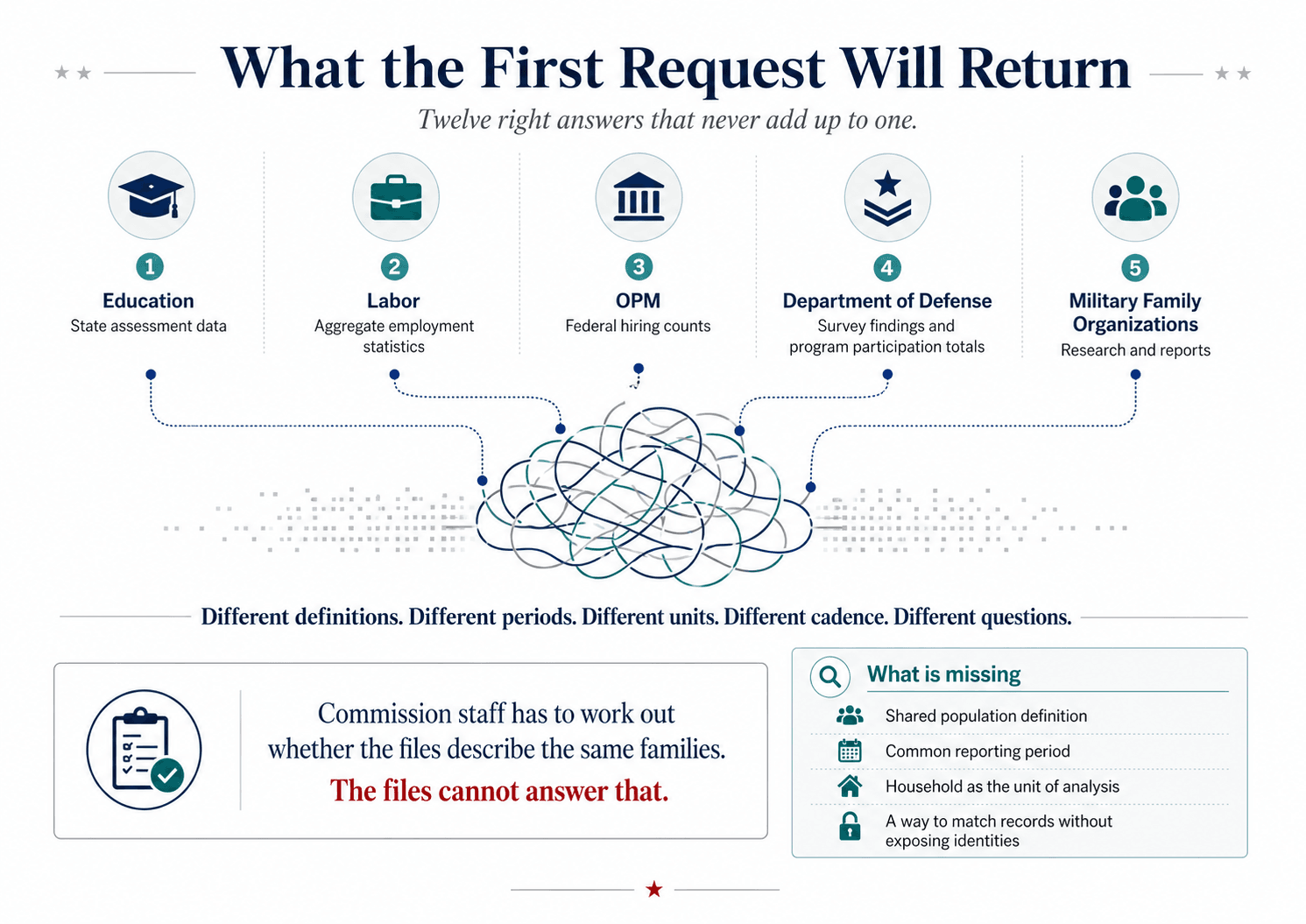
Picture that request landing in the fall. Education sends state assessment data on military-connected students, Labor sends aggregate employment statistics, OPM sends federal hiring counts, and the Department of War sends survey findings and program participation totals. Blue Star Families, MFAN, NMFA, and MCEC each send their own research, because each will be asked and each will want to be responsive. Every one of those submissions will be accurate, and every one will use a different population definition, a different reporting period, a different unit of analysis, on a different cadence, answering a different question.
Commission staff then has to work out whether the education file and the employment file describe the same families, and the files cannot answer that. Twelve right answers that never add up to one.
In April the ecosystem still held the initiative, because the request had not come and the design could be set on its own terms. Answering a request means answering in whatever shape the request arrives in, and the shape of a first request tends to become the shape of every request after it, which is why the useful window is the one before it goes out.
What healthcare already paid for
I spent twenty years in federal health IT, and most of it was spent watching institutions with excellent reasons not to share data eventually share it anyway. Hospital systems owned their patient records and had operational, academic, and competitive reasons to keep them, while patients moved between them carrying paper, repeating tests, and falling through handoffs between two institutions that each held half the chart. Persuasion did nothing about that. Architecture did, in the form of neutral exchange infrastructure, standards-based interoperability, and tokenized identifiers that let a query return an answer without the requesting party ever seeing the underlying record. What moved people in the end was one patient who died in the gap.
Tokenization was solved years before anyone adopted it, and the decade went to governance instead: who convenes, who pays, who is accountable when a query returns nothing, and what happens to a custodian that declines to participate. Every one of those had to be answered by somebody with standing to answer it, and until that somebody existed the architecture sat in white papers.
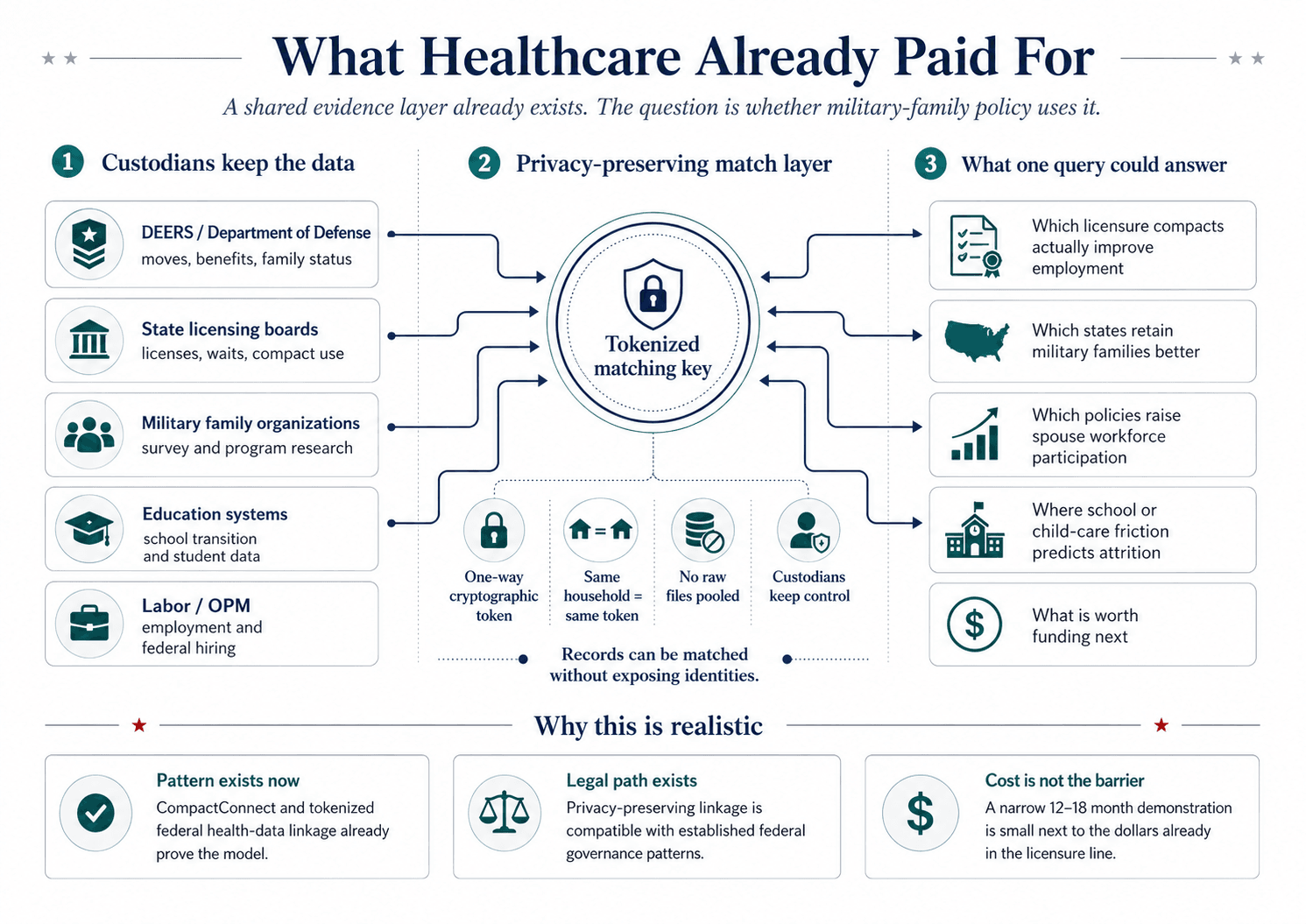
The military family ecosystem is sitting roughly where healthcare sat in 2009, with the same structural problem and the same good-faith custodians holding data close for legitimate reasons. The difference is the clock. Healthcare got HITECH and a decade, and family policy has a two-year commission and an annual reporting requirement, which is why I am not waiting for the 2028 list to publish before writing this.
What moved since April
In April I named five things to watch and gave them eighteen months. Four of them moved in a hundred days.
The 2028 priority designation is still open and it is the live one. The RFI under docket DOD-2026-OS-0232 closed April 23, [7] Stephen B. Simmons still holds the chair, [8] and MC&FP has not announced the list. The window between a closed docket and a published list is when a priority gets added, and that window is open right now.
The Pentagon's data leadership filled in around the same question. Cameron Stanley has been Chief Digital and AI Officer since January 13 [9] and Gavin Kliger has been Chief Data Officer since March 6, [10] and the January AI strategy directs the CDAO to treat data-sharing barriers as operational risks instead of bureaucratic inconveniences. [11] That posture is explicit, funded, and led, and it covers warfighting data, with family data sitting outside it and Stanley's office not chartered to reach across.
The federated pattern kept scaling. CompactConnect went operational September 30, 2025, issued its first privileges in Louisiana and West Virginia on October 28, and has added jurisdictions since April, [12] while the Nurse Licensure Compact stands at 43 with member states keeping their regulatory authority throughout. [13] This is running in production, on a military family problem, right now.
The NDAA moved faster than I expected, with the House passing H.R. 8800 on July 22 [21] and the Senate companion still not advanced, which puts the vehicle in front of us this fall instead of next year.
The one that did not move is the one that matters most, and it is the easiest to misread as criticism, so read this part carefully. MFAN's national survey runs hundreds of questions across thousands of respondents and takes doctoral-level analysis to surface patterns across the full response set, and that research has to stay under MFAN's control to protect respondent confidentiality and the reliability of the findings. The same is true at Blue Star Families, at NMFA, and at MCEC. None of these organizations is hoarding anything, and each is honoring a promise made to the families who answered. A federated layer exists precisely because that promise is worth keeping.
I framed all of this in April as an eighteen-month watch, on the assumption that the priority cycle set the pace. That assumption is dead.
The mechanism MC&FP already has
MC&FP cannot build data infrastructure, which was true in April and is true now. What MC&FP can do is designate a State Policy Priority, and that mechanism has a record worth restating. Ohio launched the first Purple Star School program in 2017, the Department made it a State Policy Priority four years later, and by November 2025, 44 states had programs or approved legislation on the books. [14] A single-state idea became a national norm inside four years, carried by fifty legislatures and tracked on a public dashboard.
A 2028 priority touching shared measurement, outcome reporting on existing priorities, or data-sharing agreements between states and the organizations serving military families would put that same machine behind the evidence question. It costs no appropriation and requires one decision from one office.
There is a second body with the same need. The FY2025 NDAA established the National Commission on Quality of Life for the All-Volunteer Armed Force, mandated to build a framework for objective, metrics-informed quality-of-life assessment, [22] and the FY2026 NDAA required mandatory key performance indicators for evaluating personnel. [23] Two commissions chartered by two branches, needing the same underlying evidence, working the same two-year window. A joint touchpoint between them costs a meeting.
The families
In April I wrote five composites, and composites were the honest tool at the time. Here are three people who said it themselves.
In 2024 a military spouse sat in a discussion group run by federal auditors and described a career that ran on a loop: a new duty station, a job at thirteen dollars an hour, a year spent getting a schedule figured out, and then, in the spouse's own words, "land a great job making $80,000. Everything is going good, and then guess what? You get [military move] orders and it's time to move again." The Government Accountability Office wrote that down and printed it in GAO-24-106263, one of seventeen spouses across five discussion groups. [3]
A spouse in the 2023 Blue Star Families survey priced the same problem in a different profession. Asked what certification had cost, the answer was "Between the cost of testing, application fees, and only getting substitute teacher pay while waiting for my certification I would say $7,000." [5]
Now set that beside a budget line. FY2026 mandatory funding put $10 million into military spouse professional licensure interstate compacts, [18] so ten million dollars is the federal investment and seven thousand is what one teacher paid out of a household running on one income while waiting for a state to act. The Office of People Analytics measures the appropriation and does not measure the household.
In April I wrote that we can align satellite tasking across combatant commands in minutes and cannot tell a separating service member whether their state joined the compact that would preserve a spouse's income. Here is the sharper version. The Department of War knows the family's address at every duty station, because it pays a housing allowance calibrated to the ZIP code, and it knows the day the family enrolled in TRICARE at each move, and it knows which school district the children entered. DEERS carries all of it, continuously, across a twenty-year career, because pay and benefits depend on getting it right.
We can track a dependent's eligibility status across every duty station in the world in near real time. We cannot tell you whether that dependent worked.
What the layer actually is
The word scares people more than the mechanism warrants, so here it is plainly. Each custodian runs a one-way cryptographic function over identifiers it already holds, and out comes a token that cannot be reversed into a name or a Social Security number. Two custodians running the same function on the same person produce the same token, so records match without either one shipping identifiable information anywhere. The Department of War never sees a state licensing file, MFAN never surrenders custody of its respondents, and a researcher learns that record A and record B belong to the same household and nothing else.
That is a matching key, and it is why data sovereignty and a shared evidence layer can hold at the same time. PCORnet already uses tokenized linkage against Veterans Administration and Department of War health data, [15] which means the hard question has an affirmative federal answer tested against these exact custodians.
It is also cheaper than the conversation usually assumes. A Health and Human Services award for privacy-preserving data sharing across public health jurisdictions obligated $7,489,425, [19] and the National Secure Data Service Demonstration funded roughly thirteen cross-agency linkage pilots with over $7.5 million total. [20] A twelve-to-eighteen-month demonstration answering one narrow question against data the government already holds lands somewhere around $600,000 to $2 million, which against the $10 million already sitting in the licensure line is six percent of a line item that exists.
The readiness case, stated plainly
Every State Policy Priority has to clear one bar, which is that it contribute to readiness. That is how the Department has justified state engagement on family policy since 2004, and it is the bar an evidence priority has to clear too.
The chain is short, and it starts with the fact that the force does not retain what the family cannot tolerate. A Marine separates at the end of a first enlistment because a spouse cannot move a license into the gaining state, and that is four years of training the Corps has to replace with a recruit who needs four years to reach the same capability. Multiply that decision across a cohort and a licensure question becomes a force structure question. End strength is a ceiling, not a capability, and Congress can authorize the number and recruiters can sign it while a name on a personnel roster is still not a formation that deploys.
Twenty-three weeks is the average time a military spouse spends looking for work. [6] Nearly half a year on one income, repeated every two or three years across a career, is a retention variable whether or not anyone scores it as one, and Section 1 now says so in federal policy.
Which creates a problem, because a readiness claim carries a readiness burden. The services can count separations and correlate separation timing against satisfaction survey responses. What they cannot do is query the state-by-state status of the licensure compacts, the school transition friction in Purple Star data, the child care availability tracked in MSO research, and the state family leave provisions, for the specific families making separation decisions in the specific states where those families live. Every one of those data products exists, and none of them is queryable as a single layer attached to the retention decision, which means the readiness argument this order just made federal policy is an argument the services cannot currently score.
Why this one is winnable
I have watched a lot of good architecture die in white papers, and this one has a better hand than most. Almost nothing here has to be invented.
The datasets were already inventoried, because a Fast Track Action Committee on Data about Military-Connected Federal Employees went through DEERS and other holdings specifically to track federal employment outcomes for military spouses and published in December 2024. [25] That work is sitting on a shelf waiting for a sponsor with enough standing to pick it up, and the Commission has that standing. The legal path is already mapped, with the Privacy Act providing the routine-use mechanism for compatible purposes, [16] the HIPAA de-identification standard at 45 CFR 164.514, [17] and FERPA governing education records. The pattern is already running in CompactConnect. The money is already appropriated.
And for the first time, five things are true in the same season: a presidentially chartered commission with an annual reporting clock, a department whose own AI strategy calls data friction an operational risk, a federated pattern scaling in production, a State Policy Priority window sitting open between a closed docket and an unpublished list, and a defense authorization bill still moving through the Senate. That alignment does not hold. Commissions terminate, priority lists publish, and bills pass with the next one a year behind.
This is the cheapest version of this problem anyone is going to get, and it is the only stretch I have seen where the sponsor, the pattern, the authority, and the money are all on the table at once. So I am asking.
What closes in ninety days
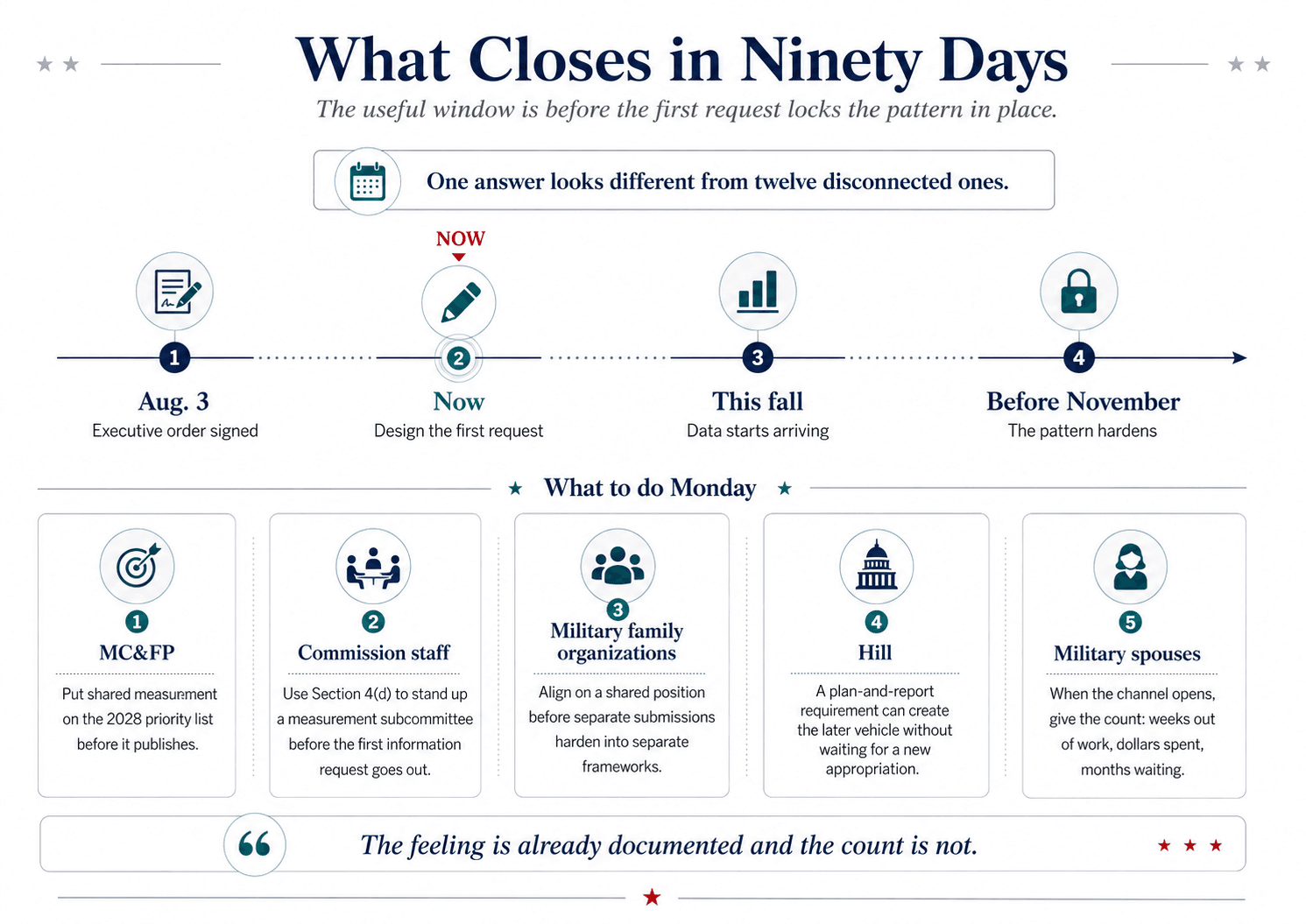
The clock is not ninety days because ninety is a round number. Section 3 requires a report at the end of each fiscal year, and if the first one is due September 30 that is eight weeks from Friday, while if it is FY2027 the design decisions that shape it still get made this fall, when the charter is being written and the first information request is being drafted. Either way the decisions land before November.
A request that produces one answer looks different from a request that produces twelve. It names the population by a shared definition, fixes the reporting period, and sets the unit of analysis at the household instead of the program, and then it asks one question of each custodian, which is what identifiers do you already hold. That last part is the whole ballgame, because custodians will answer questions about their own data all day long, and they resist shipping that data anywhere, and they are right to.
So if you sit in MC&FP, put shared measurement on the 2028 list before it publishes. If you sit on the Commission staff, stand up a Section 4(d) subcommittee on measurement before the first information request goes out, while the charter has still not appeared in the FACA database [24] and no first meeting notice has published and the agenda is still being written. If you run research at one of the four big MSOs, get to a shared position among yourselves before that request lands, because four coordinated positions beat four separate submissions and the difference is decided by who moves first. If you have a relationship on the Hill, a plan-and-report provision in the pending Senate bill authorizes no new money and creates the requirement that later justifies a vehicle.
And if you are a military spouse reading this, the Commission is required to liaise with spouses on common areas of concern, so when that channel opens, give it the number. Weeks out of work, dollars spent on a license, months waiting on a state board. The feeling is already documented and the count is not.
I closed the April issue by writing that these families are already running implementation the system cannot see, and that they deserve a system that can see them doing it. On August 3 the federal government agreed with that sentence in writing and made it policy. Every claim in Section 1 is an empirical claim, which is a feature, because empirical claims can be demonstrated and demonstrated claims survive budget cycles that asserted claims do not.
Corie Weathers almost quit, and she did not quit, and she drove to Austin and said the words into a microphone in front of a committee, and a transcript exists because of it. The spouses who did quit did not testify. They took the substitute teaching job, or stopped renewing the license, or told the next spouse at the next duty station not to bother, and somewhere there is a separation coded as end of obligated service with the reason living in a kitchen conversation that no system in the federal government has ever captured.
We can track a dependent's eligibility across every duty station in the world in near real time. We cannot count the ones who stopped.
In April I wrote that it closes in 2028. What opens now closes in ninety days.
Let's roll.
— Mary
Mission Meets Tech
The views expressed in this newsletter are my own and do not represent the official position of any organization. This content is for informational purposes only.
MMT Premium
Today's free issue covers the analytical frame. Premium subscribers get the operational layer underneath it: monthly Capture Intelligence Sheets with sourced signals, action windows, and capture priorities across the VA, DHA, and HHS pipeline.
Founding Member rate: $199/year, locked permanently for the first 100 subscribers. Standard rate: $249/year or $29/month.
Premium adds deep-dive analysis, 48-hour early access, direct Q&A access, and tool discounts: ProposalPulse $14.99 per assessment, MarketPulse $35 per brief.
Subscribe at missionmeetstech.com/pricing.
Sources
[1] The White House, "Establishing the President's Military Spouse Commission," executive order signed August 3, 2026. No Federal Register executive order number assigned as of publication. https://www.whitehouse.gov/presidential-actions/2026/08/establishing-the-presidents-military-spouse-commission-af64/
[2] The White House, "Fact Sheet: President Donald J. Trump Establishes the President's Military Spouse Commission," August 2026. https://www.whitehouse.gov/fact-sheets/2026/08/fact-sheet-president-donald-j-trump-establishes-the-presidents-military-spouse-commission/
[3] Government Accountability Office, GAO-24-106263, "Military Spouse Employment: Part-Time Workforce Characteristics and Perspectives," February 8, 2024, reissued with revisions May 9, 2024. Verbatim discussion-group responses; seventeen spouses across five groups. https://www.gao.gov/assets/gao-24-106263.pdf
[4] Corie Weathers, LPC, testimony before the Texas House of Representatives on licensure reform, video published August 29, 2024. Georgia and Texas duration figures drawn from that testimony. https://www.youtube.com/watch?v=PLf8ztdt32k
[5] Blue Star Families, "2023 Military Family Lifestyle Survey Comprehensive Report," April 2024. Certification cost quote from an Active-Duty Army Spouse open response. https://bluestarfam.org/wp-content/uploads/2024/04/BSF_MFLS_Comp_Report_Full_Digital-042424.pdf
[6] Office of People Analytics, "2024 Active Duty Spouse Survey," key findings, fielded January 8 through May 8, 2024. Civilian spouse unemployment at 20 percent; average search of 23 weeks; survey response rate of 20 percent. https://download.militaryonesource.mil/12038/MOS/Presentations/2024-active-duty-spouse-survey-key-findings.pdf
[7] Federal Register, "Request for Information for 2028 Department of War State Priorities Impacting Service Members and Their Families," docket DOD-2026-OS-0232, published March 24, 2026, submissions closed April 23, 2026. https://www.govinfo.gov/
[8] Department of War official biography and Military OneSource leadership profile, Stephen B. Simmons, Deputy Assistant Secretary of Defense for Military Community and Family Policy since June 2, 2025. https://www.militaryonesource.mil/
[9] ExecutiveGov, Cameron Stanley begins as Chief Digital and AI Officer, effective January 13, 2026. https://www.executivegov.com/articles/cameron-stanley-cdao-pentagon-start
[10] DefenseScoop, Gavin Kliger named Chief Data Officer, effective March 6, 2026. https://defensescoop.com/2026/03/06/doge-dod-gavin-kliger-new-pentagon-chief-data-officer/
[11] Department of War, "Artificial Intelligence Strategy for the Department of War," issued January 9, 2026, announced January 12, 2026. https://media.defense.gov/2026/Jan/12/2003855671/-1/-1/0/ARTIFICIAL-INTELLIGENCE-STRATEGY-FOR-THE-DEPARTMENT-OF-WAR.PDF
[12] Audiology and Speech-Language Pathology Interstate Compact, CompactConnect data system operational September 30, 2025; first compact privileges issued October 28, 2025 in Louisiana and West Virginia; member jurisdictions. https://aslpcompact.com/
[13] Nurse Licensure Compact Commission, member jurisdiction roll, 43 jurisdictions. https://www.nursecompact.com/
[14] Military Child Education Coalition, Purple Star Schools program history and 44-state figure as of November 2025. https://militarychild.org/programs-and-initiatives/purple-star-schools/
[15] Greater Plains Collaborative, VA linkage repository documenting tokenized record linkage against Veterans Administration and Department of War health data. https://github.com/gpcnetwork/gpc_va-linkage
[16] Privacy Act of 1974, 5 U.S.C. 552a. https://www.archives.gov/about/laws/privacy-act-1974.html
[17] HIPAA de-identification standard, 45 CFR 164.514.
[18] Department of War Comptroller, "FY2026 Mandatory Funding Allocation Plan," $10 million for military spouse professional licensure interstate compacts. https://comptroller.war.gov/Portals/45/Documents/news/FY2026_Mandatory_Funding_Allocation_Plan.pdf
[19] Health and Human Services contract award for a privacy-preserving data-sharing solution across federal public health jurisdictions, $7,489,425 obligated. https://orangeslices.ai/hhs-inks-urgent-contract-with-datavant-for-data-sharing-solution-for-public-health-jurisdictions/
[20] National Science Foundation NCSES, National Secure Data Service Demonstration projects, over $7.5 million across approximately thirteen cross-agency linkage pilots. https://www.ati.org/press-releases/national-science-foundations-national-center-for-science-and-engineering-statistics-funds-over-7-5-million-in-national-secure-data-service-demonstration-projects/
[21] Congress.gov, H.R. 8800, FY2027 National Defense Authorization Act, passed the House July 22, 2026. https://www.congress.gov/bill/119th-congress/house-bill/8800
[22] Senate Armed Services Committee, FY2025 NDAA bill text establishing the National Commission on Quality of Life for the All-Volunteer Armed Force. https://www.armed-services.senate.gov/imo/media/doc/fy25_ndaa_bill_text.pdf
[23] House Armed Services Committee, FY2026 NDAA joint explanatory statement, mandatory key performance indicators for evaluating personnel. https://armedservices.house.gov/uploadedfiles/fy26_ndaa_joint_explanatory_statement.pdf
[24] General Services Administration, Federal Advisory Committee Act Database. Commission charter and first meeting notice status confirmed as of August 5, 2026. https://www.facadatabase.gov/
[25] Fast Track Action Committee on Data about Military-Connected Federal Employees, report, December 2024. https://download.militaryonesource.mil/12038/MOS/Reports/DataAboutMil-ConnectedFedEmployees-Dec2024.pdf
Sources verified as of August 5, 2026.